
Model showed a fivefold difference in asteroid deflection — ScienceDaily
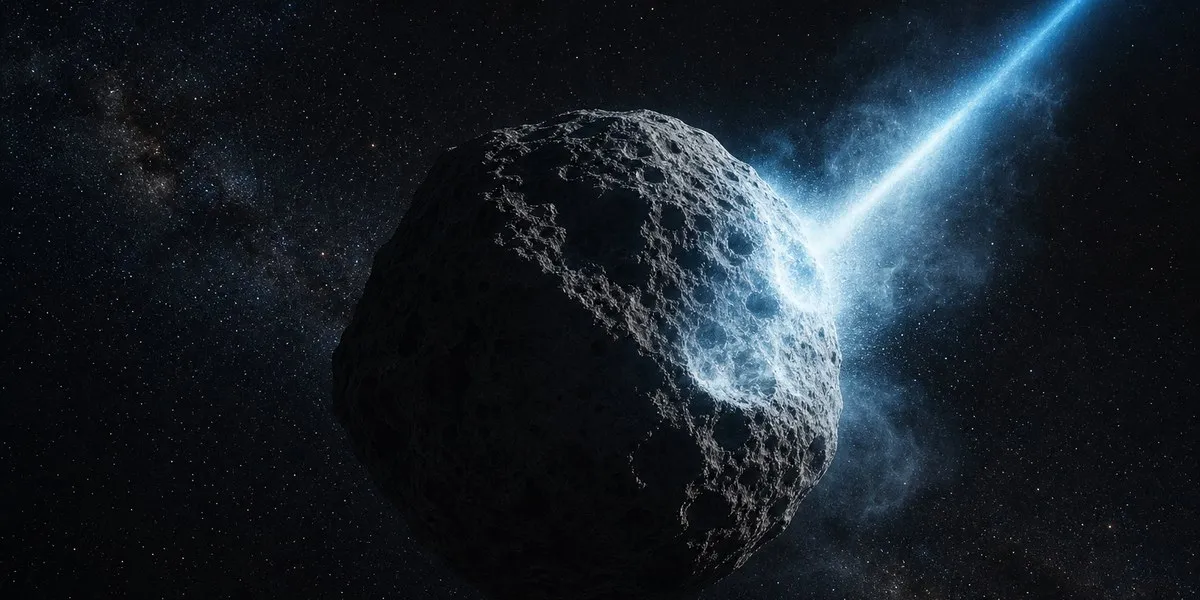
New computer modeling has shown that the direction of X-ray radiation from a nuclear explosion can change the effectiveness of deflecting asteroids that may threaten Earth by nearly a factor of five. The study, published in the journal Icarus, was conducted by a team led by Sandia National Laboratories physicist Nathan Moore, ScienceDaily reports.
The asteroid’s shape changes the outcome
Under the method’s concept, powerful X-ray radiation heats the asteroid’s surface and vaporizes part of its material. This creates an impulse that can alter the celestial body’s trajectory. However, real asteroids have uneven surfaces, depressions, and protrusions, so they do not respond to radiation in the same way as idealized spherical objects often used in previous calculations.
In one simulation, the asteroid’s velocity change was 3.9 millimeters per second when radiation came from one direction and 0.8 millimeters per second when it came from another. Thus, the difference in deflection velocity reached nearly a factor of five for the same modeled object. For another asteroid, the change in rotation speed differed by a factor of 17 depending on the direction of the X-ray pulse.
A new approach to calculations
The team developed a model that combines a detailed representation of an asteroid’s irregular shape with calculations of physical processes following an X-ray pulse. According to Moore, the new algorithm operates more than 1,600 times faster than older models, making such calculations possible.
More current news is available on the UA.News Telegram channel Telegram.
For the modeling, researchers combined the ALEGRA code, used for rapid high-energy processes, and SPARTA, software for modeling relatively weak and slow impacts. An asteroid can be recreated using detailed three-dimensional images obtained during spacecraft flybys, and the explosion’s power, distance to the object, and radiation direction can then be varied in calculations.
Limitations of the model
The program estimates how much material will vaporize in different areas of the surface and also calculates the impulse, change in rotation, and extent of surface damage. At the same time, it does not yet make it possible to accurately predict the destruction of the entire asteroid. This is important because planetary defense should preferably alter the trajectory of one large body rather than create several fragments that could also pose a threat.
Practical application of this approach requires precise data on an asteroid’s shape from different sides, as well as the ability to position a nuclear device in space with great precision. If a dangerous object is detected too late, there may not be enough time for the necessary observations.




