
Hubble studies Cat's Tail, likely formed by collision of Pluto-sized bodies — Space.com
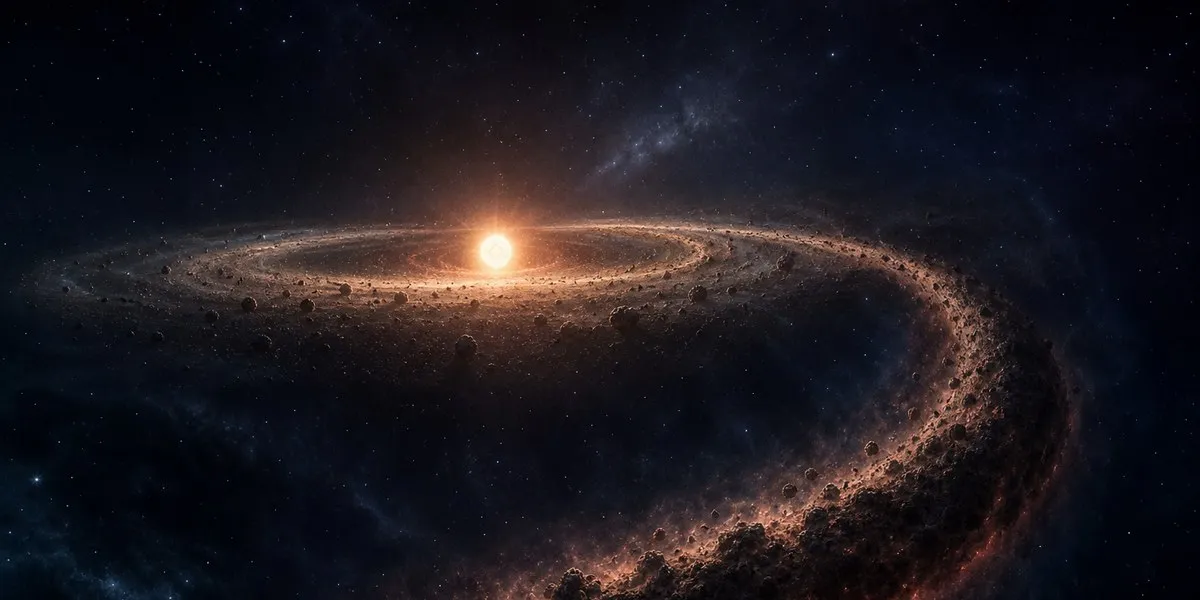
Astronomers using the Hubble Space Telescope studied the "Cat's Tail" structure in the Beta Pictoris system, located 63 light-years from Earth. It extends from the debris disk around the star and, according to researchers' estimates, may have formed as a result of a collision between two large bodies, likely Pluto-sized, Space.com reports.
A structure 10 billion miles long
The "Cat's Tail" has an estimated length of 10 billion miles. According to the publication, it could be wrapped around the Earth-Sun system about 500 times. The team analyzed 14 years of observations to determine the conditions under which this structure formed.
Study leader Arin Avsar of the University of Arizona said that the "Cat's Tail" is considered to be the result of a collision between large objects. Previously, the structure had only been observed with the James Webb Space Telescope, which operates in the infrared range; it remained invisible at shorter wavelengths.
More current news is available on the UA.News Telegram channel Telegram.
Porous carbon dust
Scientists believe that this feature is explained by the composition of the dust. It consists almost entirely of refractory organic material with a high carbon content: long chains of carbon atoms absorb visible light, making the substance appear very dark.
Hubble observations also indicate that the dust particles in the structure are extremely porous. According to team member Kevin Wagner, high collision speeds could have caused carbon grains to vaporize, after which they turned into gas and condensed again as they cooled.
Influence of a giant planet
The researchers detected a bend in the "Cat's Tail," which is likely related to the interaction of the material trail with the planet Beta Pictoris b. This is a gas giant whose mass is approximately ten times that of Jupiter. According to Avsar, the observations provide additional evidence of how massive planets affect dust and icy bodies through their gravity at distances of hundreds of astronomical units. The study was published last month in The Astrophysical Journal Letters.




