
James Webb discovers the most distant known ring galaxy — Live Science
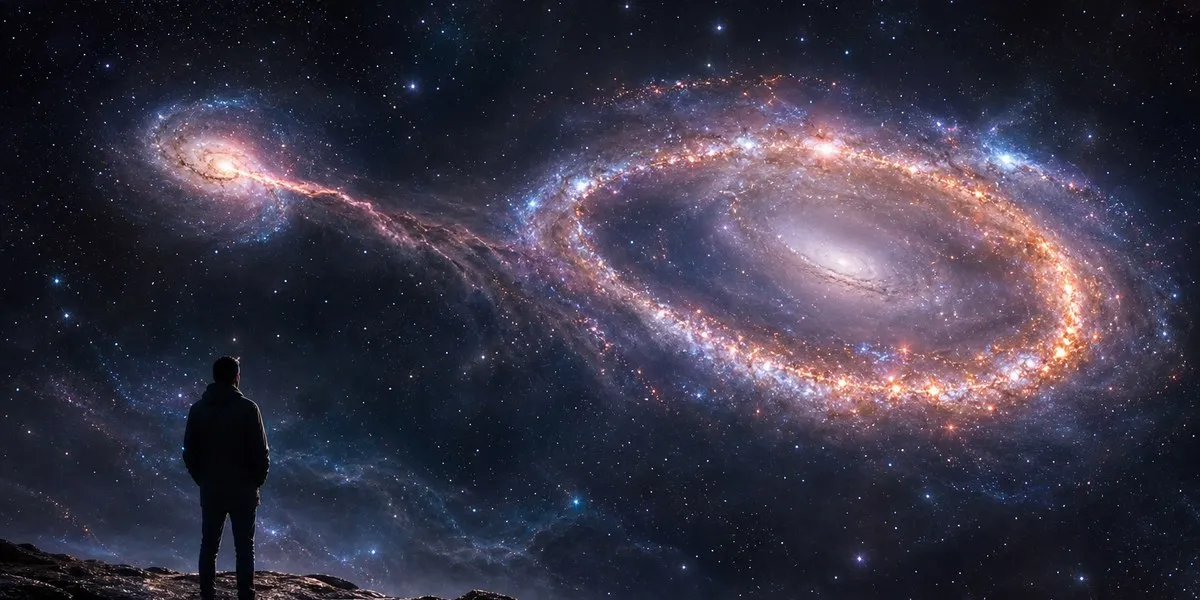
Astronomers using the James Webb Space Telescope have discovered the galaxy GS18660, which has a bright ring of newborn stars. It is observed as it was 2.1 billion years after the Big Bang. Researchers called GS18660 the most distant ring galaxy discovered to date, Live Science reports.
Possible galaxy collision
Scientists suggest that the ring may have formed as a result of a collision between two galaxies. In this scenario, a smaller galaxy passes through the center of a larger one, creating a wave of dense gas. The gas accumulates along this wave and forms new stars, resulting in a ring-shaped structure.
This version is supported by a small companion galaxy moving away from GS18660 at a speed of about 425 km/s. A gas bridge with changes in gas velocity along it was also detected between the objects. According to the team’s calculations, the possible collision occurred approximately 17–42 million years before the time at which the galaxy is observed.
More current news is available on the UA.News Telegram channel Telegram.
Burst of star formation
Researchers estimated that between 10% and 20% of the ring’s stellar mass formed over the past tens of millions of years. This is consistent with the assumption that the collision and intense star formation were linked to a single event.
At the same time, the study’s authors do not consider the collision to be a conclusively proven explanation. GS18660 shows a structure resembling a stellar bar: such bars can direct gas and stars into rings at a certain distance from the galaxy’s center. Scientists have not yet determined whether this structure is a genuine bar or the result of an interaction between galaxies.
The study on GS18660 was published on September 8 in the journal Astronomy & Astrophysics.




