
JWST may observe a supernova 1.15 billion years after the Big Bang — Live Science
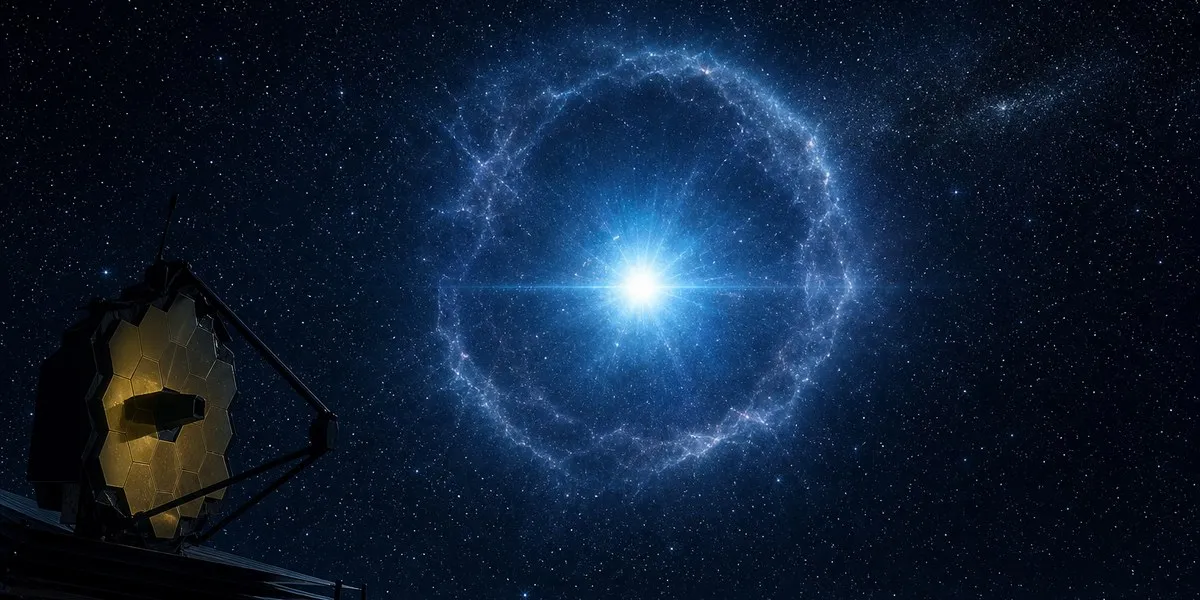
Astronomers using the James Webb Space Telescope (JWST) have detected supernova AT 2026abck, which exploded approximately 1.15 billion years after the Big Bang. It may be one of the most distant supernovas ever observed, Live Science reports.
The light from the explosion was emitted more than 12.5 billion years ago. Over that time, the expansion of the Universe increased the distance between Earth and the light source by approximately sixfold. The findings are described in a preprint uploaded to arXiv on September 29; the work has not yet undergone peer review.
Early phase of the explosion
The study’s authors estimate that JWST saw the supernova four to 10 days after the explosion in the object’s own reference frame. During a previous observation on May 28, 2026, the telescope did not detect the supernova, while the next observation took place on August 7.
More current news is available on the UA.News Telegram channel Telegram.
Seventy-one days passed on Earth between these dates, while about 12 days passed in the supernova’s frame of reference. According to the study’s first author, Minyan Zhu from the University of Illinois Urbana-Champaign, due to the expansion of the Universe, the event appears to an Earth-based observer to unfold approximately six times more slowly. That is, changes that lasted a week near the supernova unfold over roughly six weeks as seen from Earth.
Brightness and host galaxy
Study co-author Xiaohui Fan of the University of Arizona estimated the supernova’s peak brightness at approximately 8 billion times that of the Sun — nearly the brightness of the entire Milky Way galaxy. During the explosion, it emits as much energy as the Sun will emit in approximately 2 billion years.
The object’s temperature exceeds 16,000 degrees Celsius, and the radius of the shell of ejected material is estimated at about 46 astronomical units. The host galaxy ID101411 has a mass of about 6.3 billion solar masses and forms new stars more than ten times faster than the Milky Way. Researchers suggest that AT 2026abck may belong to the rare class of superluminous supernovas, which release tens or hundreds of times more energy than ordinary supernovas.




