
Modeling links early black hole seeds to star mergers — Space.com
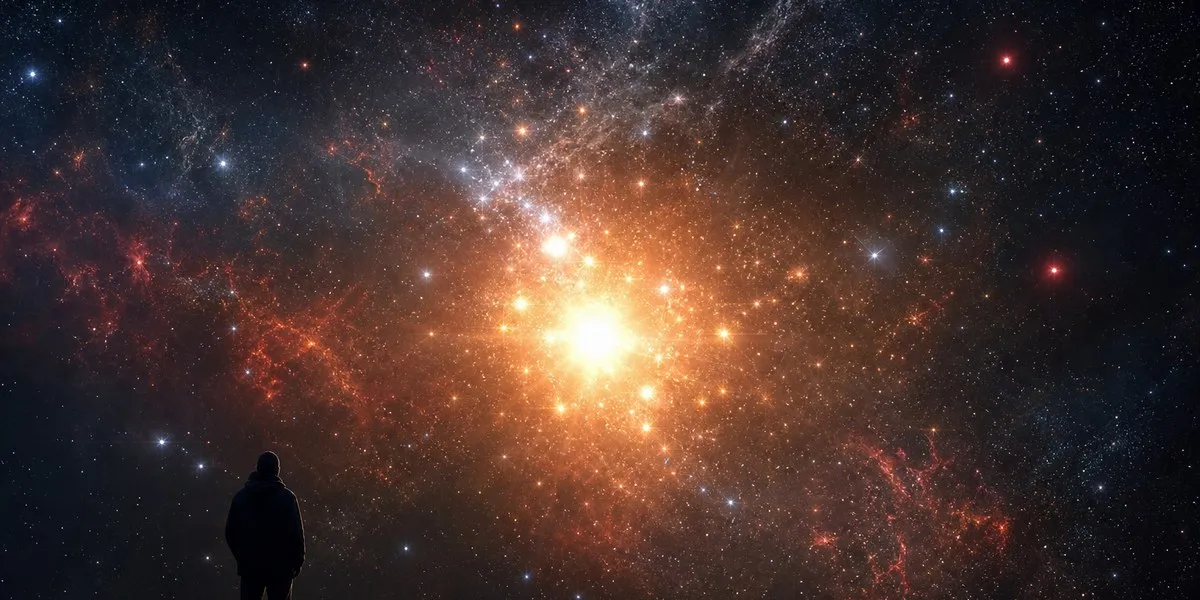
Simulations of the early universe have shown that collisions and mergers of stars in dense clusters could have formed massive black hole seeds. This mechanism may explain the rapid growth of supermassive black holes in the first billion years of the cosmos, Space.com reports.
Star mergers in dense clusters
A research team modeled conditions in the early universe and concluded that stellar systems at the time could have been very dense. Under such conditions, stars collided frequently: high-speed collisions would have destroyed the objects, while slower ones could have led to successive mergers.
As a result, according to the models, one extremely massive star could have formed. At the end of its life, it could have collapsed and formed a massive black hole. Team member Claire Williams of the University of California, Los Angeles, said that stars in a cluster could have repeatedly merged into an object whose mass would equal that of the entire cluster.
More current news is available on the UA.News Telegram channel Telegram.
Possible black hole seeds
Usually, the collapse of a massive star forms a stellar-mass black hole — approximately 10 to 100 solar masses. Intermediate-mass black holes, considered possible seeds of supermassive ones, have masses from 100 to 100,000 solar masses. The simulations suggest that such objects could have formed in dense star clusters, where stars and gas were available for their further growth.
Little Red Dots
The study also offers a possible explanation for Little Red Dots — extremely compact red objects that the James Webb telescope observes in the early universe. According to one version, they may be dense star clusters in which repeated collisions create a very massive star that later collapses into an intermediate-mass black hole.
As the report notes, Little Red Dots appear to have disappeared by the time the universe was about 2 billion years old. The researchers link this to the expansion and cooling of the cosmos: chaotic dense regions gradually became the foundation of less turbulent galaxies, where conditions for such collisions no longer persisted. The team's work was published in the Astrophysical Journal.




