
Molecular motor increased conductivity 100-fold — ScienceDaily
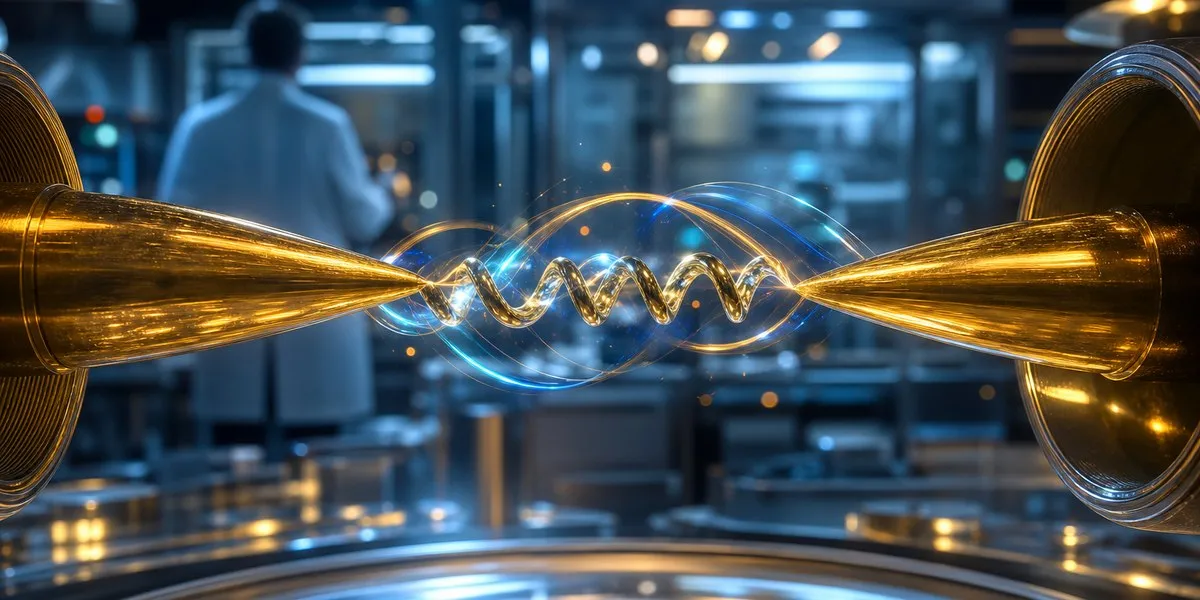
An international group of scientists has developed a spiral-shaped molecular motor that rotates under the action of an electric current and can change its direction of motion after the voltage polarity is reversed. Experiments with individual molecules were conducted at the Weizmann Institute of Science in Israel, ScienceDaily reports.
The device is based on a specially synthesized spiral molecule created by the group of Professor Michael P. C. P. T. Pittelkow at the University of Copenhagen. Thanks to sulfur atoms, it can attach to gold surfaces. The researchers placed individual molecules between two gold electrodes sharpened to atomic dimensions and changed the distance between them, compressing or stretching the molecular spiral.
Electrons set the spiral in motion
When voltage was applied, measurements showed that the molecule rotated. Reversing the voltage polarity made it possible to change the direction of this rotation. According to the researchers, electrons passing through the spiral structure transfer angular momentum to it. The operating principle resembles an Archimedes screw, an ancient mechanism in which a rotating spiral moves material.
More current news is available on the UA.News Telegram channel Telegram.
Previously, molecular motors powered directly by electricity were created on surfaces and activated using the tip of a scanning tunneling microscope. In the new experiment, the molecule was fixed between two metal electrodes, and its movement was controlled by electric current.
Conductivity changes during rotation
The scientists also found that while rotating, the molecule conducts current much more efficiently than in a stationary state. Theorists at the University of Augsburg performed quantum-mechanical simulations on the LiCCA supercomputer and found that electrical conductivity depends on the angle of rotation of the spiral and can increase by up to two orders of magnitude, or 100-fold.
The modeling showed that the molecule usually avoids configurations with the highest conductivity when at rest. Rotation makes such positions accessible. Physicists from the Niels Bohr Institute in Copenhagen and the Huazhong University of Science and Technology in Wuhan also worked on explaining the mechanism. The researchers believe this principle could be useful for molecular electronics, spintronics, and microfluidic systems.




