
NASA Is Looking for a Way to Protect Lunar Missions from Dangerous Electrical Discharges — Space
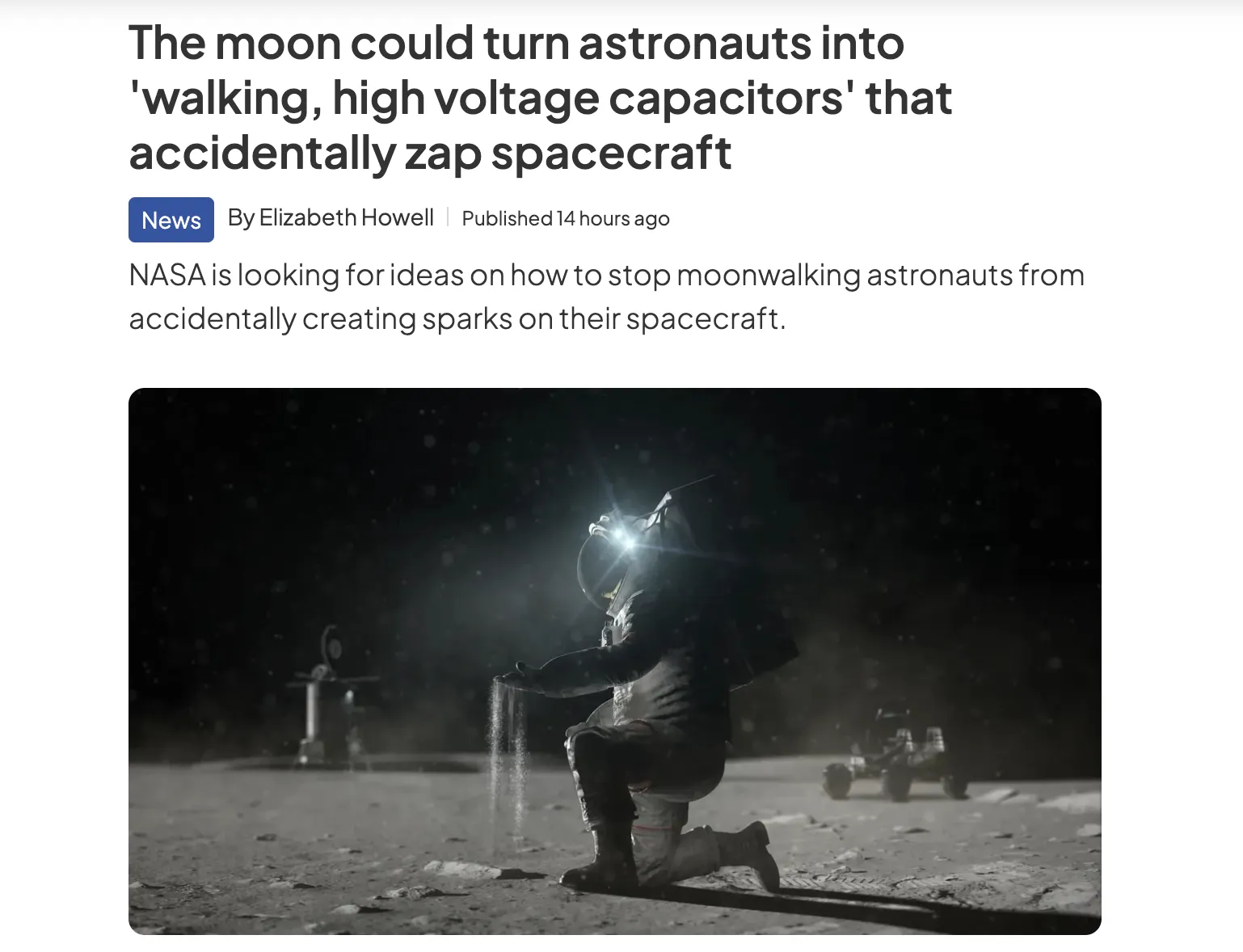
NASA is seeking a solution to the problem of static electricity buildup on astronauts during their stay on the Moon. Due to the unique characteristics of the lunar environment, spacesuits can accumulate an electrical charge that could potentially cause a discharge upon contact with a spacecraft or other equipment. The agency is offering $150,000 for the development of a solution.
NASA has announced a competition among partners in the space industry aimed at developing technology to protect astronauts and critical equipment from static electricity discharges on the Moon, according to Space.
The space agency has launched the “Lunar Grounding Challenge” to prevent situations where an astronaut on the Moon could become a walking high-voltage capacitor. The prize fund totals $150,000.
NASA plans to land the first astronauts on the Moon since 1972 as part of the “Artemis-4” mission in 2028. Simulations show that an electric charge can build up on astronauts’ spacesuits due to an excess of electrons (negatively charged particles) relative to ions (positively charged particles) in the lunar environment.
The main risk is that when an astronaut returns to the spacecraft, they will carry a small positive charge, which will create a problem when a negatively charged astronaut approaches it.
Therefore, NASA has announced a competition among partners in the space industry to propose technologies capable of preventing, for example, the formation of an electric arc, which could damage a spacesuit, cause a fire in the spacecraft’s oxygen-rich atmosphere, or result in an electric shock that damages equipment.
This technology is intended to help dissipate the astronaut’s electrical charge before contact with the spacecraft. It must function under conditions of extreme temperature fluctuations on the Moon’s surface and ensure the safety of up to four astronaut excursions onto the Moon’s surface from the landing module.
NASA has not specified a specific timeline for when this technology will be ready for use by astronauts.
Source: Space
You may also be interested in:
NASA researchers estimate Earth’s center of mass to be approximately half as far off-center
NASA has announced a competition for private orbital stations
The U.S. Congress has maintained funding for NASA’s participation in the LISA mission




