
Possible 300-day delay between X-ray and radio flare detected in NGC 1275 — Space.com
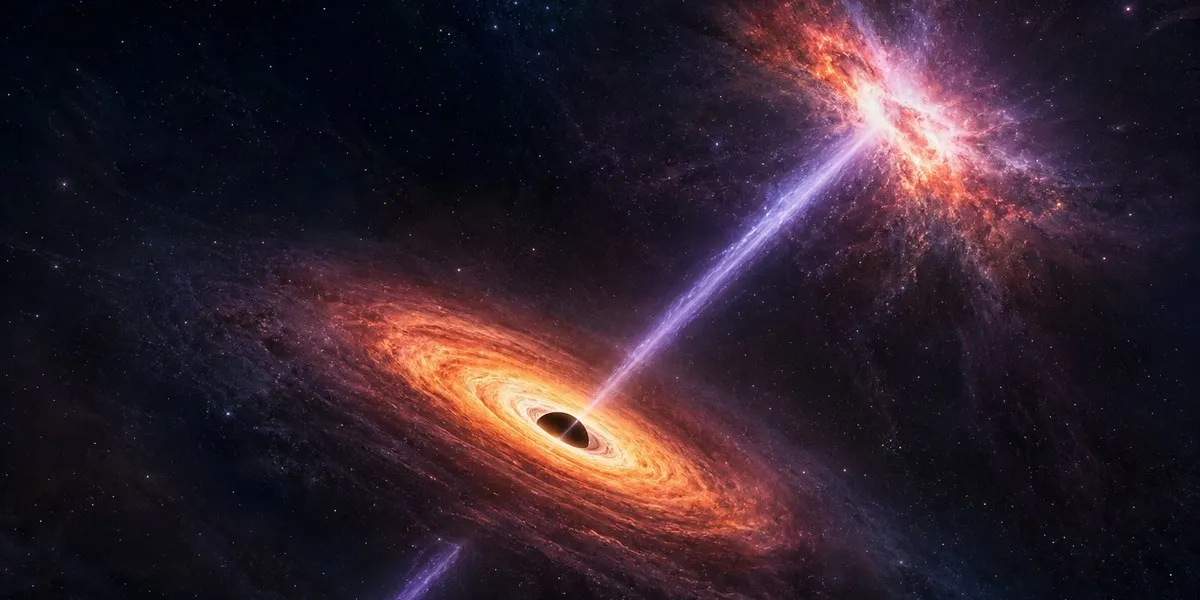
Astronomers have found preliminary evidence that approximately 300 days passed between a powerful X-ray flare from the supermassive black hole at the center of galaxy NGC 1275 and an increase in its radio emission. The flare indicated a rise in the accretion rate — the inflow of matter onto the black hole. Space.com reports on the observation results.
Flare in 2023
Researchers used data from NASA’s Neil Gehrels Swift Observatory X-ray observatory and compared them with available radio observations. The strongest recorded X-ray flare from NGC 1275 occurred in February 2023: it lasted less than 60 days and consisted of two five-day episodes. The X-ray brightness of the galaxy’s active nucleus doubled at that time.
Scientists ruled out the tidal disruption of a star, in which a star approaches a supermassive black hole too closely and is destroyed by tidal forces. According to team leader Sarah Ketchum of the University of Michigan, the flare was most likely caused by a sharp increase in the rate at which matter accreted onto the black hole.
More current news is available on the UA.News Telegram channel Telegram.
Connection between the disk and jets
NGC 1275 is the brightest galaxy in the Perseus Cluster; according to the source, its central black hole is located at a distance of about 225 light-years. An analysis of Swift archival data from 2007–2025 made it possible to separate the emission of the galaxy cluster from the signal of gas accreting onto the black hole.
The researchers called the delay between the X-ray flare and radio emission preliminary evidence. It may correspond to the time it takes plasma to travel from the base of a jet to a region of compression or a shock wave, where it interacts with surrounding gas or dust. Additional X-ray observations are needed to establish this connection more precisely.
Black hole mass estimate
Using Swift data, the team also estimated the size of the region from which the active nucleus emits energy. This made it possible to constrain the mass of the central black hole to between 100 million and 1 billion solar masses. The paper has been accepted for publication in the Astrophysical Journal Letters; its pre-peer-review version is available on arXiv.




