
Scientists propose defining the Solar System’s gravitational boundary at 3.8 light-years — Space.com
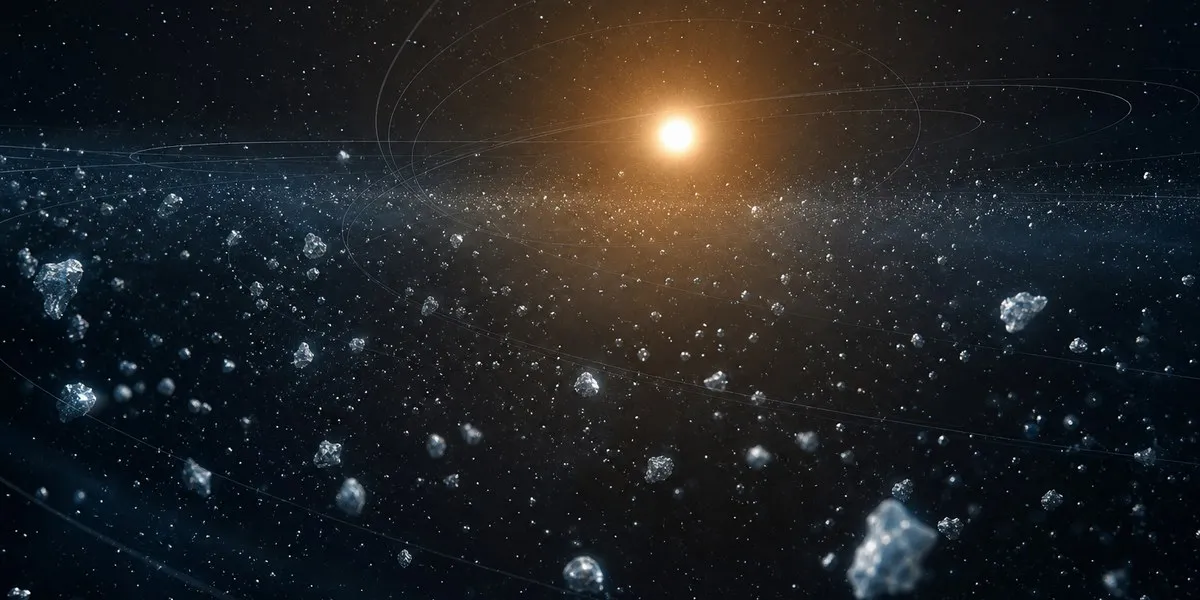
Former NASA chief scientist Jim Green and Yeshiva University mathematics professor Ed Belbruno have proposed a new way to define the Solar System’s gravitational boundary, taking into account the gravitational field of the Milky Way, including dark matter. By their estimate, this boundary could extend nearly 3.8 light-years from the Sun, or about 241,000 astronomical units, Space.com reports.
A gravitational boundary instead of a clear line
The researchers emphasize that the edge of the Solar System is not necessarily a sharp boundary. In their view, it is defined by the interaction of forces, energies and trajectories. The proposed distance brings the system’s conventional edge closer to the scale of distances between neighboring stars.
Green and Belbruno presented their arguments in the August 2026 issue of ROOM — Space Journal of Asgardia. Their approach also draws on Belbruno’s work on the permanent capture of objects by the Solar System and weak stability boundaries, published in 2024 in the journal Celestial Mechanics and Dynamical Astronomy.
More current news is available on the UA.News Telegram channel Telegram.
Lagrange points and interstellar objects
The authors of the theory suggest that the gravitationally stable L1 and L2 Lagrange points in the Sun–Galactic Center system may be pathways through which slow interstellar objects enter the Solar System and can be captured by its gravity. According to Green, such areas should be explored, including for dust that could help verify the calculations and assess the scale of dark matter in the Milky Way.
Green said he is discussing the possibility of such observations with the team of the New Horizons spacecraft, which has been operating in the outer heliosphere after exploring Pluto. Belbruno called the new approach an application of weak stability theory, which had previously been used to find fuel-efficient trajectories for flights to the Moon.




