
Roman’s Wide Field Instrument outperformed image quality forecasts by nearly 30% — ScienceDaily
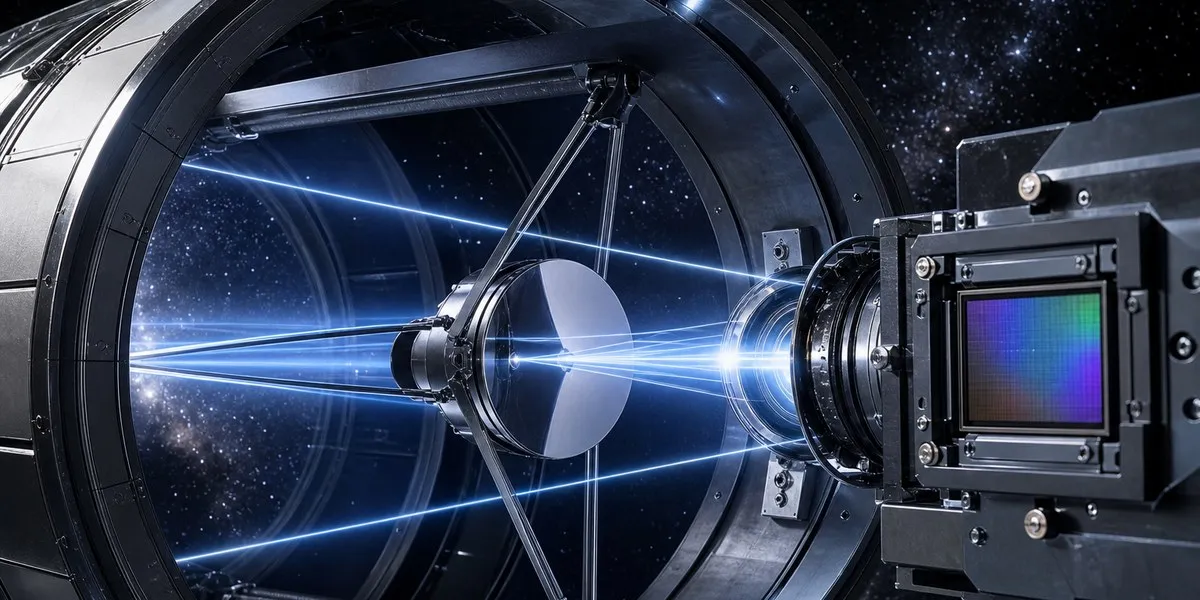
In the United States, NASA engineers have completed a series of tests and precise adjustments of the Nancy Grace Roman Space Telescope. Its Wide Field Instrument demonstrated optical image quality nearly 30% better than forecast, ScienceDaily reports.
Before launch, the instrument was assigned an optical error requirement of approximately 90 nanometers RMS. This indicator reflects the deviation of light from an ideally focused wavefront. After corrections, the team measured an error of 63 nanometers RMS, which should provide sharper images during large-scale sky surveys.
Testing the Wide Field Instrument
After the Wide Field Instrument was activated in September, specialists checked 18 detectors and the electronics that support their operation. They also tested the optical element wheel with filters, the internal LED calibration system, the alignment mechanism, and the thermal control system.
The LEDs can deliver controlled light of different colors and brightness levels to the detectors. This makes it possible to determine differences in detector sensitivity and make the corrections needed for precise observations.
More current news is available on the UA.News Telegram channel Telegram.
Mirror adjustments
Another group of engineers refined the telescope’s overall optical alignment. The mirrors and other optical components had already been installed with high precision, so only minor corrections were needed. The position of the secondary mirror was changed by approximately one-sixteenth of the diameter of a human hair.
First, the team corrected the focus of the coronagraph instrument, whose images had been slightly out of focus. The coronagraph now meets expected performance metrics. Engineers will continue adjusting its camera and deformable mirrors, and in the coming weeks they plan to test the instrument’s ability to block unwanted light for observing faint objects near brighter ones.
The Wide Field Instrument is key to the Roman telescope’s planned cosmic surveys, including studies of dark matter and dark energy. Based on the test results, both of the telescope’s scientific instruments have achieved or exceeded projected performance.




