
Scientists develop method to calculate the Kondo effect in real materials — ScienceDaily
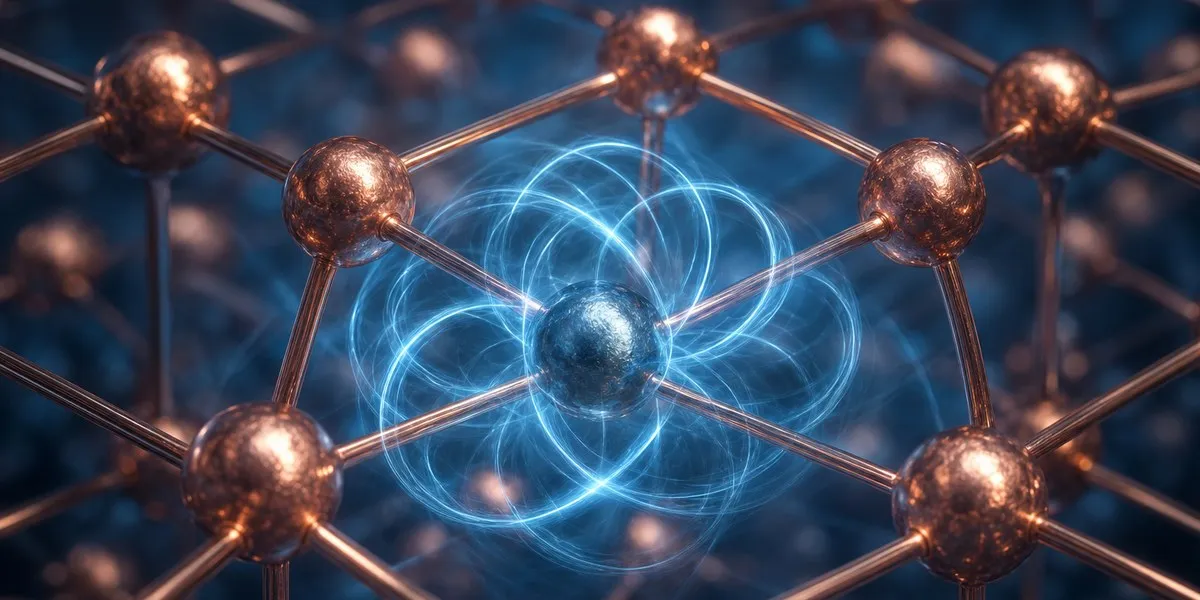
Researchers at the California Institute of Technology and Yale University have developed a method that makes it possible to accurately calculate the Kondo effect for specific real materials rather than only for their simplified models. As ScienceDaily reports, the approach takes into account the material’s actual atomic and electronic structure. The results were published in the journal Science.
Quantum interaction of electrons
The Kondo effect arises when an individual magnetic atom, such as an iron or manganese atom, is embedded in a metal, including copper. When the material is cooled to the Kondo temperature, its electrical resistance initially decreases, as in an ordinary metal, but after reaching a minimum, it begins to rise again.
This phenomenon is associated with the interaction between the electrons of the magnetic impurity and the electrons of the metal. Electrons moving through the material interact with the impurity’s spin and form a kind of electron cloud around it that screens its magnetism. Because it is necessary to describe a large number of interacting particles, the Kondo effect is regarded as a classic many-body quantum problem.
More current news is available on the UA.News Telegram channel Telegram.
Testing impurities in copper
Traditional methods usually simplify the electronic structure, leaving only a limited set of orbitals for calculation and using approximate mathematical models. The new method adapts precise computational tools of quantum chemistry, previously used for molecules, to quantum-material problems.
The authors tested the method on seven different transition-metal atoms embedded in copper. For most of the elements studied, the calculations proved to be up to two orders of magnitude more accurate than predictions obtained using conventional model approaches. The researchers believe this result could help create realistic computer models of more complex quantum materials, including high-temperature superconductors and quantum magnets.




