
Scientists identify two families of planetary systems in the Milky Way — Space.com
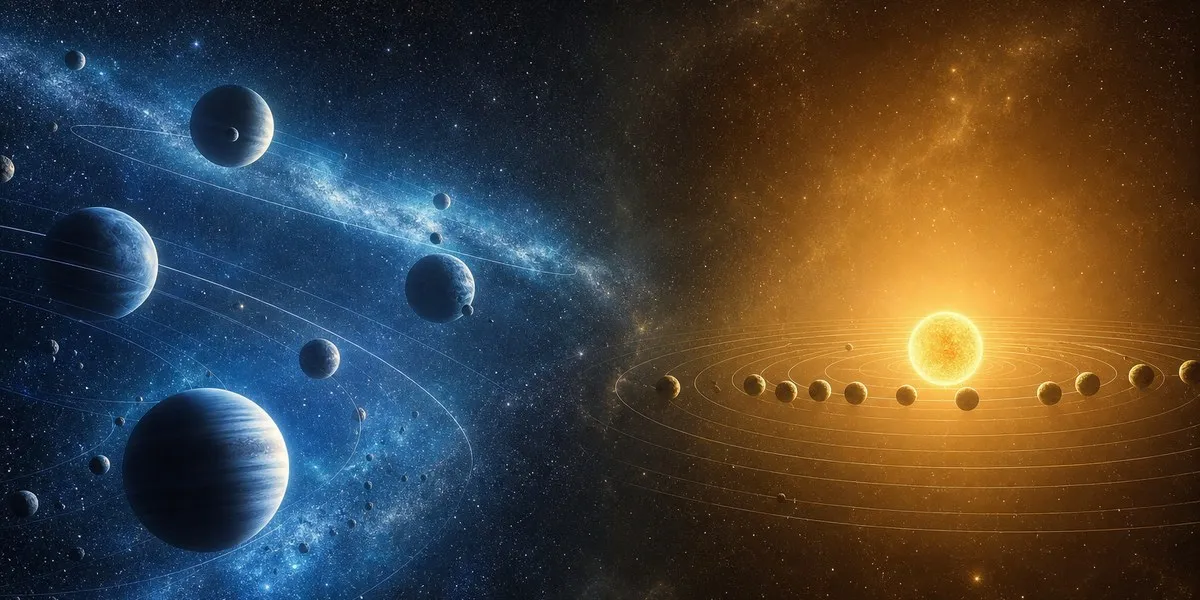
Researchers led by specialists from the Italian National Institute for Astrophysics (INAF) analyzed 300 of the best-studied multiplanet systems in the Milky Way and identified two major groups. They differ in mass, orbital configuration and tendency toward instability, Space.com reports.
The findings of the study, published on October 13 in the journal Nature Astronomy, indicate that the properties of the host star and the formation environment may affect not only the emergence of planets but also the subsequent evolution of the entire system.
Massive and extended systems
Scientists classified large and massive systems as the first family, with a total mass that is often two to ten times greater than that of the Solar System. Their planets orbit stars more massive than the Sun, with a lower content than the Sun of elements heavier than hydrogen and helium. In astronomy, such elements are called metals.
More current news is available on the UA.News Telegram channel Telegram.
This group is more commonly characterized by signs of turbulent gravitational evolution, including significant deviations of orbits from a common plane and circular shape. Scientists link this to phenomena such as giant collisions and the ejection of planets from systems.
Compact systems
The second family consists of more compact and less massive systems. Their planets have similar sizes and masses, a configuration that researchers compare to peas in a pod. They orbit stars whose mass and metallicity are equal to or lower than those of the Sun, and their orbits are usually closer to the star than Mercury's orbit is to the Sun.
The team tested the conclusions using simulations of planetary-system evolution with different initial conditions. The models that best reproduced the properties of the massive and extended group predicted system instability from the moment of their formation: a greater amount of material around the star contributed to the emergence of excessively large planets, making it more difficult to maintain stability.




