
Five silicon qubits simultaneously achieved accuracy of about 99.9% — ScienceDaily
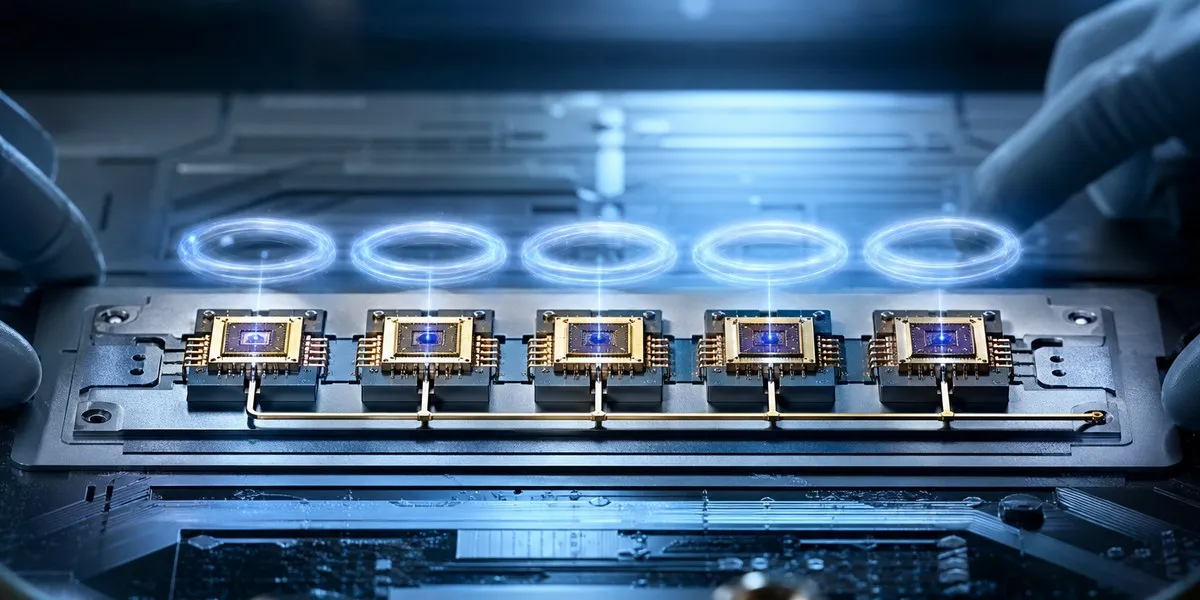
Researchers at the RIKEN Center for Emergent Matter Science, together with colleagues, demonstrated simultaneous control of five silicon spin qubits with accuracy of about 99.9%. The experimental system used an array of five qubits connected to a shared microwave control line. ScienceDaily reports on the results of the study, published in the journal Nature Physics.
Compensation for phase shifts
Silicon spin qubits store quantum information using the spin of individual electrons confined in silicon. Microwave signals are used to control them, but when several qubits operate simultaneously, the accuracy of operations may decrease.
The team linked a significant portion of such errors to the AC Stark shift — a change in a qubit's effective energy levels under the influence of microwave signals. This phenomenon causes unwanted changes in the phase of the quantum state and can disrupt planned operations, especially when several qubits are controlled in parallel.
The scientists developed a calibration method to compensate for these phase shifts. Instead of separate tuning for every possible combination of qubits, the approach uses calibration between pairs of qubits. According to the researchers' assessment, this makes the method more practical for systems with a larger number of quantum bits.
More current news is available on the UA.News Telegram channel Telegram.
Testing results
When tested individually, each of the five qubits demonstrated single-qubit operation fidelity above 99.99%, while the best result approached 99.999%. Fidelity indicates how closely a quantum operation matches the intended result.
When up to three qubits operated simultaneously, operation fidelity also exceeded 99.99%. When the researchers controlled all five qubits at the same time, it remained at approximately 99.9%.
It was not possible to completely eliminate the loss of accuracy. The researchers attributed the remaining errors to control-signal-induced decoherence: simultaneous operation of several qubits requires greater microwave power, which weakens quantum coherence. The study's authors believe that further improvements to the device design could reduce this effect.




