
Radio observations show companion’s impact on Betelgeuse’s atmosphere — Space.com
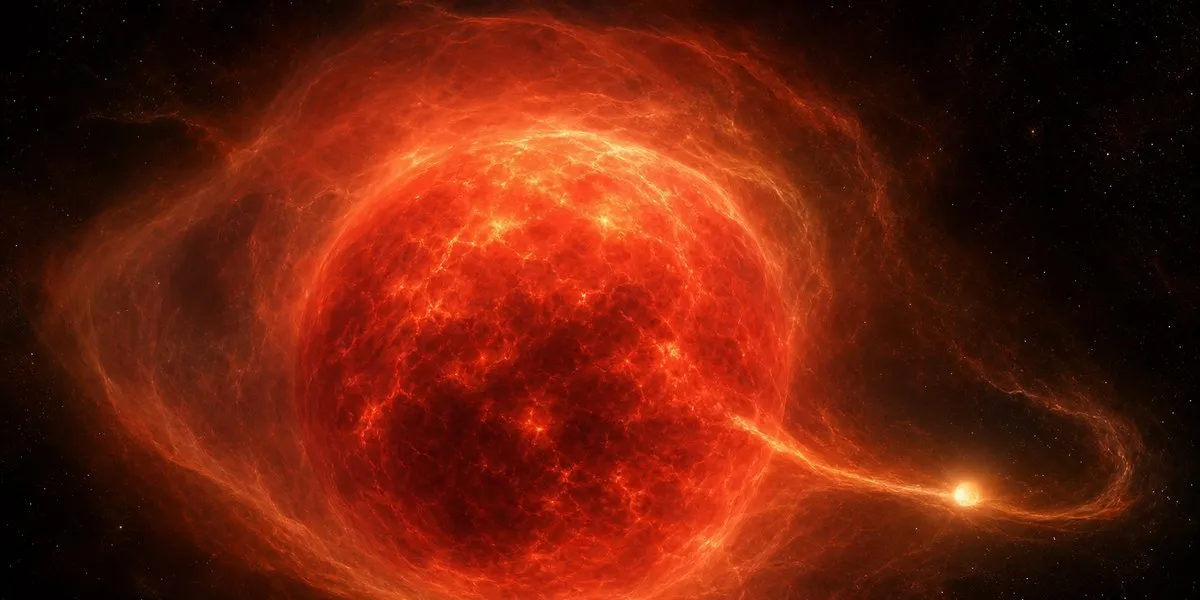
Radio observations using observatories in the United States and Chile have shown that the smaller companion star Siwarha moves so close to the red supergiant Betelgeuse that it passes through its extended atmosphere and leaves a trail behind it. This was reported by Space.com, citing a new study.
The atmosphere changes shape
Data collected between 2021 and 2026 by the Karl G. Jansky Very Large Array radio observatory in New Mexico and the ALMA complex in Chile showed changes in the shape of Betelgeuse’s atmosphere. When Siwarha is farthest from the supergiant, its atmosphere stretches and takes on an egg-like shape. When the companion passes in front of or behind the star, the atmosphere becomes more rounded.
Observation lead Lynn Matthews, a principal research scientist at the Massachusetts Institute of Technology’s Haystack Observatory, explained that the companion orbits so closely that it effectively passes through Betelgeuse’s extended atmosphere.
More current news is available on the UA.News Telegram channel Telegram.
Recovery after dimming
The same observations indicate that Betelgeuse has largely recovered after the Great Dimming, which drew attention in 2020. At that time, the red supergiant ejected large amounts of gas and dust and became its faintest in more than a century.
Astronomers have long sought to explain Betelgeuse’s approximately 2,100-day brightness variation cycle. Previous studies pointed to a low-mass companion orbiting deep within the star’s atmosphere, and Siwarha’s existence was confirmed in early 2026. The companion itself is too faint to be directly detected at radio wavelengths, but its influence can be traced through changes in the supergiant’s shape.
Further observations
To confirm this effect, researchers need to track a larger part of Siwarha’s orbit, primarily at radio wavelengths that have so far been observed too infrequently. The future Next Generation Very Large Array telescope could facilitate regular monitoring of such systems and help study how red supergiants lose matter at the end of their lives and how close companions affect this process. The results are described in an article published in The Astronomical Journal.




