
Spain creates 3D-printed device to absorb sound — ScienceAlert
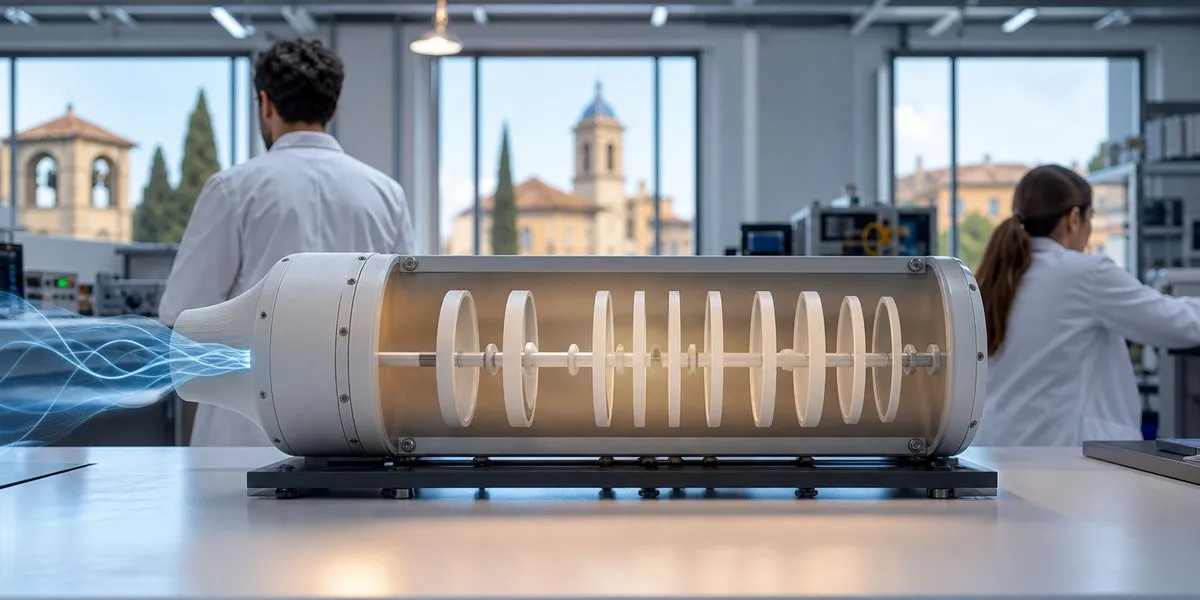
Researchers at La Salle, Universitat Ramon Llull in Spain have developed a 3D-printed device capable of significantly reducing sound reflections in pipes and ducts. The design was dubbed a “sound black hole”: unlike traditional solutions that need to be built into the walls of a duct, it can be manufactured separately and inserted into an existing pipe. ScienceAlert reports on the development.
How the design works
The design consists of rings mounted on a central rod, with the gaps between them forming cavities. They alter the propagation of a sound wave: as it moves inside the device, the wave slows down, its wavelength decreases, and its energy is concentrated.
A significant portion of this energy is dissipated through friction and heat exchange between the air and the device’s surfaces. As a result, less sound returns as an echo. The name is an analogy with astrophysical black holes: the development does not reproduce gravitational phenomena but is intended to control sound propagation.
More current news is available on the UA.News Telegram channel Telegram.
Testing and applications
The team tested a 15-centimeter-long 3D-printed prototype consisting of 29 rings on a central rod. It was installed in an impedance tube, a laboratory device for measuring the behavior of sound waves. A speaker sent sounds of different frequencies into the tube, while microphones recorded the level of reflected sound.
The results generally matched computer modeling, although the device did not eliminate echoes completely. The modeling also showed that the insertable design reflects less sound across a wider frequency range than a traditional “sound black hole.”
The developers consider noise control in air ducts and mufflers to be the most immediate areas of application. At the same time, the technology requires further testing in the presence of airflow, at different temperatures and pressures, and under conditions in which particles may clog the cavities. The study was published in the journal Applied Acoustics.




