
Astronomers Have Discovered a White Dwarf That Could Reveal the Future of the Solar System — Reuters
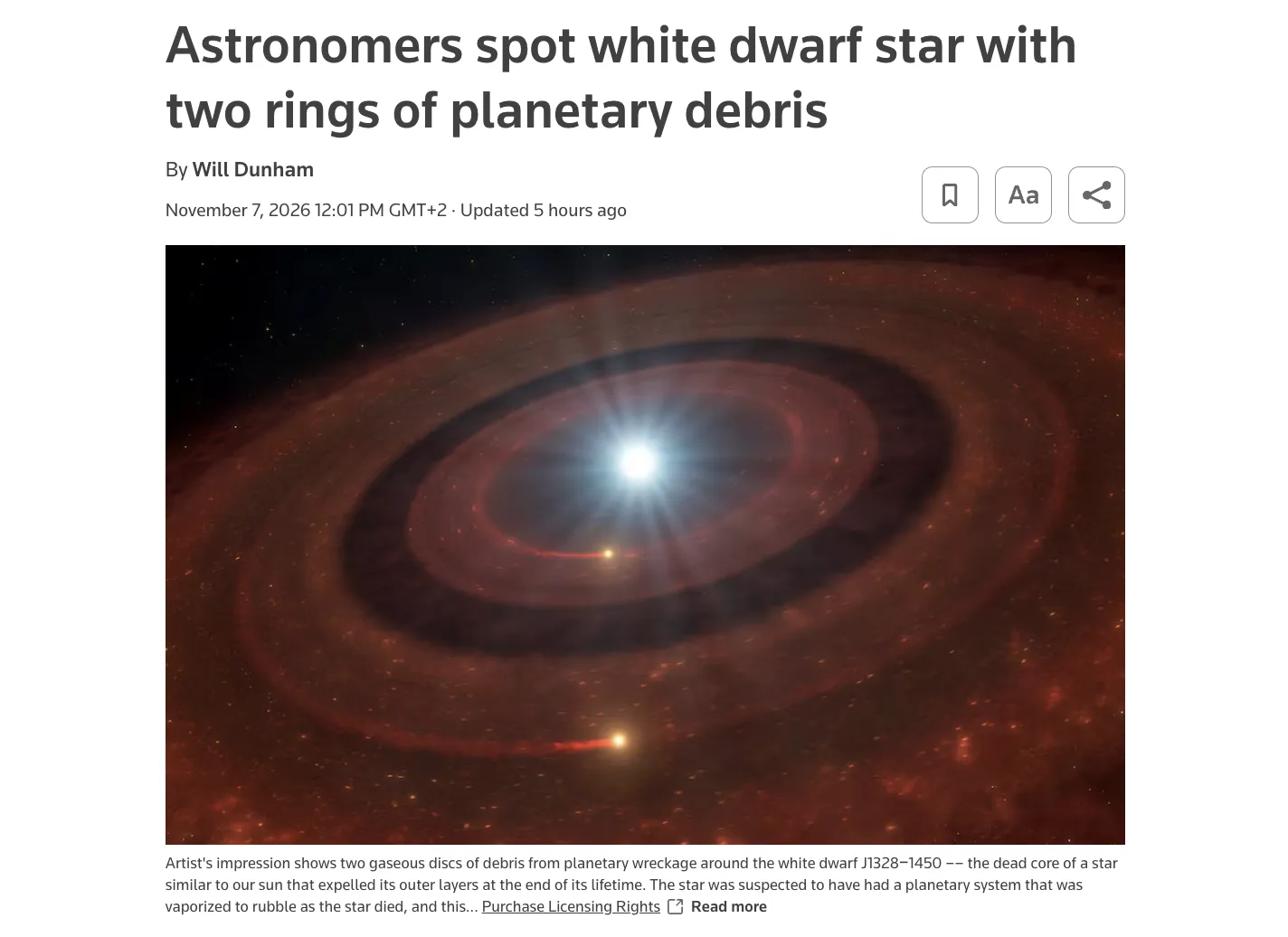
Two rings of planetary debris orbit the newly discovered star. Studying them could help scientists understand how the Solar System will change in the later stages of its existence.
Unlike previously discovered similar systems, the debris disk around this white dwarf consists of two separate rings. Researchers speculate that their unusual structure may have formed under the influence of two rocky bodies that survived the star’s violent transformation.
The white dwarf, designated J1328−1450, is located in the Milky Way, approximately 1,600 light-years from Earth, in the constellation Virgo. It was discovered using the European Southern Observatory’s Very Large Telescope, located in Chile.
Prior to this discovery, astronomers had identified 21 white dwarfs surrounded by planetary debris. However, in all previous cases, only a single disk was observed, rather than two separate rings.
“This also confirms the hypothesis that rocky planetary bodies can survive a star’s transformation into a white dwarf,” said one of the study’s authors, astronomer Felipe Lagos-Vilches of the Federico Santa María Technical University in Chile.
The white dwarf’s mass is approximately 47% of the Sun’s mass, and its diameter is nearly equal to that of Earth.
The surviving rocky bodies may be the remnants of larger planets that suffered significant destruction. According to Lagos-Vilches, after the star evolved into a red giant, the closest planets were engulfed, while some more distant objects survived.
“The planetary system did not disappear completely. Under the influence of gravity, some rocky bodies moved into elongated orbits that brought them closer to the white dwarf,” the astronomer explained.
Objects that came too close to the star were torn apart by its gravity, and their material formed a disk of dust and gas. At the same time, two larger rocky bodies likely survived inside the disk. Their presence may explain the formation of two concentric rings around the white dwarf.
According to Lagos-Vilches, the outer ring contains significantly less magnesium than the inner one. This may indicate that the rings formed from different initial bodies or from different layers of a rocky body.
In about 5 billion years, the Sun will also become a red giant and, eventually, a white dwarf.
“This will have dramatic consequences for the inner Solar System. Mercury and Venus are expected to be engulfed by the expanding Sun. At the same time, scientists still do not agree on whether Earth will suffer the same fate. The outer planets—Jupiter, Saturn, and other more distant bodies—will have a much better chance of surviving,” the astronomer noted.
After the Sun transforms into a white dwarf, the surviving remnants of planets, moons, and asteroids may also come so close to it that they will be torn apart by its gravitational forces.
“Therefore, a debris disk similar to the one surrounding J1328−1450 could be one of the possible scenarios for the evolution of our own planetary system in the distant future,” Lagos-Vilches concluded, according to Reuters.
Astronomers detected a gamma-ray burst with a 27-day activity period.
Astronomers found two rings of debris near a white dwarf.
Astronomers have detected identical knots around the zombie star in Pa 30.




