
The Chronicles of a Pharmacy Millionaire: How Igor Chervonenko Built His Empire Under Mindich’s “Wing” and With Fake Patents
New details have emerged about the story of pharmaceutical magnate Igor Chervonenko and his brainchild—the “Pharmastor” group (known to every Ukrainian by the brand “Apteka Dobrogo Dnya”)—. Although most media outlets stubbornly ignore Chervonenko, his connections just as stubbornly lead to the sanctioned businessman Timur Mindich.
Nevertheless, the findings of investigators and law enforcement officials continue to be striking: a criminal case involving the embezzlement of 2 billion hryvnias through fake patents for “rodent control,” the disappearance of profits amid billions in turnover, and even the sudden “retraining” of pharmacists into… film producers—it’s all here.
Limassol, sanctions, and a “brotherly exchange”: where did Mindich come from?
On the well-known interactive portal “Mindichgate,” which details Timur Mindich’s network of contacts, one of the key elements had long been missing—the owner of a massive pharmaceutical business through which colossal sums flowed. We’re talking specifically about Igor Chervonenko.
His main asset is Farmastor LLC, whose revenue in 2024 alone reached an impressive 4.24 billion UAH. According to data from the YouControl analytical system, the lion’s share of the company (nearly 90%, equivalent to 64.4 million UAH of authorized capital) is registered to the Cypriot shell company Pharminvest Holdings Limited. Insiders claim that the threads of actual control converge in the offices in Limassol, and that more than 30% of the offshore company is controlled by people directly linked to Mindich.
How did this alliance come about? According to investigators, Mindich established a relationship with Chervonenko through an intermediary. The goal was purely pragmatic—to shield Igor’s older brother, former Minister of Transport Yevhen Chervonenko, from sanctions. The transfer of a substantial stake in the pharmacy holding company served as a sort of “fee” for resolving this issue.
The scheme laid bare: 2 billion for “rat disinfection”
Law enforcement agencies are currently actively investigating Pharmastor’s operations. In May 2025, criminal case No. 12025100120000127 was opened under the article on money laundering (Part 3 of Article 209 of the Criminal Code of Ukraine).
According to the Office of the Prosecutor General, the scheme worked as follows:
In 2021, the operators registered a representative office of a foreign company in Ukraine, through which they filed patents for “utility models.” Among them were “ultrasonic methods for repelling rats” and “innovative room cleaning.”
Between 2022 and 2025, about ten pharmacy retail giants (a total of 183 legal entities) signed contracts and began paying millions in royalties for the use of these dubious “technologies.” In reality, however, these services existed only on paper.
Over 2 billion hryvnias have accumulated in the accounts of the Odesa branches of the Polish company “SKIL TRADE SP. z o.o.” and the Estonian company “KVIK VENT OU.” From there, the money flows onward—ostensibly to purchase “household goods” through a network of 101 companies (26 of which have already been officially recognized as shell companies).
The prosecutor’s office notes that the state treasury lost at least 361 million hryvnias in income tax revenue due to this scheme. Moreover, investigators suspect that the diverted “cash” was used to bribe doctors so that they would prescribe medications to patients that are sold exclusively in “select” pharmacy chains.
In addition to “Pharmastor” (the “Apteka Dobrogo Dnya” chain), other well-known market players are mentioned in the case files:
- The “ANC” chain (“ANC Pharmacy” LLC, “Low-Price Pharmacy,” “Kopiyka Pharmacy”);
- Regional divisions of the “Podorozhnik” group (“Podorozhnik Kyiv,” “Podorozhnik Khmelnytskyi”);
- The “Farmatsiya” chain (“Farmatsiya Kyiv” LLC, “Farmatsiya Vinnytsia”);
- The companies “Solomiya-Service” Private Enterprise, “Prana-Pharm” LLC, “Osan” Private Enterprise, and “Biocon” Pharmacy Association LLC.
Currently, the Pechersky District Court of Kyiv has frozen the accounts of the transit companies, and an appeal in April 2026 confirmed the legality of this freeze.
Billions in revenue and 100,000 hryvnias in profit
The “Pharmastor” holding company is the parent entity for a number of profitable companies. For example, here are their revenues for 2024:
However, Pharmastor’s own financial statements reveal unexpected declines in profit. While the company was actively paying royalties for “ultrasound against rats,” its net profit plummeted, despite revenues in the billions:
- 2023: Revenue — 3.69 billion UAH ➔ Profit — 9.6 million UAH.
- 2024: Revenue — 4.24 billion UAH ➔ Profit fell to 2 million UAH.
- 2025: Revenue — ~4.2 billion UAH ➔ Official profit amounted to a paltry 112,000 UAH.
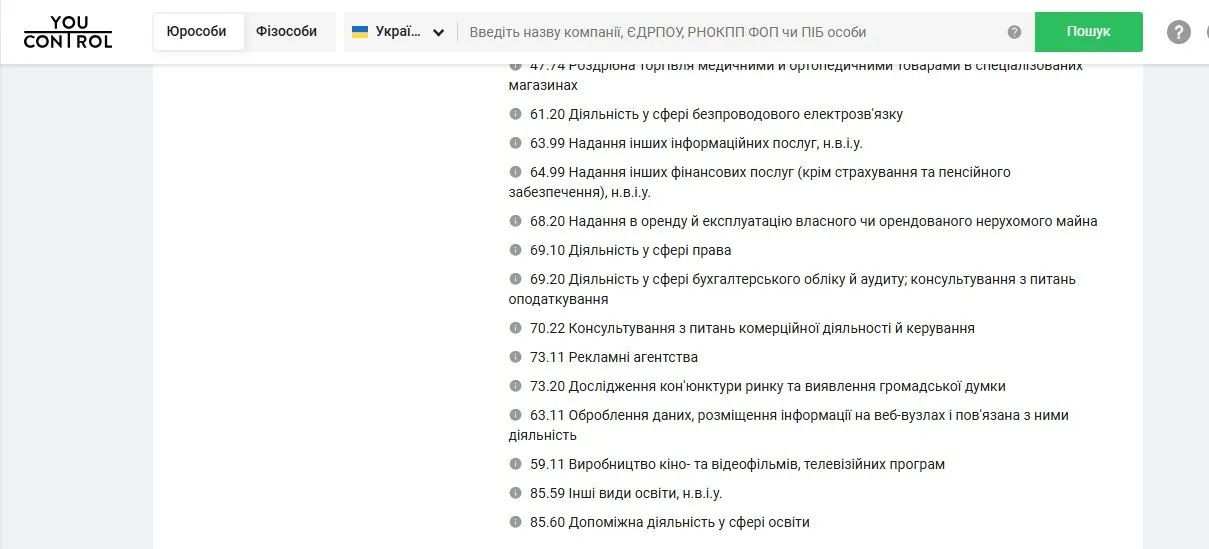
Then, on June 20, 2025—literally just a few weeks after the criminal investigation began—the pharmacy giant suddenly added new KVED codes to its profile: “production of films and videos” and educational services. Analysts are convinced that this was how the businesspeople were setting up back channels to siphon off money under the guise of purchasing “copyrights to media content.”
Ihor Chervonenko himself owns luxury real estate in the historic center of Kyiv: two apartments on Volodymyrska Street (across from St. Sophia Cathedral), a residence on Lesya Ukrainka Boulevard, and a massive 344-square-meter apartment on Velyka Zhytomyrska Street.
The Budget Pie and Old Sins
Its criminal history does not prevent “Pharmastor” from actively securing government funds through the Prozorro system. In total, the company has won 747 government tenders.
In 2024, the value of its government contracts totaled 40.8 million UAH; in 2025, 16 million UAH; and in the first five months of 2026, the pharmacy managed to sign agreements worth another 7.6 million UAH. Its largest clients are state hospitals and law enforcement agencies: the Kyiv Psychiatric Hospital (25.7 million hryvnia), the Military Hospital (3.3 million hryvnia), and even the SBU’s Military Medical Directorate (1.4 million hryvnia).
In addition to the “patent case,” the holding company faces a long list of other violations:
- Fictitious marketing: Previously, the State Fiscal Service investigated the activities of Farmastor LLC and Pharma-City LLC as part of Case No. 756/16262/20. They were accused of using fictitious transactions and advertising services to minimize taxes by more than 53 million UAH (estimated budget losses—7.4 million UAH).
- Shadow insurance: “Pharmacy No. 1 Trasfarm” LLC was mentioned in materials regarding possible tax evasion through fictitious risk insurance schemes, as well as in a corruption case involving officials of the municipal enterprise “Kyivreklama.”
- Prescription Drug Crimes: Companies within the group have repeatedly been implicated in cases involving violations of regulations governing the trade in controlled substances. At Pharmacy No. 61 in Lubny (LLC “Apteka Dobrogo Dnya”), police documented the sale of codeine-containing medications without prescriptions or receipts. And the manager of Poltava Pharmacy No. 16 (Zirka Farmatsiiki LLC) was tried for the illegal dispensing of narcotic drugs (Case No. 554/5476/22), where she pleaded guilty and was released on the good faith of her colleagues.
Cartel Collusion and an Ultimatum to the Ukrainian Pharmaceutical Industry
An investigation by the Antimonopoly Committee of Ukraine (AMCU) has become an additional source of pressure on the business model of large chains. The agency opened proceedings following an official complaint from the pharmaceutical company “Darnitsa.”
According to the AMCU’s findings, starting in February 2025, major pharmacy chains (“Apteka Dobrogo Dnya,” “9-1-1,” “Podorozhnik,” “Bazhayemo Zdorov’ya”) simultaneously ceased selling products from Ukraine’s three largest pharmaceutical manufacturers. Public demand for these essential medicines has not declined, so the AMCU is treating the retailers’ actions as a possible anti-competitive concerted practice (boycott) aimed at forcing manufacturers to increase the amount of unofficial “marketing bonuses”—hidden fees for the right to sell medicines on store shelves. The investigation is currently in its final stages, and those involved face substantial fines.
What Chervonenko’s Defense Says
Journalists sent Igor Chervonenko an official request regarding his ties to Timur Mindich. However, instead of substantive answers, they received an angry letter from his attorney, Iryna Kostenko. She called the media’s questions an “information mishmash” and claimed that such publications damage her client’s business reputation and cause him financial losses.
Meanwhile, the NABU briefly mentions the use of the Ukrainian pharmaceutical industry to launder money in a corruption case involving the construction of the “Dynasty” cottage community in Kozin.
By the way
An unexpected player has emerged in the NABU and SAPO investigation into the “Dynasty” cottage community in Kozin: the Ukrainian pharmaceutical industry. It’s not as if it made a big splash—rather, it was merely mentioned in passing. The investigators’ focus is entirely on corruption at “Energoatom,” while the role of pharmaceutical companies—through which funds were “laundered” for the country’s top officials—unfairly remains unnoticed.
When the “Mindichgate” materials were made public (the case involving construction in Kozin funded by Timur Mindich’s criminal organization), NABU briefly mentioned the money-laundering scheme via the so-called “Form 1.” And that’s a shame. After all, it is precisely this “quasi-legitimate” financing channel that explains a great deal about how the real sector of the economy became integrated into the corrupt ecosystem of Oleksiy Chernyshov, Andriy Yermak, and Timur Mindich.
UA.News journalists asked People’s Deputy Yaroslav Zheleznyak when exactly Chervonenko would appear on the list of suspects; Deputy Zheleznyak replied cautiously:
“It’s hard to say at this point whether he will become an official suspect in the ‘Midas’ case. We need to study the case files in detail, to which we currently do not have full access. So far, we’ve only seen him in group photos. However, there was one strange incident: Vasya Veselyi, along with Zuckerman (a key figure in the case), for some reason went into one of the pharmacy chains. What they were ‘treating’ there is a question for NABU.”
Journalists continue to monitor the developments in the legal battles surrounding “mouse patents” and the decisions of antitrust authorities.


