
In Ternopil, a patient was awakened during brain surgery
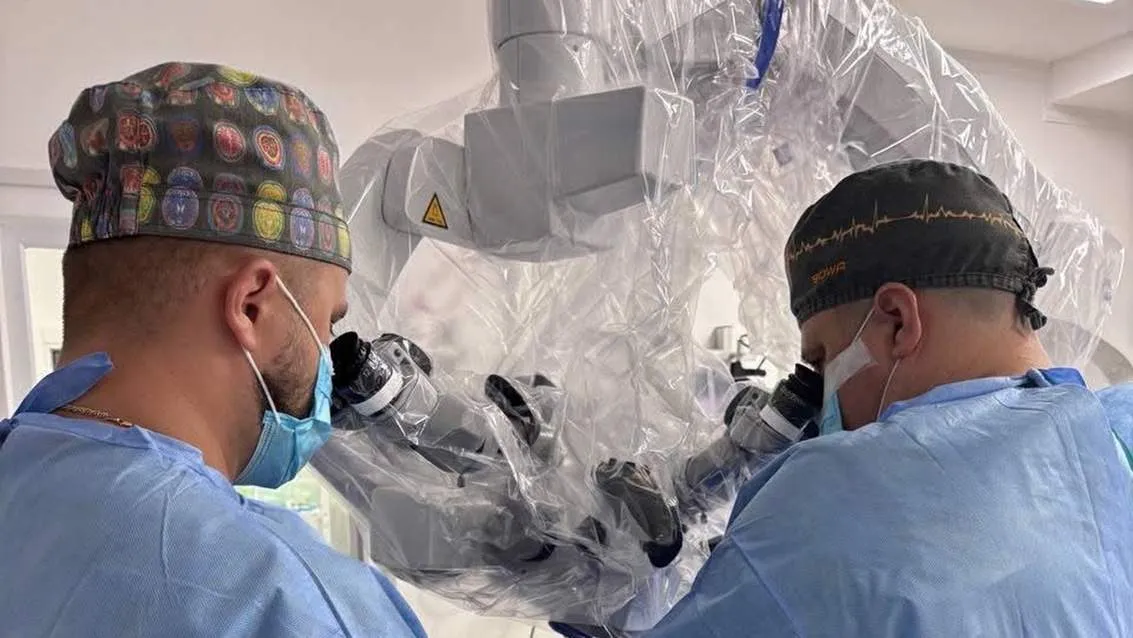
In Ternopil, doctors performed a complex brain surgery on a 56-year-old woman with a large tumor. During the procedure, the patient was deliberately awakened to check her speech and movements and to avoid damaging critical areas of the brain. The tumor was completely removed, and the woman is now undergoing rehabilitation.
A 56-year-old resident of Ternopil sought medical attention due to a decline in her health. She was suffering from severe headaches and occasional loss of consciousness. During the examination, doctors discovered a large brain tumor in the woman. They recommended surgery, as the tumor needed to be removed.
However, due to its location, a standard operation could have been risky. The tumor was situated in an area where it was crucial not to damage the parts of the brain responsible for movement and other vital functions.
The patient was awakened during the surgery
The surgery was performed by a team of neurosurgeons at the Ternopil Regional Clinical Psychoneurological Hospital. The medical team used the “wake-up” technique—at a certain stage during the surgery, the patient was brought out of anesthesia and asked to perform simple tasks. Neurosurgeon Pavlo Yashchuk explained that this allows doctors to monitor brain function directly during the operation. “The ‘wake-up’ method is performed at only a few clinics in Ukraine, and in the Ternopil region—only at our hospital. It’s not very common because it should only be performed when the tumor is located in functional areas of the brain,” the doctor said.
When the surgeons reached the tumor, they woke the woman up. She remained under medical supervision and answered simple questions. “We wake the patient up once we’ve reached the tumor and then proceed with the surgery. The patient answers simple questions: ‘What is your name? Where do you live?’ This is necessary to preserve brain function as much as possible,” explained Pavlo Yashchuk. This monitoring helps doctors determine whether they are affecting important areas of the brain. If speech or movement changes during the operation, surgeons can adjust their approach.
About 10 medical professionals monitored the surgery.
The procedure lasted about four hours. The operation was led by Oleksiy Leontyev, head of the hospital’s neurosurgery department and a candidate of medical sciences. In total, the team consisted of about 10 medical professionals. Three surgeons were directly involved in the operation.
In addition to the “wake-up” technique, the doctors used intraoperative neuromonitoring. This allows them to monitor the functioning of neural structures and vital bodily functions during the operation. This is particularly important for such a procedure, as the doctors’ primary goal is not only to remove the tumor but also to preserve normal brain function as much as possible.
The tumor was completely removed
According to the medical team, the surgery was a success. The tumor was completely removed. The patient retained movement in her limbs. After the surgery, all motor function indicators were at the same level as before the procedure.
The patient is currently undergoing rehabilitation. Hospital officials note that such surgeries are no longer isolated cases there. Since the beginning of 2024, doctors have performed about 30 procedures using this technique.
The “wake-up” method is not used for every brain surgery. It is necessary in cases where the tumor is located close to functionally important areas. It is precisely the ability to communicate with the patient during surgery that helps surgeons more accurately determine the boundaries for safe tumor removal.
The Ministry of Health does not maintain a separate registry of medications that have been destroyed or lost due to Russian attacks. Health Minister Viktor Lyashko explained that companies do not disclose such data due to trade secrets, so the ministry assesses the risks of drug shortages separately after each attack.
Alona Shevtsova, CEO of Sends, will moderate a panel discussion at the executive level at the 17th Middle East Banking Innovation Summit (MEBIS 2026), which will take place on September 16–17 at the Jumeirah Emirates Towers in Dubai.


