
Zelenskyy: Russia has turned civilian and critical infrastructure into targets
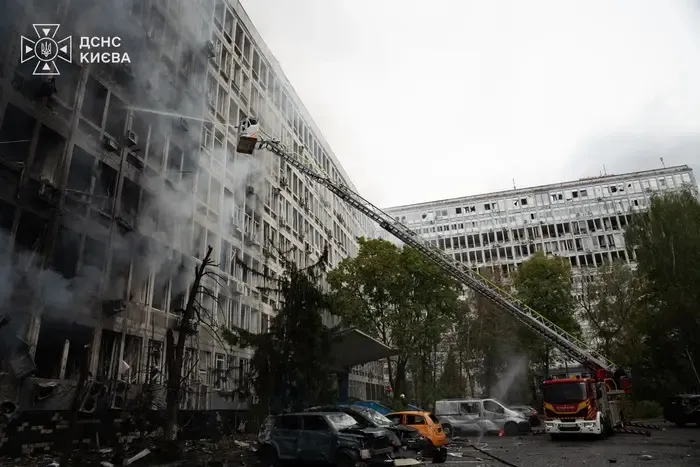
President Volodymyr Zelenskyy responded to the Russian attack on Kyiv and called on partners not to ease sanctions pressure on Russia. According to him, during meetings on the sidelines of the UN General Assembly, Ukraine continues to work on securing support and imposing new restrictions on Russia. As of the time of the statement, the president said that two people had been killed and 24 others wounded as a result of the strikes on Kyiv.
Ukrainian President Volodymyr Zelenskyy commented on the Russian attack on Kyiv. He stated that Russian forces had once again struck not only military targets but also civilian and critical infrastructure. According to Zelenskyy, cleanup efforts are ongoing in Kyiv following the nighttime attack. Russia launched a large number of drones at the city, including jet-powered drones. “Since this morning, efforts to deal with the aftermath of the Russian strikes on Kyiv have been underway. The Russians launched many drones at the city, a significant portion of which were jet-powered,” the president wrote.
Zelenskyy noted that various facilities were targeted during the attack. Among them were pharmaceutical companies, gas stations, the railway, communications facilities, and shopping centers. “Russia continues to target civilian and critical infrastructure: pharmaceutical facilities, gas stations, railways, communications, and shopping centers,” the head of state stated.
Two dead and 24 wounded
According to Zelenskyy, at the time of his statement, two people were known to have been killed as a result of the attack on Kyiv. Another 24 people were injured. The president also reported strikes on cities and communities in eight regions. Information on the consequences of the Russian attack may be updated once rescue workers and other emergency services have completed their operations.
Zelenskyy called for tougher sanctions
Separately, the president highlighted the work of the Ukrainian delegation during the UN General Assembly in New York. According to him, meetings with foreign partners concern not only continued support for Ukraine but also sanctions against Russia. “During every meeting at the UN General Assembly, we are working to ensure support for Ukraine. And equally important is fair sanctions pressure on Russia,” Zelenskyy stated.
He thanked the countries that continue to support Ukraine and advocate for tightening restrictions against Russia. The president noted that, in his view, sanctions pressure should not be eased following such attacks. “In fact, all our partners agree that, when such strikes occur and while this terrorist war continues, this is no time for weakness,” the head of state said.
Zelenskyy specifically mentioned Russian oligarchs
The president also stated that sanctions should serve as a signal not only to the Russian state but also to representatives of Russian business who remain subject to restrictions or may be added to sanctions lists. According to Zelenskyy, they must understand that the continuation of the war will have consequences for Russia and its representatives. “It is important that the sanctions serve as a signal to Russia—and, in particular, to its oligarchs—that the war must be ended, not simply weathered,” the president emphasized.
The issue of sanctions was one of the key topics during Zelenskyy’s meetings with international partners in New York. The day before, the president discussed the EU’s sanctions policy with Danish Prime Minister Mette Frederiksen. During his meeting with European Commission President Ursula von der Leyen, additional sanctions against Russia were also discussed. Thus, following yet another attack on Kyiv, Zelenskyy once again linked the Russian strikes to the need to intensify international pressure on Moscow. The president emphasized that Ukraine continues to discuss support and sanctions with its partners during the UN General Assembly. The head of state wrote about this on social media.
As a result of the enemy attack on Kyiv, the number of casualties rose to eight; three of them were hospitalized. The other five victims received medical care on-site or as outpatients.




