
Ukrainian Armed Forces soldiers thwarted Russia's plan to encircle key cities in the Donetsk region, according to the ISW
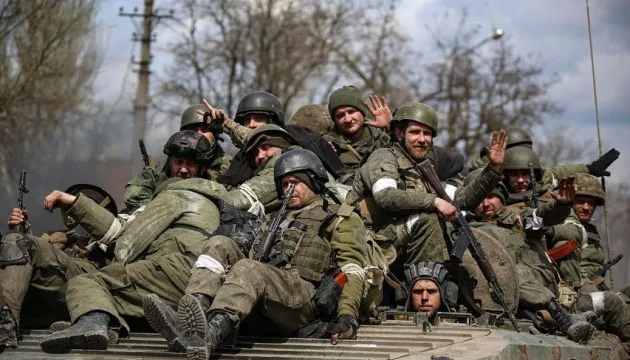
Russian troops planned to encircle key fortress cities in the Donetsk region by advancing simultaneously from the north and south. According to the Russian command’s plan, two groups were to converge in the Barvinkove area of Kharkiv Oblast, which would then create conditions for the subsequent capture of the entire Donetsk Oblast.
According to Biletsky, the Russian command planned to encircle the so-called “belt of fortresses” in the Donetsk region from two directions.
The northern group was to advance through Lyman and Svyatogorsk, while the southern group was to advance through the Dobropillya area.
According to the Russian military’s plan, both parts of the offensive were to converge near Barvinkove, which, according to Biletsky’s assessment, would have created the conditions for the capture of the entire Donetsk region.
The Ukrainian military carried out counteroffensive operations on the Lyman front as part of Operation “Vivaldi.”
Biletsky stated that the Russian force, which was supposed to advance through Lyman and Svyatogorsk, suffered an operational defeat, and Operation “Vivaldi” continues. According to him, this thwarted the northern part of the plan to encircle the “belt of fortresses.”
At the same time, the ISW assesses the actions of Ukrainian forces in the Lyman sector as a sign of progress in restoring certain elements of tactical maneuvering. According to analysts, one of the factors contributing to this was a systematic campaign of Ukrainian strikes against Russian logistics and support facilities in the temporarily occupied territory of the Luhansk region.
The Third Army Corps noted that strikes on Russian logistics have disrupted fuel supplies to Russian units on the front lines.
According to ISW estimates, the shortage of resources also affected the ability of Russian units to use drones and electronic warfare systems to counter Ukrainian drones.
Analysts explained that electronic warfare systems consume significant amounts of electricity, and the Russian military relies on diesel generators to power them. Therefore, according to the ISW, strikes on logistics and energy infrastructure weakened the effectiveness of Russian electronic warfare and facilitated the more effective use of Ukrainian drones during mechanized operations in the Lyman sector.
Separately, the ISW highlighted the operational surprise of Ukraine’s actions. The Ukrainian Armed Forces maintained a media blackout during the counteroffensive, which made it difficult for the Russian command to assess the actual situation on the battlefield. Analysts noted that Ukraine had already employed a similar approach during previous counteroffensive operations.
This was stated by Brigadier General Andriy Biletsky, commander of the Ukrainian Armed Forces’ Third Army Corps. His assessments were cited by the Institute for the Study of War (ISW) in its report.
As of September 18, 2026, 230 combat engagements had been recorded on the front lines. Ukrainian forces continue to hold back Russian troops on all fronts and inflict casualties on them.
As a reminder, Russia struck a shopping center in Zaporizhzhia.
In Zaporizhzhia, the number of people injured as a result of a Russian FPV drone attack on a passenger bus has risen. Currently, eight people are known to have been injured—four men and four women. All of them are receiving the necessary medical care.
The enemy attacked a passenger bus in the Kosmichny district of Zaporizhzhia with an FPV drone. At the time of the attack, the bus was carrying passengers who were going about their daily business.




