
The Main Intelligence Directorate named 35 companies that manufacture Russian Iskander missiles
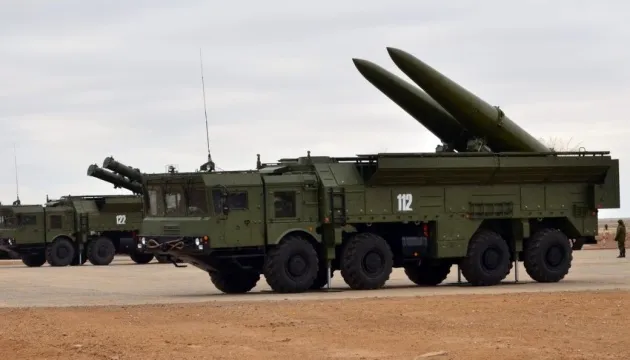
The Main Intelligence Directorate of the Ukrainian Ministry of Defense has released information on 35 companies involved in the production of Russian “Iskander-M” ballistic missiles. The intelligence agency noted that these enterprises are involved in various stages of the production of Russian missile systems.
The data was published on the War&Sanctions portal.
In recent months, the enemy has been using ballistic weapons as the primary means of its airstrikes in the war. The fact that such strikes occur mainly at night, and that the flight time of the missiles to the Ukrainian capital is only a few minutes, indicates their purely terrorist nature. Such tactics are aimed at intimidating Ukrainians and forcing them to accept peace at any cost, rather than on terms that are fair to Ukraine and the civilized world, the Main Intelligence Directorate noted.
“To counter the aggressor’s plans, it is important to consolidate efforts aimed at curbing Russia’s program for the development, production, and modernization of ballistic weapons. As we begin a series of publications on Russian ballistics, today the Main Intelligence Directorate of the Ministry of Defense is releasing additional details regarding the production of 9M723 ballistic missiles for the “Iskander-M” operational-tactical missile system,” the Main Intelligence Directorate emphasized.
In one of the combined missile strikes on Kyiv this summer, the Russians used the upgraded 9M723-2 ballistic missiles—also known by the code name “Iskander-1000”—for the first time. This missile is part of the “Bora-M” system.
Thanks to its more powerful engine and, consequently, a larger launch unit, the upgraded missile is capable of striking targets at a range of up to 550 km (390 km for the 9M723-1). The rest of the missile remains identical to the 9M723-1.
The new page on the portal combines several datasets: an interactive 3D model of the missile, its main components, and over 170 Russian- and foreign-made components identified in the samples analyzed; 82 Russian and two Belarusian enterprises involved in the production of these missiles; 108 key officials and employees of the main enterprises in the production network; and 121 units of foreign-made technological equipment used by these enterprises.
A significant portion of this data is being made public for the first time today—140 components, 35 enterprises, and 108 individuals.
“Despite ongoing efforts at localization, the 9M723 missile still contains a significant proportion of foreign components. Only a quarter of the 140 components published today are manufactured by Russian enterprises; nearly half—63—are produced by U.S. manufacturers; 8 each come from Switzerland and Belarus; 4 each from Germany and Taiwan; and 3 from China,” the Main Intelligence Directorate noted.
In one of the most critical components of the missile’s guidance system—the unit that processes flight data received from a laser gyroscope—only 5 out of 43 components are manufactured in Russia.
“The most critical components—the microprocessor, FPGA, memory, and digital-to-analog and analog-to-digital converters—are from American and Taiwanese manufacturers: DM&P; Electronics, Xilinx (part of AMD), Atmel (part of Microchip Technology), Winbond Electronics, Micron Technology, and Analog Devices,” the GUR reported.
The intelligence agency emphasized that all the disclosed companies, entities, and facilities must become the top priority in the sanctions policy of the civilized world, “since the experience of recent months has shown that no country is capable of providing sufficient resources to shoot down dozens of ballistic missiles every night.”
The GUR reported this on Facebook
GUR fighters are destroying military equipment and occupiers in the Zaporizhzhia sector.
Footage of combat operations was released by the Main Intelligence Directorate of the Ministry of Defense of Ukraine.
The Ministry of Defense will recover 617 million hryvnias through the courts for canceled contracts.
Prior to this, the Ministry of Defense certified and authorized the domestic “Volynyaka” unmanned aerial system for use by the Armed Forces of Ukraine.
Earlier, the Ministry of Defense of Ukraine approved the ShaBlya MK19(M) remotely controlled combat module for use by the armed forces. It is equipped with an MK19 40-mm automatic grenade launcher.




