
The occupiers have changed their logistics routes due to drone strikes by the Ukrainian Armed Forces
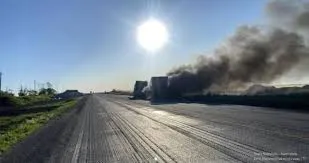
The Ukrainian military’s establishment of fire control over strategic highways in the temporarily occupied territories forced the enemy to completely reorganize the supply routes for its forces.
The most significant blow to the enemy’s logistics was dealt after the Defense Forces placed the movement of vehicles under constant threat of attack on two key routes, namely the Novoazovsk–Mariupol highway and the Donetsk–Mariupol–Berdyansk route. Petro Andriushchenko, head of the Center for the Study of the Occupation, provided a detailed analysis of the situation regarding the reorganization of the invaders’ military transport.
According to the analyst, the Russian troop group’s logistics system has currently suffered significant degradation, though it has not completely collapsed. To minimize losses of equipment and personnel, the occupiers have abandoned the use of major highways and established three new bypass routes. The first alternative route runs through the towns of Mariupol, Nikolskoye, Rozyvka, Kamianka, Osipenko, and Berdyansk. The second route runs along the coast and via local roads through Mariupol, Melekine, Yalta, Urzuf, Berdyansk, Osipenko, and Andriivka, with a subsequent exit to Tokmak and Melitopol. The enemy has organized a third logistics corridor in the opposite direction—from Berdyansk through Kamianka, Rozyvka, and Khlibodarivka to Volnovakha.
In addition to the main bypass routes, the invaders have begun actively utilizing a network of small local roads. Increased military transport activity has been observed in the Mangush district near the villages of Demyanivka, Komyshuvate, Starodubivka, and Zakharivka, as well as in the Nikolsk district near the settlement of Boyove. Petro Andriushchenko also noted that due to the constant threat of attacks by Ukrainian drones, the Russians are forced to abandon the movement of large units. Now the invaders are transporting ammunition and weapons in much smaller convoys accompanied by mobile air defense fire groups, which leads to an increase in the number of trips and significant time losses during the delivery of cargo to the front line.
Source: Andriushchenko on Telegram.
In the temporarily occupied Crimea, fuel problems could escalate into a much more serious crisis. Due to logistical difficulties on the peninsula, prices have already begun to rise, lines are forming, and residents are actively stocking up on essential goods.
The shortage of motor fuel, previously observed in the temporarily occupied Crimea, has begun to spread to the southern regions of the Russian Federation. Residents of the Krasnodar Krai and the Rostov Oblast are reporting shortages of gasoline and diesel fuel.


