
During Operation "Vivaldi," the robots created 400 meters of minefields
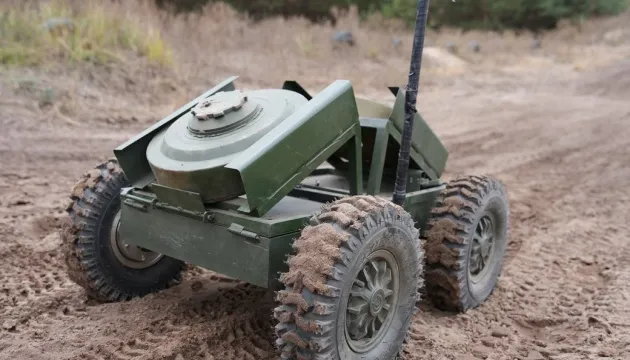
During Operation “Vivaldi,” soldiers of the Third Army Corps laid 400 meters of minefields in two nights using ground-based robotic systems. Corps officials say that remote mining allows them to block Russian troop routes more quickly and do so without directly exposing personnel to dangerous work.
During the “Vivaldi” offensive operation, the Third Army Corps of the Ukrainian Armed Forces used ground-based robotic systems for remote mining. Over the course of two nights, the military used robots to create 400 meters of minefields. “Remote-controlled mining is now also underway in Troitska—over two nights, 400 meters of minefields were created using robots,” according to a military statement.
This refers to the use of ground-based robotic systems capable of performing tasks in hazardous areas without the direct presence of military personnel. This approach reduces risks for sappers and other service members who would previously have had to perform such work directly in the field.
How Robots Help Mine Routes
Remote mining allows for the creation of minefields along routes that Russian troops might use. The Third Corps notes that during Operation “Vivaldi,” this technology helps quickly cut off the enemy’s lines of movement.
Minefields can be used to restrict the movement of equipment and personnel. At the same time, deploying them is a complex and dangerous task, as military personnel must operate in combat conditions and under the constant threat of attack.
That is precisely why the use of robotic systems makes it possible to carry out some of these tasks at a safe distance from personnel. A robot can operate in areas where it would be particularly dangerous for a service member to be present.
Officials in the Third Corps note that it would typically take people significantly longer to complete such a task. According to military estimates, work that could have taken about two weeks was completed in two nights with the help of robots. “Now, tasks that would have taken people about two weeks are being completed by robots in two nights,” the corps noted.
Robots are used for more than just demining
Ground-based robotic systems have become an important part of Operation “Vivaldi.” They are used to carry out various tasks to reduce the burden on infantry and avoid exposing soldiers to unnecessary risk.
The Third Corps previously reported that ground robots have already carried out thousands of missions during the operation. According to the corps, this includes over 15,700 successful missions and approximately 3,300 metric tons of delivered cargo. At the same time, the corps states that robotic units are already covering up to 80% of the infantry’s needs and handling a significant portion of evacuations on the front lines.
Robotic systems can be used to deliver ammunition and equipment, evacuate the wounded, transport cargo, and perform other tasks. This allows some of the work to be carried out by machines rather than people. A separate area of focus has been the use of robots directly during offensive operations. Earlier, the Third Corps reported that during the second phase of “Vivaldi,” the Defense Forces, for the first time, deployed ground-based robotic systems behind Russian lines using heavy drones.
What Is Happening During Operation “Vivaldi”
Operation “Vivaldi” is underway in the Lyman sector. The Third Army Corps announced the launch of the operation on September 15 and subsequently began releasing specific details of combat operations. According to the corps, during the operation, Ukrainian units are conducting offensive operations, targeting Russian logistics, and gradually expanding their area of control. However, the military is not disclosing all the details, as the operation is still ongoing.
On September 20, the Third Corps announced the liberation of Shandryholove and Derylove, as well as the establishment of full control over Drobyshev. The corps stated that during the two phases of the operation, 125 square kilometers of territory were returned to Ukrainian control, of which 50 square kilometers were de-occupied.
Robotic systems have become one of the technological elements of this operation. The military is using them not as a standalone demonstration of new technology, but as part of a system in which various unmanned and robotic vehicles perform specific tasks on the battlefield.
Why the military is relying on robots
The main advantage of robotic systems is that they can perform dangerous tasks in place of humans. On the front lines, this is particularly important for operations near enemy positions, in mined areas, or under the constant threat of drone strikes. The more of these tasks that can be delegated to machines, the fewer soldiers need to be sent directly into dangerous areas. At the same time, an operator can control the system remotely.
In the case of mine clearance, this is particularly important, as laying mines is a dangerous procedure even in the absence of active combat. A robot allows personnel to be removed from the immediate danger zone and enables part of the work to be performed by technical means. At the same time, robotic systems do not completely replace military personnel. Behind them are operators, technical specialists, and other service members who plan missions, operate the equipment, and monitor the results.
The Third Corps continues to use robotic systems during Operation “Vivaldi.” A new incident involving remote demining shows that robots are increasingly being deployed not only for logistics or evacuation but also directly for combat missions. This was reported by the Third Army Corps itself.
We previously reported that Russian forces shelled Kramatorsk, resulting in one fatality and one injury.
Russian troops attacked the Zaporizhzhia region 928 times over the past 24 hours. One person was killed and three others were wounded as a result of strikes on the Zaporizhzhia district. Fifty-five settlements in the region came under fire.
Russian forces attacked a monastery in the village of Chervonyi Mayak, in the Novorayska community of the Kherson region, using a drone. A 71-year-old clergyman was killed in the strike, and four other priests were wounded.
A 71-year-old clergyman was killed in the attack on the monastery in Chervonyi Mayak. Four other priests were injured. Information regarding their condition may be updated.




