
A Russian drone attacked a passenger train in the Sumy region
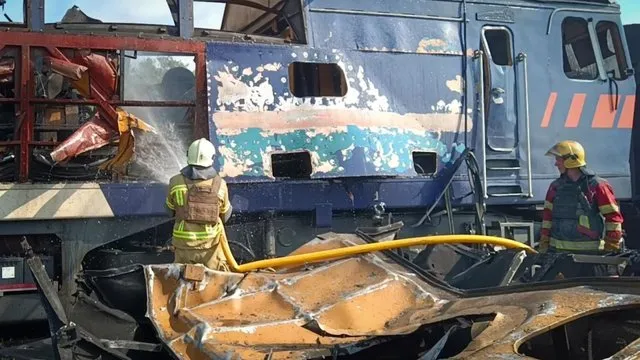
A Russian drone attacked a passenger train in the Sumy district this morning. The drone struck the locomotive, causing a fire. According to preliminary reports, no one was injured, but rescue workers had to suspend firefighting efforts several times due to the threat of further strikes.
According to the State Emergency Service, a Russian drone attacked a train carrying passengers. The impact caused the locomotive to catch fire. Rescue workers arrived at the scene and began extinguishing the fire. However, they had to interrupt their work due to the threat of repeated attacks by Russian drones. “This morning in the Sumy district, a Russian drone attacked a passenger train carrying people. While extinguishing the fire caused by the strike, firefighters repeatedly suspended their work due to the threat of further attacks,” the State Emergency Service reported.
According to preliminary information, no one was injured as a result of the attack. Rescuers resumed their work after the threat of a follow-up strike subsided, allowing them to return to extinguishing the fire. The circumstances of the attack and the damage to the locomotive are being investigated.
Russian troops regularly attack the Sumy region with drones and other types of weaponry. Due to the region’s proximity to the border with Russia, its civilian infrastructure remains under constant threat of attack. The attack was reported by the State Emergency Service of Ukraine.
As of August 8, 2026, the total combat losses of Russian troops since the start of the full-scale invasion of Ukraine amount to approximately 1,456,610 soldiers.
On August 7, there were 192 combat engagements between Ukrainian defenders and Russian troops on the front lines. The occupiers were most active in the Pokrovsk direction—25 assaults were recorded there over the past 24 hours, and Ukrainian forces neutralized 56 Russian soldiers.
Russian troops have made new advances near Kostiantynivka in the Donetsk region. Changes along the front line were documented by the DeepState monitoring project.




