
Ukraine Is Using Balloons for Long-Range Attacks on Russia — The Economist
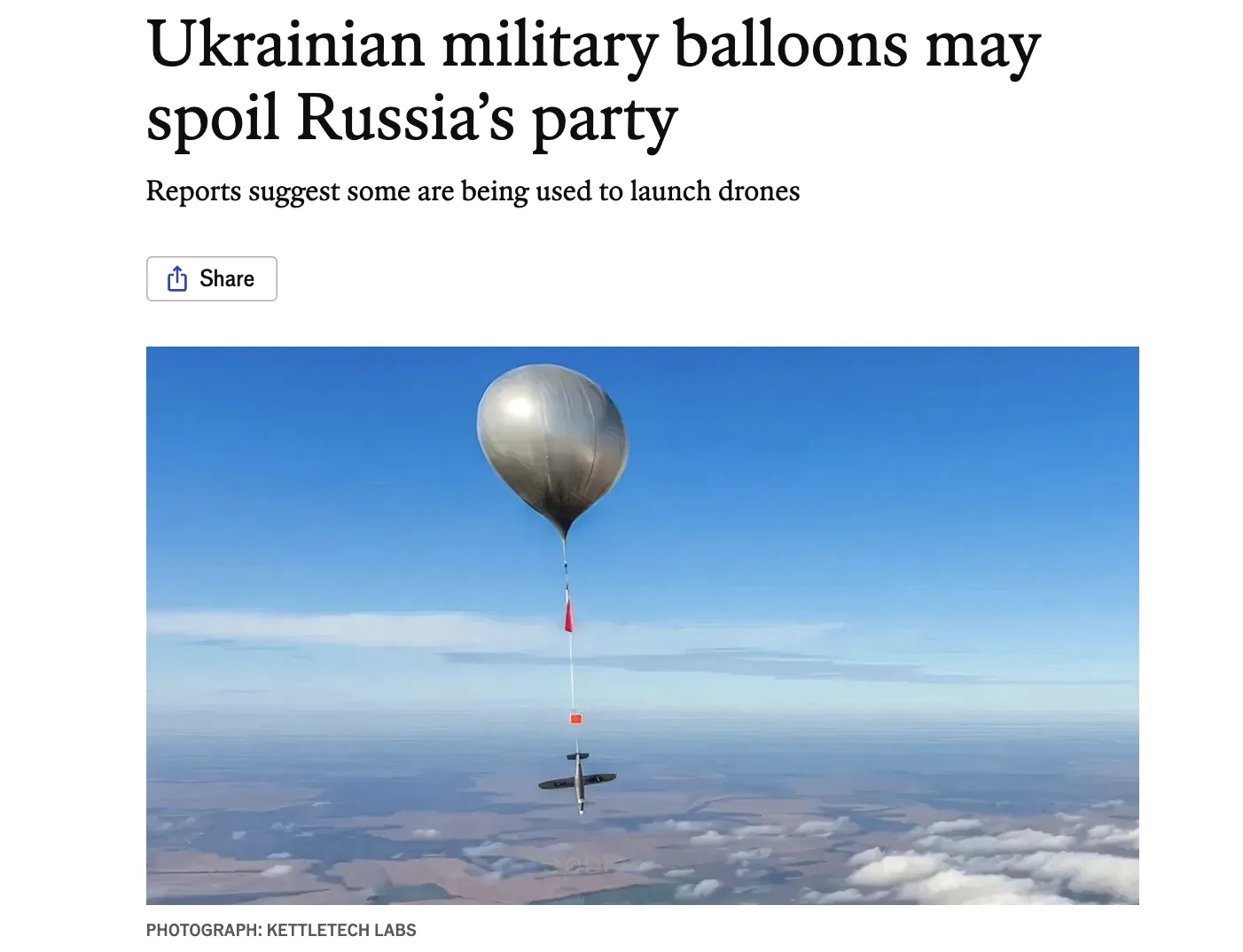
On August 27, reports emerged of Ukraine’s new tactic involving the use of balloons to expand the capabilities of drones. This technology could enable Ukrainian drones to travel significantly greater distances and strike targets deep inside Russia.
Balloons have been used in warfare for over two centuries. Initially, they were used for observation, and later as aerial barriers and reconnaissance tools. Ukraine, however, is trying to find a new use for them.
According to reports, Ukraine has launched more than 1,000 balloons into Russian territory since the fall. They can perform various tasks: drop small munitions, force Russian air defenses to waste resources on false targets, and provide radio communication with drones.
The most interesting application is the use of balloons as a kind of aerial “taxi” for drones.
A balloon can lift a drone to a significant altitude and carry it part of the way using the wind. After that, the drone can be released in the desired area. At altitudes of up to 18 kilometers, it can glide a considerable distance before turning on its engines.
The Ukrainian military has likely been working on this technology for over a year. In March 2025, a photo emerged of a drone suspended from a Ukrainian-made balloon.
In September, Russian Telegram channels and officials reported a large number of balloons that were spotted roughly at the same time as drone attacks deep behind Russian lines.
And in May, the Ukrainian military reportedly used a balloon to transport an American Hornet drone. The drone allegedly traveled about 42 kilometers on the balloon before being released at an altitude of approximately 8 kilometers.
This helps conserve battery power. According to the data provided, during transport, the drone used only about 5% of its battery power to run its electronics. Thus, almost the entire charge remained for carrying out its primary mission.
It is noted that the Hornet’s typical flight range from a ground launch is about 150 kilometers. Using a balloon could potentially double this range.
For now, the technology is designed primarily for lightweight drones. However, using a balloon as an airborne communications relay could open up additional possibilities even for aircraft that are not capable of performing missions completely autonomously.
Russia is also experimenting with balloons, though weather plays a significant role here. Wind direction can significantly affect where the balloon ends up.
Source: The Economist
Since the start of the day, 189 combat engagements have been recorded on the front lines. Russian troops deployed 7,192 drones and dropped 197 guided aerial bombs. The occupiers are attacking most actively in the Pokrovsk and Kostyantynivka sectors.
The General Staff is discussing a change to the mobilization age: who this might affect.
Russia’s Permanent Representative to the UN, Vasily Nebenzya, stated that the Kremlin currently has no plans to announce a mobilization after the fall elections. At the same time, he called for waiting until the end of the electoral process, hinting that the situation could change.
In Russia, authorities plan to impose fines for failure to comply with decisions made by regional leaders and operational headquarters regarding mobilization and meeting the army’s needs. The Russian government has submitted a corresponding bill to the State Duma for consideration.
The General Staff confirmed a strike on the Novokuybyshevsk oil refinery in Russia.




