
Juice spacecraft changed course by 20° during Earth flyby — ScienceDaily
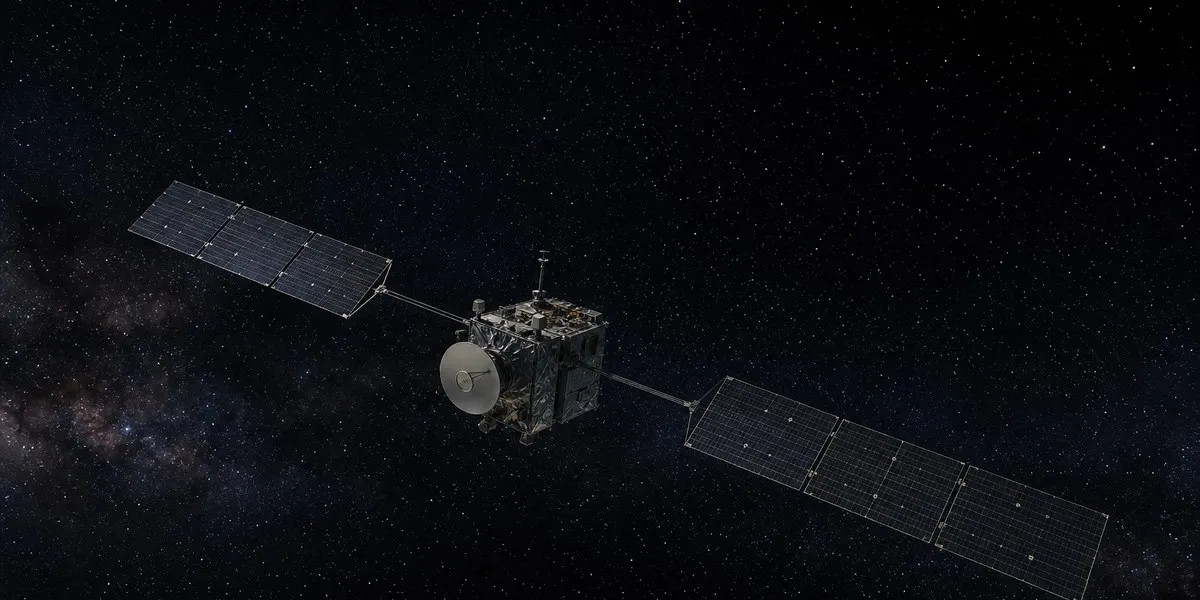
The European Space Agency’s Juice spacecraft flew close to Earth on September 28, using the planet’s gravity to alter its trajectory on the way to Jupiter. The maneuver changed the spacecraft’s direction by 20° and increased its speed by 3.5 km/s, ScienceDaily reports.
Flyby over the Indian Ocean
Juice made its closest approach to Earth at 13:45 Central European Summer Time, or 11:45 UTC. At that moment, the spacecraft passed at an altitude of 8,640 km above the Indian Ocean and took a series of images using its onboard monitoring cameras.
During the four weeks before the gravity-assist maneuver, specialists carried out only one small course correction out of six planned opportunities. ESA said that precise planning made it possible to use only a small portion of the fuel reserved for this flyby. This will leave more resources for observations of Jupiter and its icy moons.
More current news is available on the UA.News Telegram channel Telegram.
Testing scientific instruments
The flyby also provided an opportunity to test and calibrate Juice’s 10 scientific instruments, using Earth as a real planetary object. This was the third such opportunity since the mission began: the spacecraft previously conducted a lunar-Earth gravity-assist maneuver in 2024 and observed comet 3I/ATLAS in 2025.
For several days, Juice also traveled through Earth’s magnetotail, the part of the planet’s magnetic field that extends away from the Sun. The spacecraft measured magnetic fields and charged particles, while the European-Chinese Smile mission observed auroras and conducted measurements closer to Earth. Scientists expect to release images and spectra in the coming weeks, including highly detailed images of Earth and the Moon from the JANUS camera.
Route to Jupiter
In January 2029, Juice will return to Earth for its third and final flyby, which will place it on its final trajectory to Jupiter. The spacecraft is scheduled to arrive at the planet in 2031. The mission is then expected to conduct 35 flybys of Ganymede, Callisto and Europa before later entering orbit around Ganymede.




