
Which objects have approached the Sun closer than Mercury — Live Science
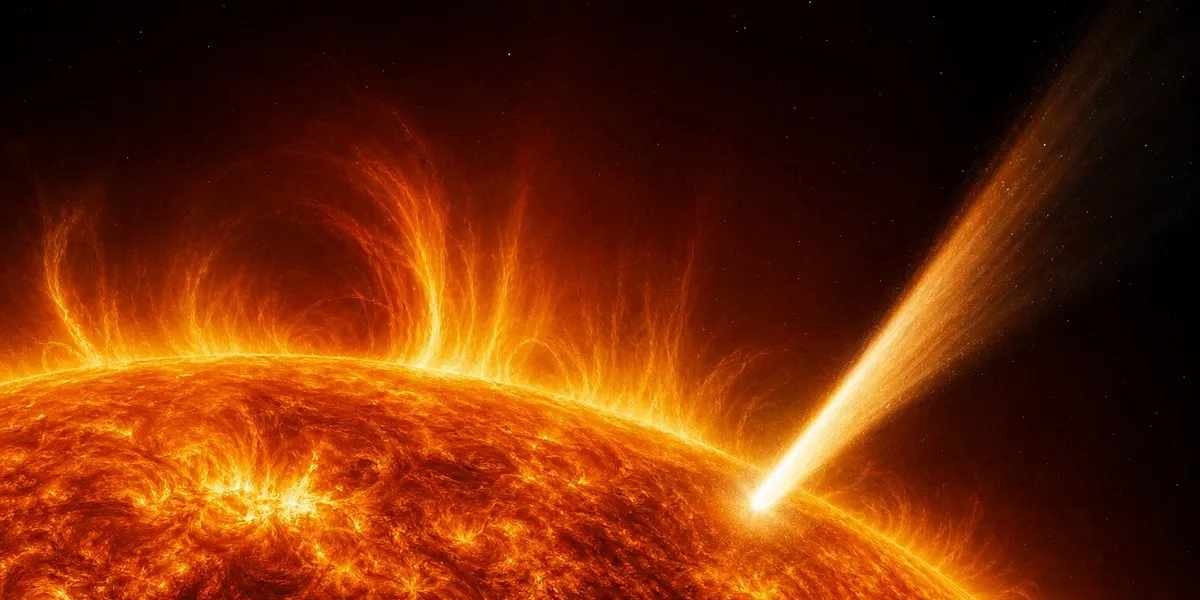
The closest to the Sun among recorded objects that were not destroyed in the star was the Great Southern Comet of 1887. It passed at a distance of 718,070 km from the center of the Sun, Live Science reports. For comparison, at perihelion Mercury approaches the Sun to within 47 million km.
Asteroids and a spacecraft
Some asteroids whose orbits cross Mercury's orbit come much closer to the Sun than the planet does. According to a search of NASA's small-body database, the current record holder among known asteroids is the 141-meter-long 2024 YL3. Its perihelion is 10.3 million km from the center of the Sun.
Astronomer Scott Sheppard of Carnegie Science explained that such asteroids have highly elongated orbits and were likely moved from the main asteroid belt toward the Sun. According to him, their orbits are dynamically unstable: within several million years, they may collide with the Sun or a planet, or be ejected from the Solar System.
The NASA Parker Solar Probe spacecraft, launched in 2018 to study the solar corona, flew even closer to the star. During the final three orbits of its primary mission, its perihelion was 7.3 million km from the center of the Sun. The spacecraft flew through the corona and was protected from extreme heating by a carbon-foam shield.
More current news is available on the UA.News Telegram channel Telegram.
Models also allow for the existence of vulcanoids—hypothetical asteroids on circular orbits inside Mercury's orbit. They could potentially approach the Sun even more closely, but such bodies have not yet been detected: a 2013 study found no traces of them.
Comets near the Sun
Comets approaching the Sun can pass within 2.39 million km of its center. Small bodies sometimes break apart due to uneven heating during rotation, while large ones can be destroyed by the Sun's powerful gravity. At the same time, some such comets survive the close approach.
Potentially, the closest could be so-called sun-diving comets, whose trajectory crosses the visible surface of the Sun—the photosphere. Their perihelion would have to be smaller than the Sun's radius, meaning less than 695,630 km from the center of the star. No such comets have been recorded so far; after plunging into the Sun, they should be destroyed.




