
The Kremlin Persecutes Opponents Not Only in Russia — UN Report
Russian authorities are using national security laws to persecute journalists, human rights defenders, anti-war activists, and other critics of the Kremlin. Moreover, this pressure is not limited to Russian territory: people abroad can be placed on wanted lists, subject to extradition requests, and their relatives can face repercussions.
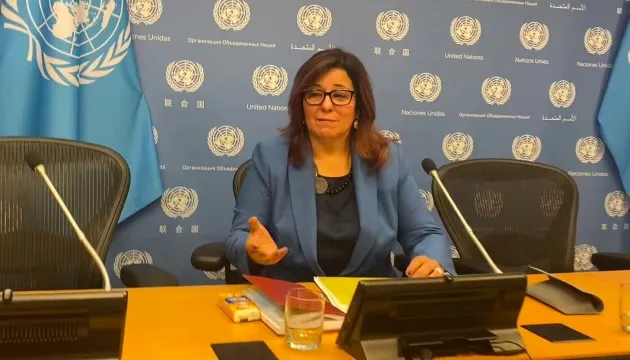
Russian authorities are increasingly portraying the defense of human rights as a threat to the state. According to Mariana Katsarova, journalists, lawyers, human rights defenders, representatives of indigenous peoples, the LGBT community, and anti-war activists are accused of treason and labeled enemies of the state. Katsarova emphasizes that the war against Ukraine and repression within Russia are closely linked. The authorities are using the war as a pretext to tighten control over society, and the persecution of critics helps eliminate those who openly oppose their policies. “Repression within the country has removed the constraints on aggression abroad. Now the war justifies intensified repression at home. Repression at home and aggression abroad are part of a single policy,” the Special Rapporteur stated.
According to data cited in the report, as of September 2026, 4,968 people in Russia had faced criminal prosecution for political reasons. Of these, 2,178 were in custody. At the same time, the average prison terms have increased: while in 2021 they were less than seven years, they now reach approximately 11 years. The number of cases involving treason and espionage is also rising. In 2025, 468 convictions were handed down in such cases—30% more than the previous year. And nearly 22,000 people have already been added to Russia’s registry of “terrorists and extremists.”
Organizations that document human rights violations are also coming under pressure. Russia’s Supreme Court designated the human rights center “Memorial,” a Nobel Peace Prize laureate, as an extremist organization. OVD-Info—a project that monitors political persecution in Russia—has also been added to this list.
The Kremlin is persecuting opponents outside Russia
The report devotes special attention to transnational repression—the persecution of individuals abroad by their country of origin. In Russia’s case, this involves pressure on journalists, human rights defenders, opposition figures, and anti-war activists who have left the country. According to Katsarova, the Russian authorities use more than just threats and surveillance to achieve this. Among the tools used are in absentia convictions, extradition requests, international wanted notices, and placing individuals on “terrorist and extremist” lists.
The number of in absentia convictions in Russia has risen sharply. While there were four in 2022, by 2025 there were already 157. The use of Interpol mechanisms is a particular cause for concern. Russian authorities can issue search requests or seek the extradition of individuals they accuse of crimes. If such requests are politically motivated, they can create serious problems for those trying to live abroad.
The consequences can extend far beyond court cases. Information from Russian lists ends up in databases used by foreign banks and financial institutions to screen clients. As a result, people may face additional screening or restrictions on financial transactions. Katsarova also drew attention to legislation that increases pressure on Russians living abroad who criticize the government. In her view, such rules limit people’s ability to participate in public life. At the same time, their relatives who remain in Russia may also face persecution.
Even children are under pressure
Another section of the report is devoted to the militarization of children in Russia. According to data cited by Katsarova, the proportion of class time devoted to basic military training in Russian schools has increased. Since September 2026, it has reportedly risen from approximately 20% to 50%. In addition, nearly 1,100 children have been added to the Russian registry of “terrorists and extremists.” Most of them were added to the list after Russia’s full-scale invasion of Ukraine began in February 2022.
In Russia, criminal liability for a number of terrorist-related crimes begins at age 14. This means that minors can also find themselves at the center of criminal cases related to security and extremism.
The UN calls for holding the perpetrators accountable
Katsarova stated that torture and ill-treatment of prisoners in Russia remain a widespread and systemic problem. She also reported that since 2022, at least 55 political prisoners have died in places of detention. Another issue the rapporteur highlighted was Russia’s withdrawal from the European Convention for the Prevention of Torture. According to data cited in the report, this withdrawal is set to take effect on November 1, 2026.
Katsarova called on the international community not to wait for political changes in Moscow, but to begin working immediately to hold those responsible accountable. “Holding perpetrators accountable cannot wait for a change of power in Moscow,” she emphasized. Among the rapporteur’s recommendations are preserving evidence of violations for future trials, applying the principle of universal jurisdiction, and imposing sanctions against officials involved in the persecution.
She also called on states to carefully review Russia’s requests for arrest warrants and extradition and, if political motives are present, to refuse to comply with them. According to Katsarova, this is necessary to ensure that people who have fled persecution do not find themselves under threat again. Mariana Katsarova’s report was reviewed as part of the work of the UN Human Rights Council. In it, Russia’s transnational repression is described as a problem that affects not only the rights of individuals but also the security of the states where they seek protection. This was stated by Mariana Katsarova, the UN Special Rapporteur on the situation of human rights in Russia, while presenting the report to the UN General Assembly.
In its report, the UN General Assembly’s Independent International Commission of Inquiry on Crimes Committed During the War in Ukraine accused Russian forces of crimes against humanity due to systematic attacks on the energy sector, and also classified the recruitment of foreign citizens into the Russian Armed Forces as human trafficking.
The UN Independent International Commission concluded that Russia’s systematic attacks on Ukraine’s energy infrastructure constitute war crimes and crimes against humanity.




