
Kombu harvesting continues on Japan’s Rishiri Island despite population decline — The Japan Times
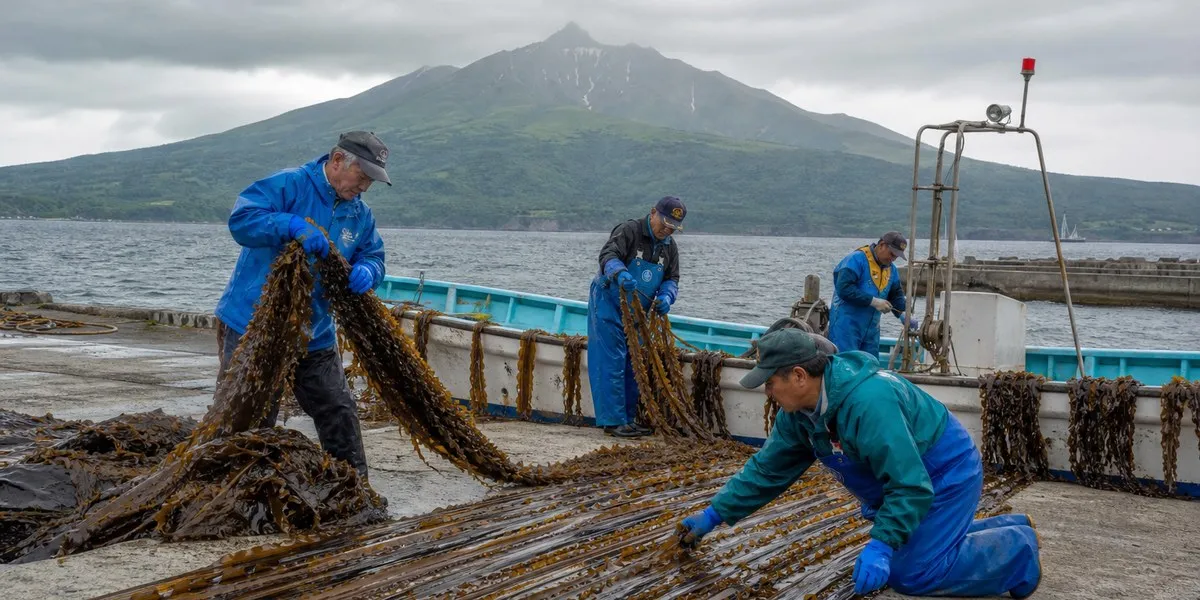
On Japan’s Rishiri Island, off the northern coast of Hokkaido, fishers continue to cultivate and harvest valuable kombu seaweed, although the island’s population has declined to about 3,800 residents and the number of fishers has decreased significantly. As The Japan Times reports, the harvest drying day is crucial to the industry: after kombu is unloaded, it must be completely dried within several hours in stable sunny and dry weather.
At the end of July, due to prolonged rain and cloud cover, crews on the island began work only at 5:30 a.m., an unusually late start to a kombu harvesting day. Fisher Zenichi Kosaka said weather forecasts have improved thanks to artificial intelligence, but the 1,721-meter Rishiri volcano still creates unpredictable weather conditions. Moisture from the ocean rises along the mountain’s slopes, cools and condenses, affecting precipitation. According to Kosaka, an unsuccessful drying day can mean the loss of a day’s catch worth more than 3 million yen.
Kombu for Japanese cuisine
Rishiri kombu has a denser and firmer texture than other varieties. It is used to make dashi, a broth distinguished by a cleaner taste and color and an important ingredient in establishments serving Japanese kaiseki haute cuisine.
Fourth-generation fisher Makoto Kannari links the qualities of local kombu to the island’s geography. According to him, meltwater from the mountain filters underground for more than 30 years, becomes enriched with nutrients and eventually emerges on the seabed, creating favorable conditions for the seaweed.
More current news is available on the UA.News Telegram channel Telegram.
Lack of successors and changes in the sea
Since the end of the 19th century, Rishiri developed through herring fishing, and in the 1950s the island’s population exceeded 20,000 people. After herring stocks declined, local fishing shifted to kombu and sea urchins. In the 1980s, kombu cultivation was introduced on the island to stabilize harvest volumes and reduce dependence on wild seaweed.
The full cultivation cycle takes about two years. In autumn, seaweed is seeded in nurseries, after which young plants are transferred to marine farms, where they grow for about a year. The strongest specimens are attached to ropes for further growth during the second year, and harvesting lasts from June through the end of July.
At the same time, according to the Oshidomari fisheries cooperative, its number of fishers has fallen by nearly 70% since 1989, from 493 to 155. A nationwide program offering a three-year internship operates to attract new workers. Students also come for seasonal work, and some return to the island in subsequent years.
Fishers also speak of changing marine conditions due to rising water temperatures. A warmer sea accelerates the appearance of hydroids on the surface of kombu in late summer, reducing the seaweed’s quality. These changes also affect sea urchin catches: fisher Shuichi Takagi said that in two hours of work he now gets about 500 grams of catch, whereas two years ago it was four to five kilograms.


