
Denisovan remains dating back 134,000 to 167,000 years found in China
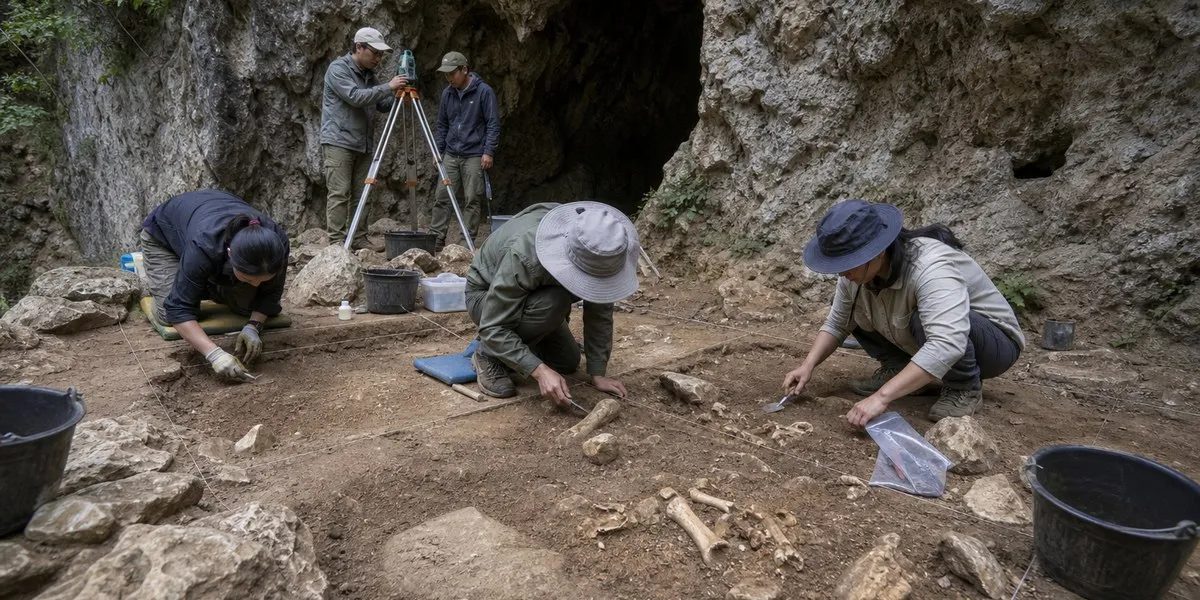
Denisovan remains dating back 134,000 to 167,000 years have been discovered in Bianfu Cave in Yunnan Province in southwestern China. Two studies published in the journal Nature on September 9 also describe the stone tools and way of life of this group of archaic humans, the South China Morning Post reports.
Five identified remains
The cave is located in the Dali Bai Autonomous Prefecture at an altitude of 2,370 meters above sea level, on the southeastern edge of the Tibetan Plateau. In 2019, workers who had begun ecological restoration of a quarry discovered bones and stone tools. Systematic excavations began in Bianfu Cave that same year and later yielded thousands of fossil remains.
A team led by Fu Qiaomei of the Institute of Vertebrate Paleontology and Paleoanthropology at the Chinese Academy of Sciences examined more than 60,000 bone fragments. Using ancient proteins, the researchers identified three Denisovan bone fragments—two parietal bones and a fragment of the proximal radius—as well as two teeth.
The authors of the first paper called Bianfu the site with the largest number of Denisovan remains outside Denisova Cave in Siberia. In their view, the finds fill an important geographic gap in data on the distribution of this group and refine understanding of its evolutionary history.
More current news is available on the UA.News Telegram channel Telegram.
Hunting in a coniferous forest-steppe
The second study, led by Chen Fahu of the Institute of Tibetan Plateau Research at the Chinese Academy of Sciences, analyzed animal remains, pollen and more than 1,300 stone artifacts. These data indicate that the cave's inhabitants lived in an environment dominated by coniferous trees.
During the Ice Age, the relatively warm climate and coniferous forest-steppe landscapes around the cave likely provided stable access to mammals. The study's authors described the Yunnan-Guizhou Plateau of that time as a favorable place for hunting.
The artifacts indicate that Denisovans hunted medium-sized and large animals, including deer. They quickly chipped stones into the required shape and made extensive use of unmodified animal bones. According to a Nature News article, the findings also indicate that Denisovans may have occupied the cave for at least 30,000 years, and possibly for up to 120,000 years.




