
Russian airlines are buying aircraft engines in a way that circumvents sanctions — Bloomberg
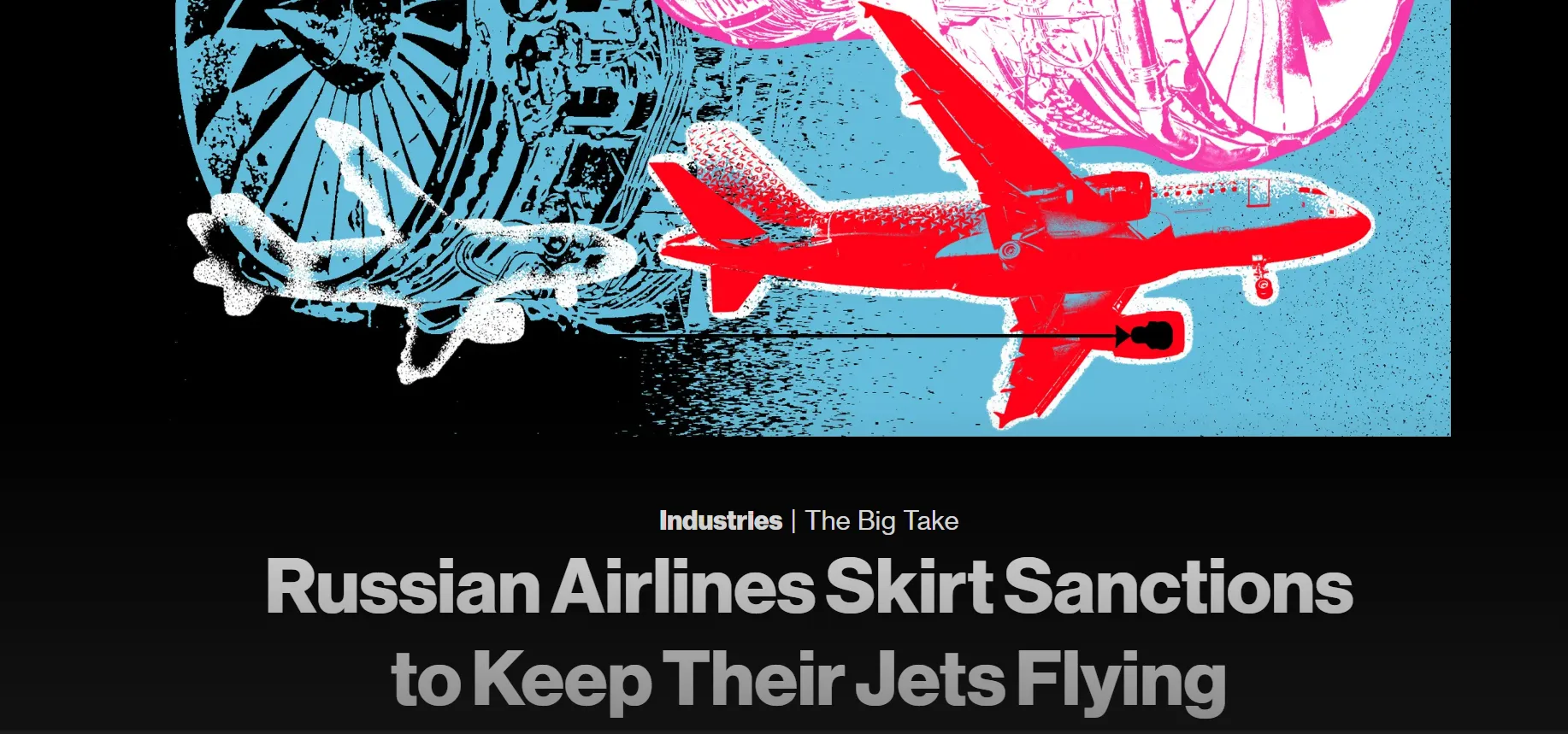
Russian airlines continue to receive engines and spare parts for Boeing and Airbus aircraft despite sweeping Western sanctions.
Bloomberg reports this, citing customs documentation and participants in the aviation spare parts market.
To do this, they use intermediaries in India, Turkey, the UAE, and Kazakhstan, and the shipments themselves go through complex resale schemes.
This approach allows the aggressor to keep its civil aviation operational.
Journalists cited a specific example of successfully circumventing current restrictions. The Russian airline Rossiya Airlines received two CFM engines for an Airbus A320.
Initially, this expensive equipment was officially purchased in Canada. It was subsequently resold via Luxembourg to an Indian company, which then shipped the aircraft components to the Russian Federation.
The initial official purchase contracts explicitly prohibited re-export to Russia. However, foreign intermediaries knowingly carried out this illegal resale anyway.
After the investigation results were made public, some foreign companies hastily announced that they were ceasing all cooperation with Russian clients.
In total, journalists identified at least 30 firms that supplied scarce components to the aggressor country last year.
India, Turkey, the UAE, Kazakhstan, Kyrgyzstan, and China became the main logistics hubs for circumventing international sanctions.
Russian importers purchase scarce spare parts from the U.S. or the EU and then resell them to domestic airlines at a substantial markup.
Supplies include not only engines but also landing gear, electronics, auxiliary power units, and other critical components.
Immediately after the start of the full-scale war, international analysts predicted a rapid collapse of the occupiers’ aviation industry due to a shortage of parts and the lack of official technical support from manufacturers.
However, the Russians managed to avoid the worst-case scenario thanks to gray market imports. According to the latest data from Cirium analysts, over 460 Boeing and Airbus aircraft are still successfully in operation in Russia.
The number of civilian flights has almost completely returned to 2021 levels, and the domestic transport market is showing growth.
The aggressor country is also actively developing its own maintenance capabilities for foreign aircraft. In particular, S7 Technics significantly expanded its engine repair facility for Boeing 737 and Airbus A320 aircraft in 2025.
However, independent experts are convinced that such a system is not a reliable long-term solution. Russian technicians are already dismantling some of the aircraft for spare parts to keep other planes operational.
The most critical issues currently arise with the maintenance of newer Airbus A320neo models.
Zelenskyy imposed sanctions against Russian commanders and the shadow fleet
Ukraine hopes that the European Union will open all six negotiation clusters regarding the country’s accession this year, and also anticipates the possibility of closing at least one of them by the end of the year.
Ukraine may temporarily forgo some of the benefits of EU membership to speed up the accession process. Taras Kachka noted that such a step would help the country integrate into the EU more quickly.


