
A Mediterranean tsunami could occur within the next 30 years
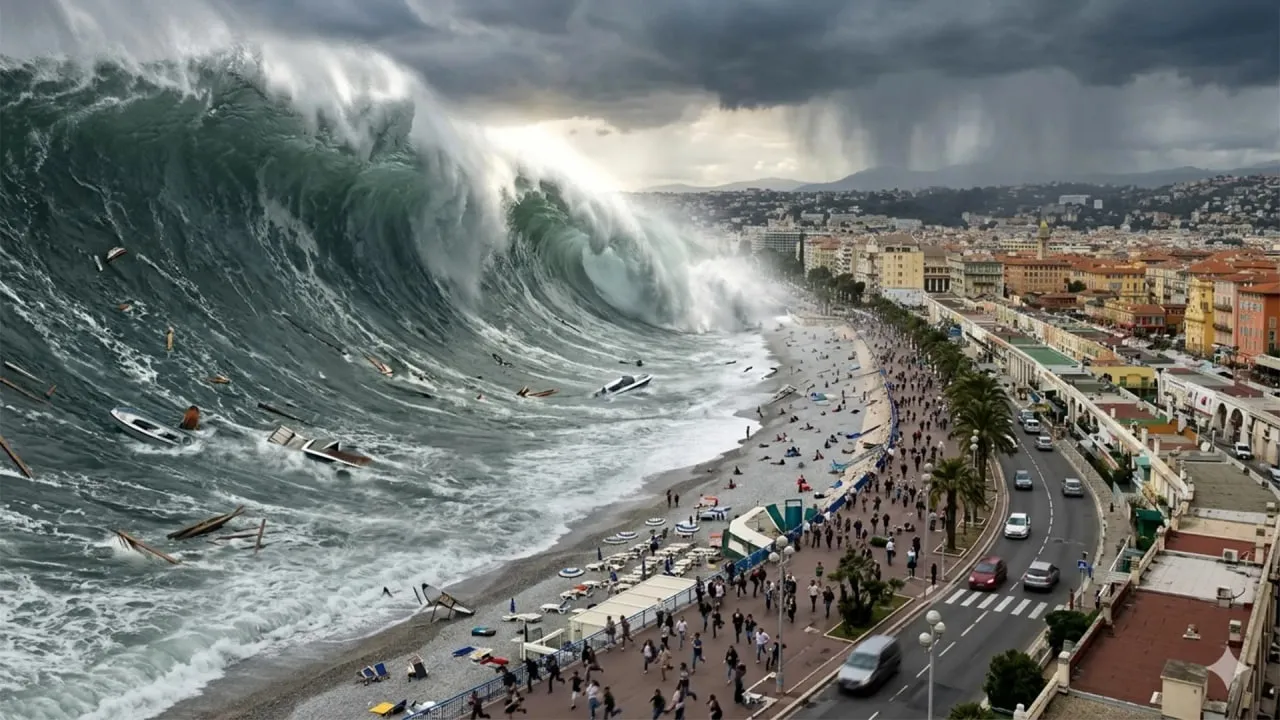
A tsunami with waves exceeding 1 meter is almost certain to occur in the Mediterranean Sea over the next 30 years. On France’s Côte d’Azur, under certain scenarios, the wave could reach the shore in less than 10 minutes.
UNESCO warns that the risk of a tsunami in the Mediterranean Sea is significantly higher than it might seem. In 2022, the organization estimated the probability of a wave exceeding 1 meter in the Mediterranean basin over the next 30 years to be nearly 100%. This does not mean that a tsunami will necessarily strike the French Riviera or occur in the near future.
The danger comes from earthquakes along active faults in the Ligurian Sea and off the coast of North Africa. Underwater landslides could be another source. Local landslides are particularly dangerous because they can trigger a wave very quickly, sometimes without a strong earthquake that people would be able to feel.
A tsunami does not necessarily look like a giant wall of water. The sea may suddenly recede or, conversely, rise rapidly. Several waves then roll onto the shore, and the largest one may not be the first. Strong currents, which can last for hours, are also dangerous.
The French coast has already experienced such events. On February 23, 1887, an earthquake in the Ligurian Sea with a magnitude of approximately 6.5–6.8 triggered a tsunami. In Antibes and Cannes, the sea receded by about 1 meter, and subsequently, waves about 2 meters high swept over the beaches.
On October 16, 1979, a section of the construction site for a new port collapsed into the sea near Nice. The landslide triggered a tsunami that claimed the lives of eight people. The effects of the incident were recorded in Nice, Antibes, and Cannes, where the water rose to as high as 3.5 meters in some places and advanced 150 meters inland.
Another example occurred following an earthquake near Boumerdes, Algeria, on May 21, 2003. Approximately 75 minutes later, the waves reached the Côte d’Azur. Eight marinas recorded a sharp drop in sea level of 0.5–1.5 meters, strong currents, and damage to boats.
In France, the national tsunami warning center, Cenalt, has been operational since 2012. It monitors earthquakes that could trigger a tsunami and relays information to emergency services. The FR-Alert system is also used to alert the public.
However, there may not be enough time to react. If the source of the tsunami is located near North Africa, the wave could reach the Côte d’Azur in less than 90 minutes. For an earthquake in the Ligurian Sea, this time would be significantly shorter. In some models, the first waves could reach the coast in less than 10 minutes, whereas the French center is designed to transmit an initial alert to authorities within 15 minutes of a potentially dangerous earthquake.
Therefore, in Nice and neighboring areas, the focus is not only on warning systems but also on evacuation. Experts have mapped out routes to safe areas, taking into account terrain, obstacles, people’s walking speeds, and potential traffic congestion. The evacuation plans include nearly 100 shelters.
To plan for evacuation along the French coast, a zone has been defined that generally covers areas up to 5 meters above sea level and within 200 meters of the shoreline. Near river mouths, the zone can extend up to 500 meters. These are boundaries for evacuation planning, not a forecast of the future wave height.
In June 2026, the Nice-Côte d’Azur metropolitan area received the international “Tsunami Ready” designation from UNESCO. The program requires compliance with 12 criteria, including risk assessment, evacuation maps, public preparedness, a response plan, and round-the-clock channels for receiving and disseminating official warnings.
Preparedness efforts also include informational signs, educational sessions, evacuation drills, and collaboration with schools. Residents and tourists can familiarize themselves in advance with maps of hazard zones and evacuation routes.
In the event of an earthquake or an official warning, people on the coast are advised not to wait for confirmation of the danger but to move inland on foot and head for higher ground along designated routes. A sudden retreat of the sea can also be a natural sign of a tsunami, although it does not occur before every such event.
After the first wave, do not return to the coast until authorities declare it safe. Subsequent waves may be stronger, and dangerous currents can persist for several hours.
ScienceDaily reports on this.
European cities have begun preparing for the new threat of a tsunami.
As a reminder, an earthquake with a magnitude of 2.8 was recorded near Lviv.
The death toll from the earthquakes in Venezuela has exceeded 5,000.




