
Trump floated the idea of manufacturing Patriot missiles in Ukraine
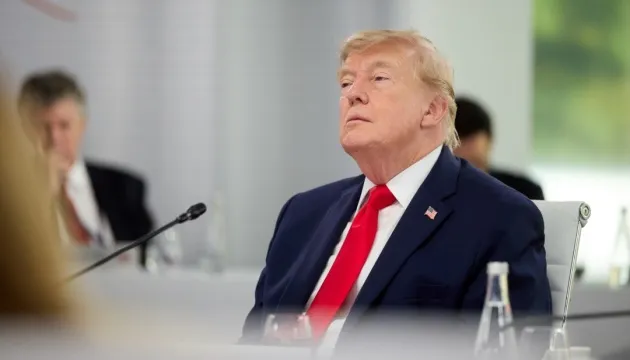
U.S. President Donald Trump shared an article from The Washington Post on his social media platform, Truth Social, in which the author proposes allowing Ukraine to manufacture Patriot interceptor missiles. The article argues that such a decision could simultaneously help Ukraine and ease the burden on American and European arms manufacturers.
On Friday, Donald Trump shared a Washington Post op-ed on Truth Social proposing that Ukraine be allowed to independently manufacture missiles for Patriot systems. The repost itself does not mean that the U.S. has already made such a decision. Trump merely shared an article in which the author urges him to allow Ukraine to manufacture the interceptors. The column, titled “How Trump Can Help Ukraine Produce Its Own Patriot Missiles,” was written by Washington Post columnist Mark Thiessen.
The U.S. Is Running Short of Patriot Missiles
The author explains his proposal by pointing to the problem with U.S. interceptor stockpiles. The U.S. must simultaneously support Ukraine, meet its own needs, and replenish its missile stockpiles. The war with Iran is putting additional pressure on the U.S. defense industry. Because of this, according to Thissen, Washington should look for ways to increase the production of Patriot interceptors outside the United States.
One option is to allow Ukraine to manufacture these missiles under a U.S. license. The author notes that during the July NATO summit in Ankara, Trump had already discussed the possibility of such production with Ukrainian President Volodymyr Zelenskyy. However, according to Tissen, no concrete decision was made following that statement.
Why the U.S. May Be Reluctant to Transfer Technology
The author cites Washington’s concerns about transferring advanced military technology to Ukraine as one reason for the delay. This primarily refers to the risk that certain technological solutions could fall into Russia’s hands.
Therefore, Tissen suggests that it is not necessary to transfer the most advanced Patriot technologies to Ukraine. Instead, he believes it would be possible to authorize the production of simpler or older versions of the interceptors. In his view, this would allow for an increase in the number of missiles without transferring the most sensitive American technologies to Ukraine.
Which missiles are being proposed for production?
One option mentioned by the author is the PAC-3 ACE. This is a variant of the interceptor that Lockheed Martin developed as a lower-cost option for the European market. According to Thissen, it offers about 70% of the accuracy of the more modern version but costs less than half the price. Another option is joint licensed production in Ukraine of the older Patriot PAC-2 GEM-T variant.
Tissen notes that this year, Raytheon was awarded a $3.7 billion contract to manufacture these interceptors for Ukraine at a new facility in Germany. In the author’s view, part of the production could be moved directly to Ukraine. This would make it possible to increase the total number of missiles while not placing the entire burden of production on American companies.
Ukraine could produce missiles not only for itself
Thissen proposes another option. The U.S. could stipulate in the licensing agreement that a portion of the interceptors produced in Ukraine would be transferred to other NATO countries. In this way, Ukrainian production could be used not only to replenish the Ukrainian Armed Forces’ stockpiles. Some of the missiles could help the U.S.’s European allies replenish their own stockpiles after the weapons are transferred to Ukraine.
In that case, Ukraine’s production capacity would become part of a broader NATO defense production system. For the U.S., this would mean the ability to increase the total number of interceptors produced without relying solely on its own factories.
Thissen also calls for providing Ukraine with missiles from South Korea
Separately, the author suggests that Trump approach South Korea regarding the transfer of M-SAM II anti-aircraft missiles to Ukraine. According to Thissen, South Korea is already supplying such systems to the United Arab Emirates to protect against Iranian missile attacks. At the same time, Seoul cites legal restrictions on the sale of weapons to countries at war.
The author believes that Washington could try to persuade South Korea to change this position and transfer some of the systems to Ukraine. In his view, the M-SAM II could temporarily address part of Ukraine’s urgent need for air defense capabilities. This would also help ease the pressure on the U.S., which has limited Patriot stockpiles and must simultaneously address its own defense needs.
What Trump’s Repost Means
Trump’s sharing of this article does not in itself mean that Washington has already approved the production of Patriot systems in Ukraine. At this point, it is merely a proposal that the U.S. president decided to publicize via his social media account. At the same time, the topic of Patriot missile production in Ukraine has already been discussed at the highest levels. Therefore, Trump’s repost has drawn attention to an issue that had previously been raised during his talks with Zelenskyy.
If the U.S. does indeed allow Ukraine to manufacture certain variants of the interceptors under license, this could enhance Ukraine’s air defense capabilities while also helping allies replenish their missile stocks. For now, however, no final decision has been made regarding such production. This repost was published on his page on the social media platform Truth Social.
U.S. Special Envoys Steve Witkoff and Jared Kushner have traveled to Ukraine and Russia with a U.S. proposal to end the war. According to Donald Trump, they are tasked with determining whether an agreement can be reached to end the war between Kyiv and Moscow. The U.S. president believes there is a chance of success, although he acknowledges serious disagreements between Volodymyr Zelenskyy and Vladimir Putin.
U.S. President Donald Trump’s envoys, Steve Witkoff and Jared Kushner, are scheduled to arrive in Moscow on September 5 to attempt to resume negotiations on ending Russia’s war against Ukraine. At the same time, expectations for their visit are very low—according to Bloomberg, sources close to the Kremlin see no preconditions for a quick agreement. Moscow also believes that Vladimir Putin is ready to end the war only on terms favorable to Russia.


