
St. Petersburg has begun restricting gasoline sales
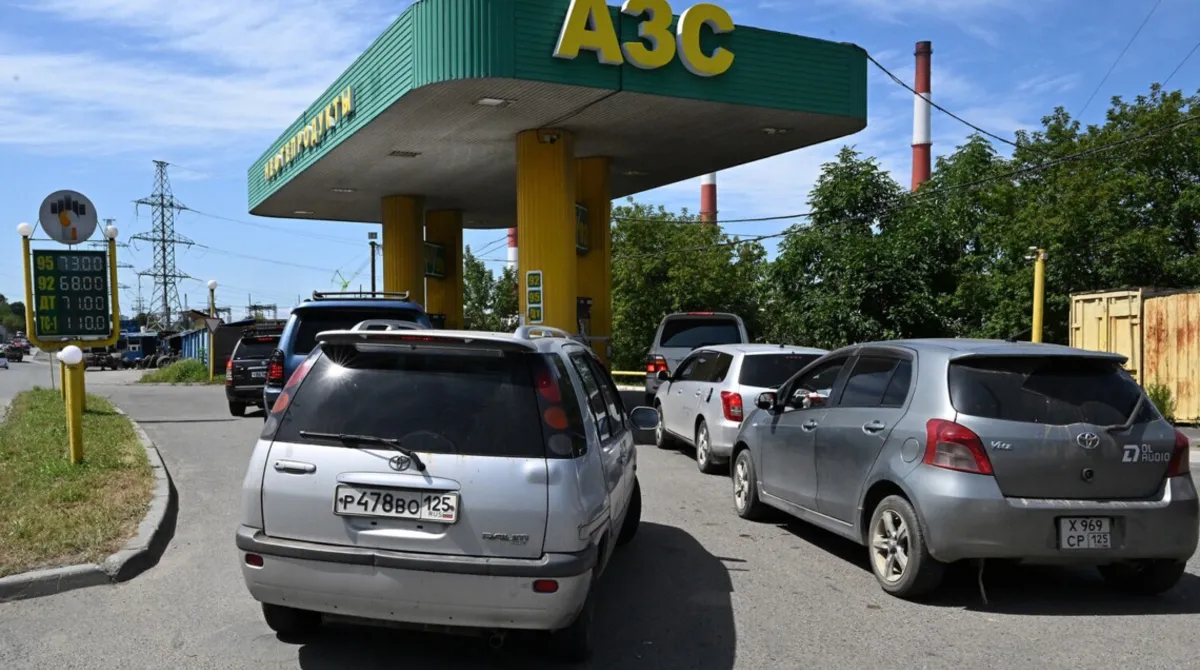
In St. Petersburg, several major Russian oil companies have limited gasoline sales at their gas stations. Specifically, Gazprom Neft has reinstated a limit of 60 liters per receipt, while Tatneft has set a limit of 50 liters for AI-92 and AI-95 gasoline. At some gas stations, drivers can no longer find AI-95, and the companies themselves acknowledge fuel shortages. Among the reasons cited are problems following Ukrainian strikes on Russian oil refineries.
Restrictions on the sale of automotive fuel have gone into effect at several gas station chains in St. Petersburg. Gazprom Neft has attracted the most attention, having reinstated a 60-liter limit per receipt. The company’s hotline confirmed that the restrictions are back in effect after having been lifted on August 4. Additionally, at this chain’s gas stations, drivers are allowed to fill a canister with no more than the contents of one such tank.
Another major chain, “Tatneft,” has imposed its own restrictions. There, customers can purchase a maximum of 50 liters of AI-92 or AI-95 per transaction. Formally, this does not constitute a complete ban on gasoline sales. Drivers can still fill up their cars, but it is no longer possible to buy large quantities of fuel in a single trip to a gas station. For ordinary drivers, the problem manifests itself in another way—some gas stations simply do not have the required gasoline in stock.
AI-95 Is Disappearing from Gas Stations
Data from the gas station chains themselves and specialized services confirm the fuel shortages. On Gazprom Neft’s map, many gas stations in St. Petersburg were out of AI-95 gasoline. The “GdeBENZ” service also reports fuel shortages at certain stations. Problems were noted, in particular, at Lukoil gas stations.
Drivers in St. Petersburg report a similar situation. One of them wrote in a local chat group: “Most gas stations only have [AI]-92.” Another driver confirmed that AI-95 is unavailable at a number of gas stations. In their posts, people complain that the problems are evident even at major oil companies.
The situation varies depending on the specific gas station. Some still have gasoline, while at others, drivers can only get AI-92. Therefore, it’s too early to say that fuel has completely disappeared throughout St. Petersburg.
Lukoil Acknowledges Fuel Shortages
Lukoil confirmed that some gas stations are experiencing supply problems. The company referred to them as “localized disruptions.” According to company representatives, the situation is linked, in particular, to the consequences of Ukrainian strikes on Russian oil refineries.
This is a significant problem for the fuel market. Refineries don’t just produce gasoline for local drivers. They supply fuel to entire regions, and damage to or shutdowns of individual facilities can affect supplies far beyond the site of the attack.
If part of the production capacity is offline or forced to reduce output, companies have to redistribute the available fuel among regions. As a result, shortages may occur at individual gas stations even when a nationwide shortage is not officially acknowledged.
Moscow Imposed Limits Before St. Petersburg
Gasoline shortages in St. Petersburg emerged after similar restrictions took effect in Moscow. The day before, Gazprom Neft had limited sales of gasoline and diesel fuel there. A maximum of 40 liters could be purchased per vehicle. Tatneft set different limits—50 liters of gasoline and 60 liters of diesel fuel.
At the same time, Moscow also faced shortages of certain types of gasoline. According to the data provided, AI-95 was available at only one gas station in the “Neftmagistral” network. AI-95, AI-92, and diesel fuel were found only at select Lukoil gas stations. This indicates that the shortages were not limited to a single chain.
Why the Gasoline Situation Matters for Russia
The Russian fuel market has recently come under additional pressure due to attacks on oil refining infrastructure. Ukraine regularly attacks facilities in Russia’s fuel and energy sector, seeking to reduce Russia’s ability to supply its military and generate revenue from the energy sector. For Russia itself, damage to oil refineries means more than just losses for individual enterprises. The country needs to maintain stable supplies of gasoline, diesel, and other petroleum products for millions of cars, trucks, agricultural machinery, and industry.
This situation becomes particularly acute toward the end of summer. During this period, demand for fuel traditionally rises due to increased travel and seasonal work. When production decreases at the same time and logistical problems arise, lines and rationing may occur at some gas stations. That is why oil companies try to control sales volumes to prevent tanks from running dry too quickly.
What Do These Limits Mean for Drivers?
For someone pulling into a gas station to fill up a standard passenger car, a limit of 50–60 liters may not pose a serious problem. Most passenger cars have fuel tanks of roughly this capacity or even smaller. However, the situation changes if a driver wants to buy fuel in bulk or fill up several vehicles. The restrictions may also be noticeable for people who use jerry cans.
That is why Gazprom Neft has separately imposed a limit on fuel sales into jerry cans. The company allows no more than one canister to be filled. These rules effectively make it more difficult for private buyers to stockpile gasoline. For oil companies, this is a way to stretch available supplies and reduce the risk of panic buying.
Is There Gasoline Throughout St. Petersburg?
So far, there is no reason to say that gasoline is completely unavailable in St. Petersburg. Fuel remains available at gas stations, but its availability depends on the specific station and the type of gasoline. According to reports, the biggest problems are with AI-95. Some gas stations have run out of it, while AI-92 is still available. At the same time, the introduction of limits by several major chains at once shows that the situation in the Russian fuel market has become quite serious. Previously, such restrictions might have seemed like a temporary measure by a single company, but now they are appearing simultaneously in several major cities.
So far, Russian companies have mainly spoken of local or isolated shortages. However, the spread of restrictions from Moscow to St. Petersburg indicates that residents of Russia’s two largest cities are already experiencing problems with the availability of certain types of fuel. Thus, while gasoline has not yet completely disappeared in St. Petersburg, drivers are already facing restrictions and shortages of AI-95. The reasons cited by the oil companies themselves are directly linked to strikes against Russia’s oil refining infrastructure.
In the temporarily occupied Crimea, fuel problems could escalate into a much more serious crisis. Due to logistical difficulties on the peninsula, prices have already begun to rise, lines are forming, and residents are increasingly stocking up on essential goods.
The shortage of automotive fuel, which was previously observed in the temporarily occupied Crimea, has begun to spread to the southern regions of the Russian Federation. Residents of the Krasnodar Krai and the Rostov Oblast are reporting shortages of gasoline and diesel fuel.


