
AI reconstructs video of blazar 3C 345 jet in the US
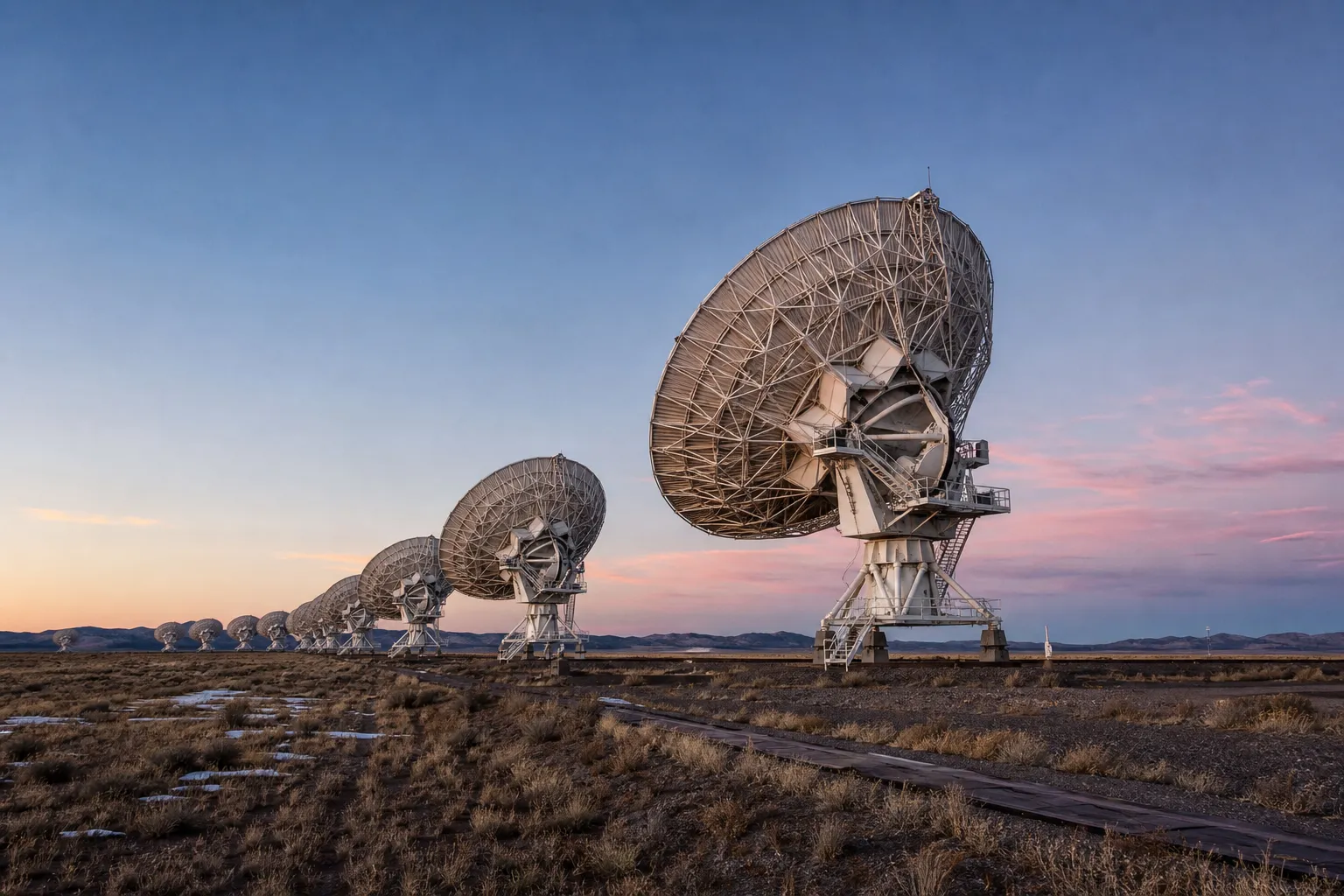
In the United States, astronomers created a highly detailed video of the jet of blazar 3C 345 based on 116 images obtained between 1995 and 2022. The data were collected using the Very Long Baseline Array (VLBA), a network of 10 radio telescopes in the United States. The clip compresses 27 years of observations into a few seconds and shows how the plasma stream changes and bends in space.
As Live Science reports, 3C 345 is located in the constellation Hercules. It is a blazar, a type of quasar associated with a supermassive black hole at the center of a distant galaxy. Such objects eject powerful jets of gas into the surrounding space, moving at nearly the speed of light and serving as sources of intense X-ray and gamma radiation.
A neural network combined decades of data
To reconstruct the video, the researchers used the Kine neural network. The algorithm processed more than a hundred images and achieved a resolution four times higher than that of each individual image. This made it possible to measure the plasma speed more accurately in different parts of the jet.
The VLBA produces two-dimensional images based on measurements between pairs of telescopes. At the same time, the limited number of antennas reduces the detail of the original data. Kine uses spatiotemporal relationships between observations made at different times to reproduce the evolution of an astronomical source with variable brightness.
More current news is available on the UA.News Telegram channel Telegram.
Unexpected plasma speeds
The researchers found that the brightest components of the jet had apparent speeds 10–13 times greater than the speed of light, while the surrounding gas had speeds of about 9–12 times the speed of light. These are projected speeds determined from observations.
The study's first author, California Institute of Technology postdoctoral researcher Marianna Foschi, noted that this result was unexpected. According to the common view, bright components are shock disturbances that move through plasma faster than the surrounding matter. According to her, the new results do not generally contradict this model, but call it into question for the specific source 3C 345.
The study on reconstructing videos of variable VLBI observations using neural fields was published in the journal Nature on August 26.


