
The Aral Sea dried up as a result of a large-scale Soviet experiment
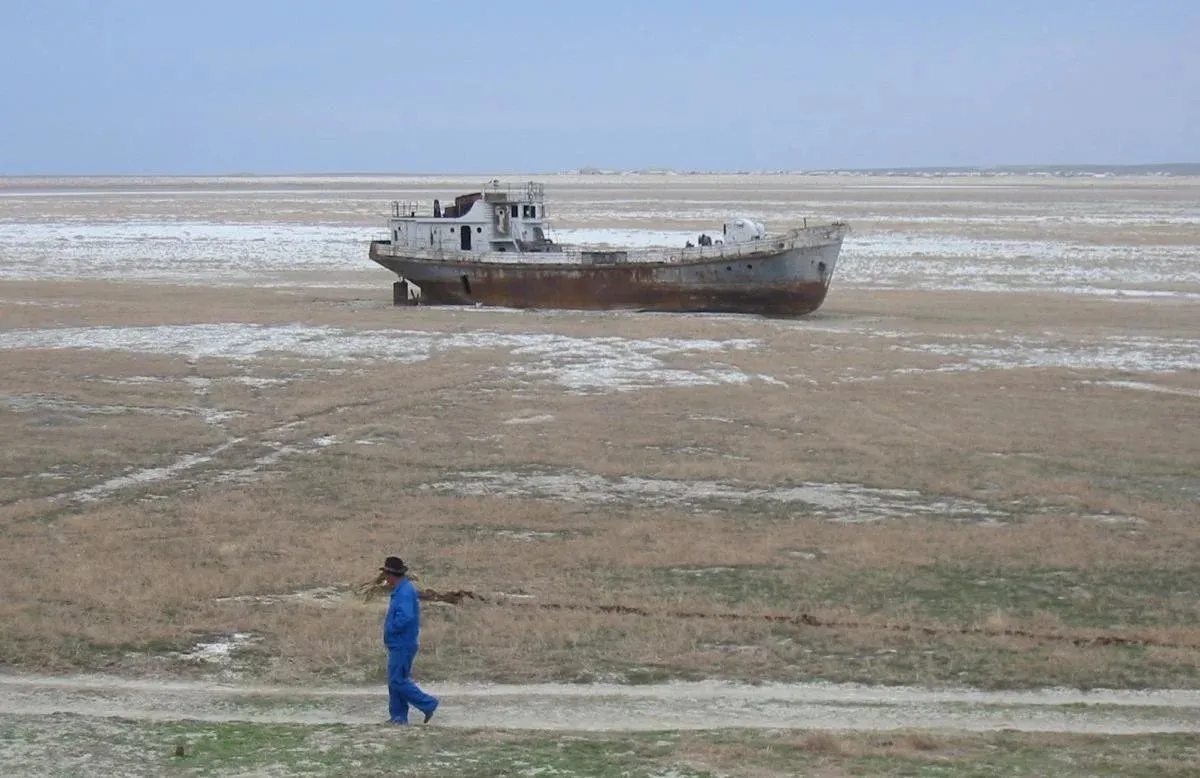
For decades, the Aral Sea lost water due to a large-scale Soviet irrigation system. The Amu Darya and Syr Darya rivers, which fed the lake, began to be diverted on a massive scale to irrigate fields, primarily for cotton cultivation. As a result, one of the world’s largest lakes turned into a vast dry expanse, and the consequences of this catastrophe are still being felt today.
As recently as the 1960s, the Aral Sea was the fourth-largest lake in the world by area. It was located between modern-day Kazakhstan and Uzbekistan and played a vital role for the entire region. Fishing enterprises operated on the lake, there were ports and canneries, and entire communities lived around it. But then the Soviet authorities decided to transform the arid lands of Central Asia into a vast agricultural region. They placed particular emphasis on cotton cultivation.
To this end, they began building a massive system of canals. Water from the region’s two main rivers—the Amu Darya and the Syr Darya—was diverted to the fields instead of flowing into the Aral Sea. It was these rivers that had provided the lake with its main inflow of water for centuries. As ScienceBlog reports, Soviet hydrologists understood even before the construction of the main canals that diverting water would have serious consequences for the sea. The article notes that experts anticipated a sharp drop in water levels. At the same time, planners hoped that the exposed seabed would eventually form a hard crust and that the salt would remain in place. This did not happen.
The sea continued to recede. The water became increasingly salty, and the fishing industry and businesses that depended on the body of water gradually declined. Along with the sea, the region’s familiar ecosystem also disappeared.
The sea receded by tens of kilometers
The problem turned out to be much more extensive than expected. According to NASA, the Aral Sea lost about 80% of its volume due to water being diverted for irrigation. By the 2000s, it had already split into separate bodies of water. By 2014, the eastern part of the South Aral Sea had completely dried up for the first time in modern history. Geographer Philip Miklin, who had studied the body of water for many years, noted that nothing like this had been observed in approximately 600 years.
Where there was once water, a desert landscape has emerged. It is called the Aralkum. NASA notes that this new desert covers an area of about 62,000 square kilometers. That is why photographs of old ships left stranded in the middle of the sand have become one of the most famous symbols of this environmental disaster. These vessels once operated in the waters of the Aral Sea, but now stand far from the shoreline.
The biggest problem turned out to be more than just the disappearance of the water
When the sea receded, a vast expanse of seabed was exposed. Left behind were salt, fertilizers, and chemicals that had been washing into the water for years along with runoff from agricultural lands. The wind began to carry this dust over long distances. NASA notes that the dust from the dried-up seabed contains salt deposits and residues of agricultural chemicals. As a result, it has become a problem for air and soil quality in the surrounding areas.
The problem has extended far beyond the Aral Sea itself. A ScienceBlog article notes that researcher Philip Miklin has documented the movement of salt hundreds and even nearly a thousand kilometers from the lake. Aksoltan Ataeva, Turkmenistan’s representative to the UN, once called the health issue one of the most serious in the region. “Of all these serious problems, the health issue is the most serious,” ScienceBlog quotes her as saying.
The drying up of the sea has also altered the local climate. The water used to moderate temperatures in the region, but after it disappeared, winters became colder and summers hotter and drier.
Has it been possible to save at least part of the Aral Sea?
It has not been possible to fully restore the sea to its former size. However, individual projects have shown that part of the body of water can still be restored. In 2005, Kazakhstan completed construction of the Kok-Aral Dam. It helped retain water in the Northern Aral Sea and separated it from the much drier southern part.
After the dam was built, the situation in the north improved. Water levels rose, salinity decreased, and fishing began to recover. At the same time, the southern part of the Aral Sea continues to suffer from water shortages. However, it is no longer possible to fully restore the Aral Sea to its former state through a single project alone. Huge volumes of water are still being used for irrigation, particularly for growing cotton.
The history of the Aral Sea has become one of the most well-known examples of what large-scale human intervention in a water system can lead to. The Soviet plan was to transform the desert into fertile agricultural land. But along with the fields, the region ended up with a dried-up sea, a new desert, salt dust, and long-term problems for both people and nature. Science Blog reports on this.


