
Physicists create a supersolid quantum state at room temperature — ScienceAlert
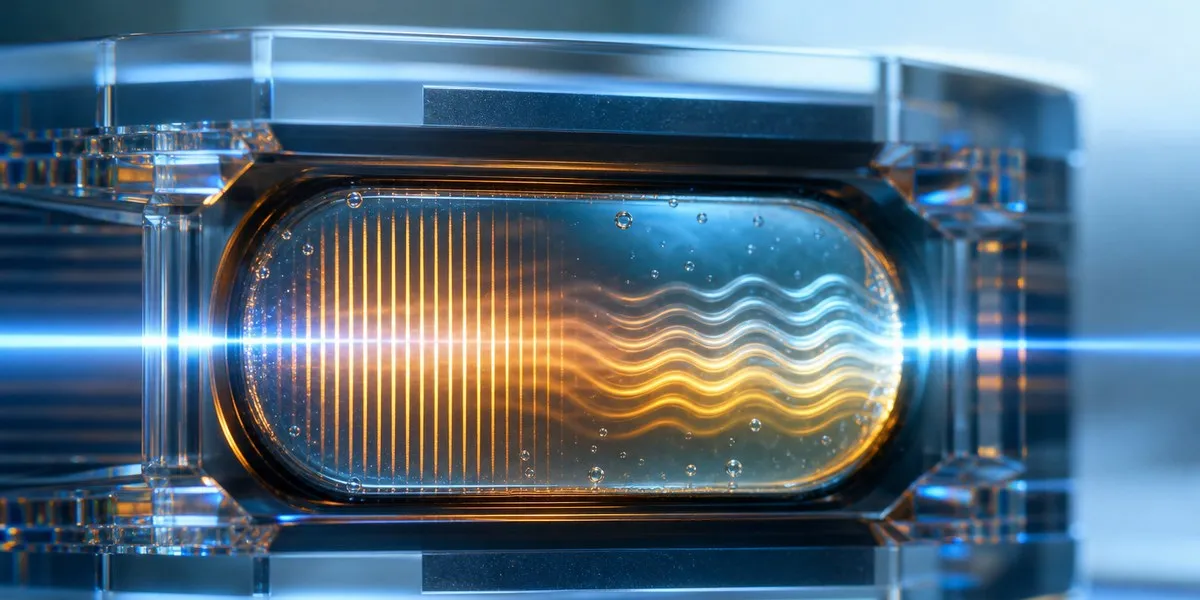
An international group of physicists has created a supersolid quantum state in an exciton-polariton Bose–Einstein condensate at room temperature. The experiment used a microcavity, a small structure that confines light. As ScienceAlert reports, the results were published in the journal Science Advances.
Combining the properties of a liquid and a crystal
A supersolid combines two properties: superfluidity, in which a system can flow without resistance, and an ordered repeating structure resembling a crystal. In this experiment, it emerged in a condensate of exciton-polaritons, hybrid quasiparticles that combine the properties of light and matter. In a Bose–Einstein condensate, many particles or quasiparticles behave as a single quantum object.
The researchers combined a liquid crystal whose properties can be controlled by voltage with an organic semiconductor that interacts strongly with light. Laser pulses supplied the energy to initiate the process. According to physicist Wiktor Pieczek of Poland's Military University of Technology, such liquid-crystal microcavities can operate even at temperatures close to 60 °C.
More current news is available on the UA.News Telegram channel Telegram.
Signs of spontaneous symmetry breaking
The created state was short-lived: the materials gradually degraded because of the interaction between the semiconductor and the liquid crystal. Physicist Marcin Muszyński of City College of New York noted that a repeat measurement required the production of a new sample.
After each laser pulse, the condensate formed again, but the stripes of its crystalline structure were arranged slightly differently each time. Physicist Guillaume Malpuech of the French National Centre for Scientific Research called this an example of spontaneous symmetry breaking: theory predicted several equivalent states from which the system could choose. The results were confirmed on several samples and through computer modeling.
Individual particles existed for only fractions of a second, but this was enough for the necessary observations. Possible directions for further development of the experiments include extending the duration of the main processes and studying quantum vortices in greater detail; these appeared as defects in the striped structure. Such a system may facilitate the study of the quantum behavior of superfluid liquids and supersolid states without cryogenic cooling.




