
ORCA telescope finds no violation of Lorentz invariance — Live Science
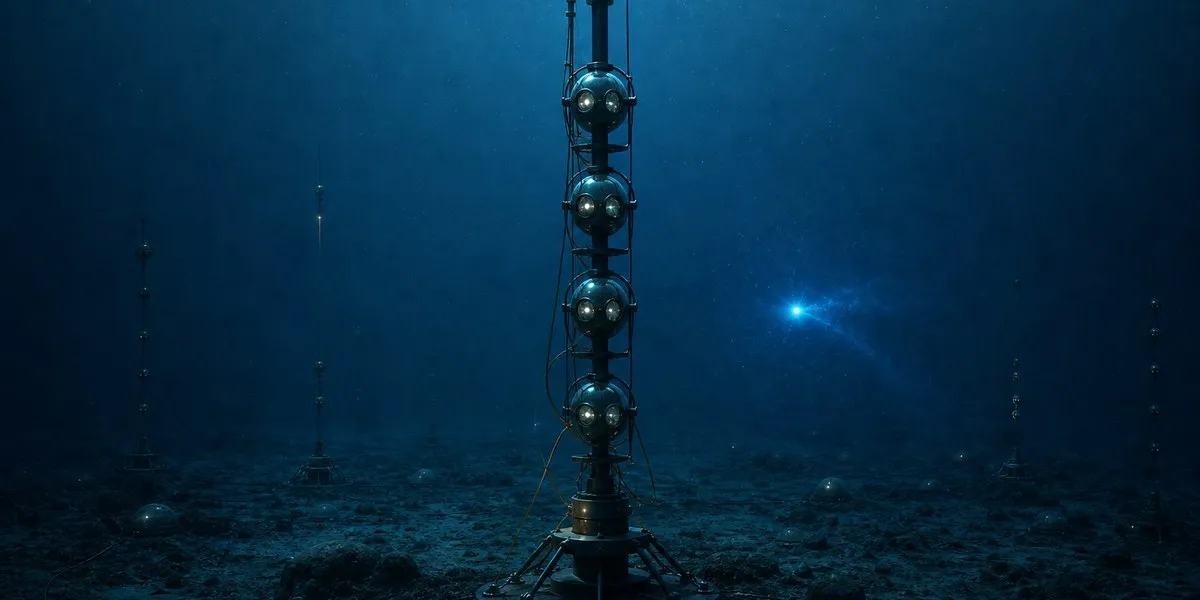
The ORCA underwater neutrino telescope, installed on the floor of the Mediterranean Sea 2.4 kilometers below the surface near the French city of Toulon, has found no signs of a violation of Lorentz invariance, one of the basic principles of modern physics. An analysis of data from the first six detector units made it possible to set limits comparable to the results of much larger and longer-operating facilities, Live Science reports.
Testing a fundamental principle
Lorentz invariance holds that the laws of nature have the same form regardless of the direction and speed of motion. Both general relativity and the Standard Model of particle physics are based on this principle.
Some approaches to quantum gravity, including certain versions of string theory and loop quantum gravity, allow that spacetime may have a discrete structure at extremely small scales. In that case, extraordinarily weak violations of Lorentz invariance could be possible.
Neutrinos passed through Earth
For the test, scientists analyzed 5,828 atmospheric neutrinos collected over approximately 17 months in 2020–2021. These nearly massless neutral particles arise when cosmic rays interact with the atmosphere and can then pass through Earth to the detector. Some of the neutrinos in the study traveled up to 12,700 kilometers — effectively the planet’s entire diameter.
More current news is available on the UA.News Telegram channel Telegram.
Neutrinos exist in three types — electron, muon and tau — and transform from one type into another as they travel. The researchers looked for deviations in these oscillations that could indicate a violation of Lorentz invariance. According to the analysis, the oscillations matched the predictions of standard physics.
ORCA is part of the KM3NeT neutrino telescope. Each detector unit is anchored to the seafloor and contains 18 glass spheres, with 31 light sensors in each. The sensors detect faint flashes of blue light produced when neutrinos interact with particles in the water. There are currently 44 detector units installed in the water, and the collaboration plans to activate 108 by 2030.
The team also obtained the first direct constraints for a possible violation scenario in which muon and tau neutrinos would behave differently. Next, the scientists plan to conduct a similar search using the ARCA detector off the coast of Sicily, designed to register high-energy neutrinos of cosmic origin.




