In Switzerland, a robotic hand was taught to walk on its fingers — ScienceAlert
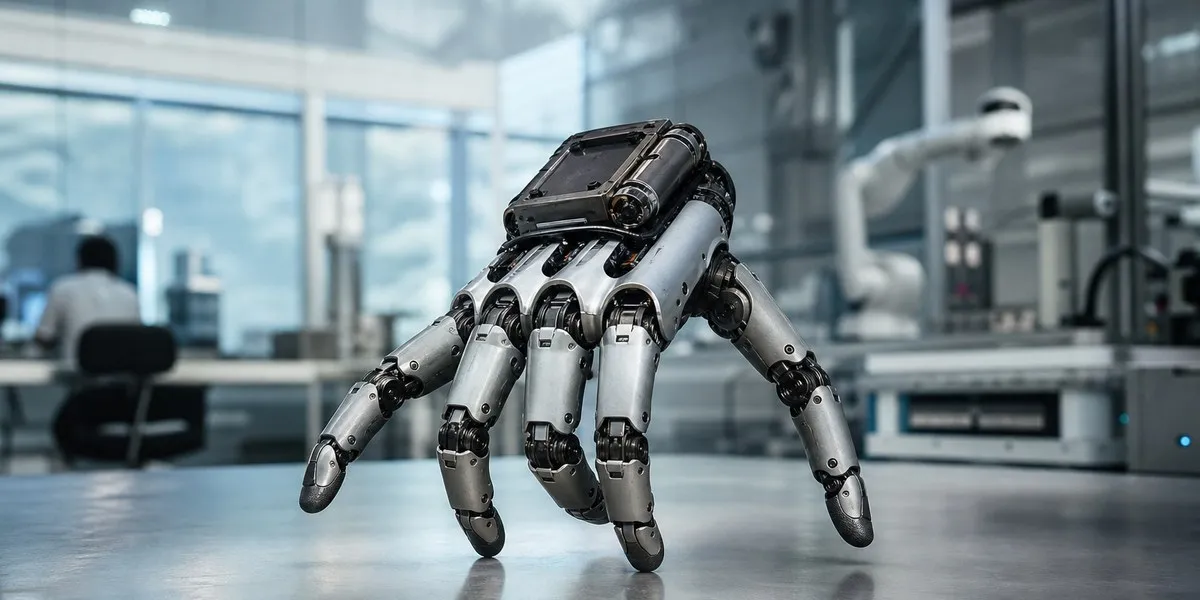
Researchers at ETH Zurich in Switzerland have taught a robotic hand to move on its fingertips, stand up after falling, and press keyboard keys while maintaining its balance with its other fingers. The development could enable robots to perform tasks in narrow spaces that their bodies cannot enter.
As ScienceAlert reports, the team used a commercially available WUJI robotic hand, adding a battery, a compact computer, and a motion sensor. The device has a total mass of 818 grams, while the power supply and computing equipment were installed on the back of the hand.
Training in simulation
The software was trained in a simulation using reinforcement learning. Moving in a specified direction rewarded the system, while excessive wobbling lowered its score. The developers also accounted for the differing lengths of the fingers and the position of the thumb, which complicate the hand's movement.
The movements were then transferred to the physical device by measuring the joints' response to commands and the fingertips' sliding over the surface. Study author Amirhossein Kazemipour said that adapting the training to the hand's shape and precisely matching the simulation to the real hardware were important.
More current news is available on the UA.News Telegram channel Telegram.
Testing on surfaces
During demonstrations, the hand moved across 14 surfaces, including a wooden floor, a metal grate, grass, and gravel. An operator set the direction of movement with a gamepad, while the onboard system coordinated finger movement and balance without cameras. On a mat, the device moved at an average speed of 9.3 centimeters per second in 21 runs.
In tests of independently standing up after a fall, the hand succeeded in 21 out of 25 attempts: in four cases, the fingers became caught on one another. A separately trained controller correctly pressed the required arrow key in 29 out of 32 consecutive commands. The hand was also used to enter moves in the Sokoban puzzle, while a camera above the work area was used for pushing a cube, tracking the position of the hand and the object.
The study was published as a preprint on arXiv and has not yet undergone peer review. The team calls its next task combining individual skills into more complex actions, improving operational reliability, and equipping the hand with embedded vision.