
From New Trade Routes to AI in Finance: What Was Discussed at the CEE Trade & Treasury Summit 2026

On October 20, Warsaw hosted the CEE Trade & Treasury Summit 2026—an international summit dedicated to trade finance, corporate finance management, and business development in Central and Eastern Europe. The focus was on changes in global trade flows, new investment opportunities, companies’ access to financing, and the impact of geopolitical instability on international operations.
The event took place at the Regent Warsaw Hotel. It was organized by MERGE Events with the support of the International Chamber of Commerce in Poland and under the patronage of the Polish Investment and Trade Agency. The program brought together representatives from the banking sector, industry, logistics, international trade, and financial technology.
The main theme of the summit was how Central and Eastern Europe’s role in the global economy is changing and what businesses need to do to take advantage of new opportunities. Participants discussed both strategic issues in international trade and practical tools for liquidity management, credit risk assessment, and financial transaction control.
Why Central and Eastern Europe Is Becoming More Important
The summit began with a discussion of the new geography of money, trade, and investment. Central and Eastern Europe is strengthening its position as a region for international business, logistics, and industrial development. For Poland, this is an opportunity to cement its role as one of the key hubs through which trade flows between European and other international markets pass.
Yaroslav Dombrovsky, a member of the Management Board of the Bank of National Economy of Poland (BGK), and Łukasz Januszewski, Vice President of the Management Board of Bank Pekao, spoke at the opening. One of the key issues discussed was how financial institutions can support economic growth and help companies operate amid changing trade routes and heightened uncertainty.
Dombrowski emphasized the importance of transforming Poland into a hub where companies can conduct trade, develop logistics operations, and find partners. Among BGK’s priorities, he cited guarantees for financing small and medium-sized businesses, support for the defense industry, as well as financing for startups, technology companies, and innovative projects.
This reflects a broader trend: a region’s competitiveness depends not only on production costs or geographic location. Access to capital, the quality of infrastructure, the predictability of financial instruments, and the ability to adapt quickly to changes in international trade are becoming increasingly important.
New Trade Agreements and Shifting International Trade Flows
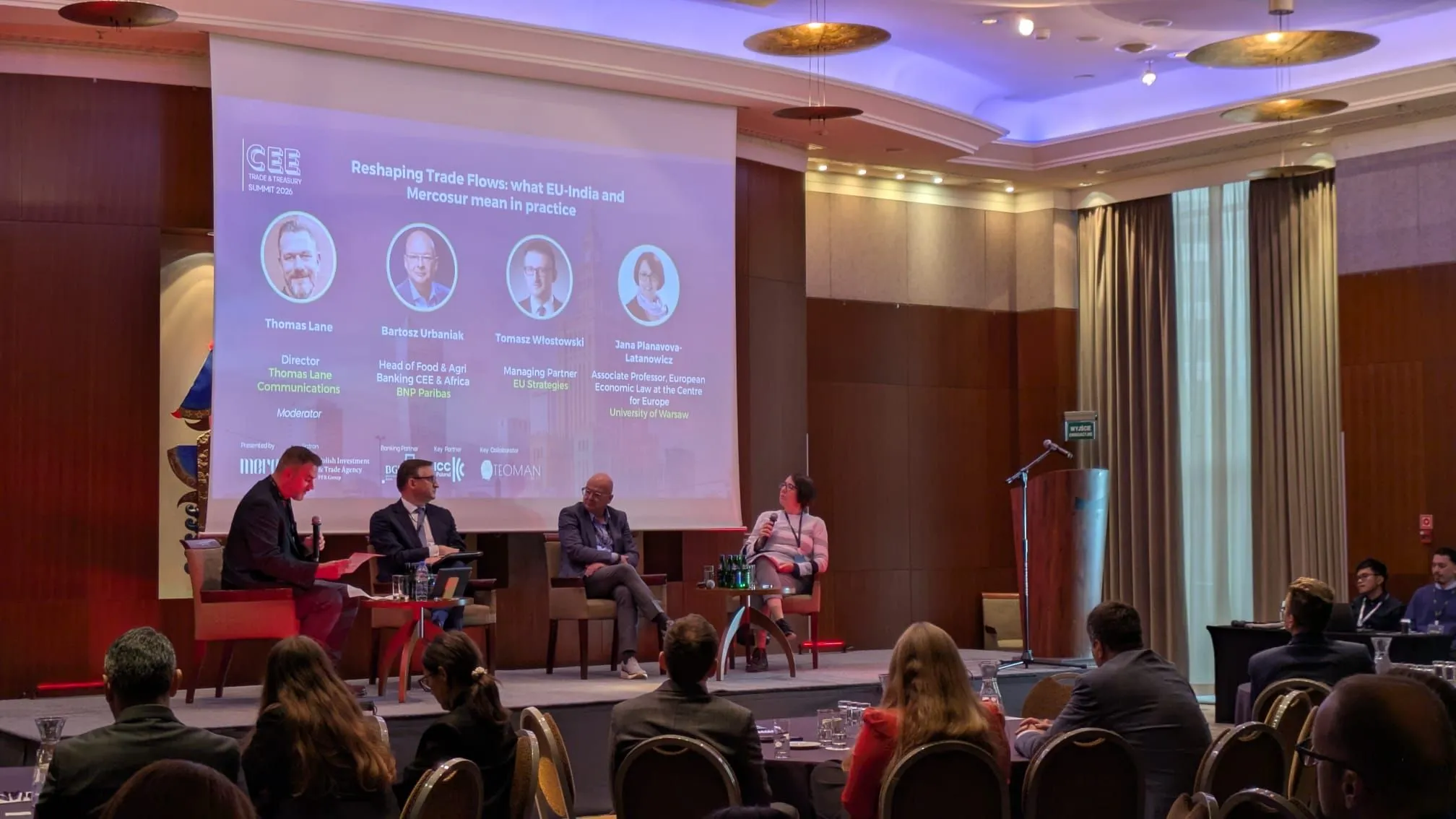
A separate segment of the program was devoted to the European Union’s trade relations with India and the Mercosur countries—a South American economic bloc. Participants discussed how new trade agreements could change companies’ access to foreign markets, affect competition, and create additional opportunities for exports and imports.
Expanding trade ties opens up opportunities for companies to diversify their suppliers and find new customers. At the same time, entering new markets requires adapting to local regulations, customs procedures, documentation requirements, and payment methods.
For finance teams, this means assessing not only the commercial viability of a deal but also its associated costs and risks. Longer supply chains, different settlement currencies, and variations in payment practices can affect a company’s working capital needs.
Therefore, new trade agreements are important not only for exporters and importers. They also change the requirements for banks, insurance companies, logistics operators, and financial service providers that facilitate international transactions.
Investments in Energy, Construction, and Industry
One of the panel discussions was the session titled “The Future of Construction, Energy, and Industrial Investments in Central and Eastern Europe.” Participants included Mehmet GökTürk İplikçioğlu, founder and CEO of Teoman Corp; Mehmet Dalkilic, head of the Polish division of Kolin İnşaat; Fatih Altinsoy, sales and business development manager at Arkas Logistics; and Jakub Kupcu, director of the Polish division of CLARITAS Investments. The discussion was moderated by Attila Arda Beşen, founder and CEO of VolareVers.
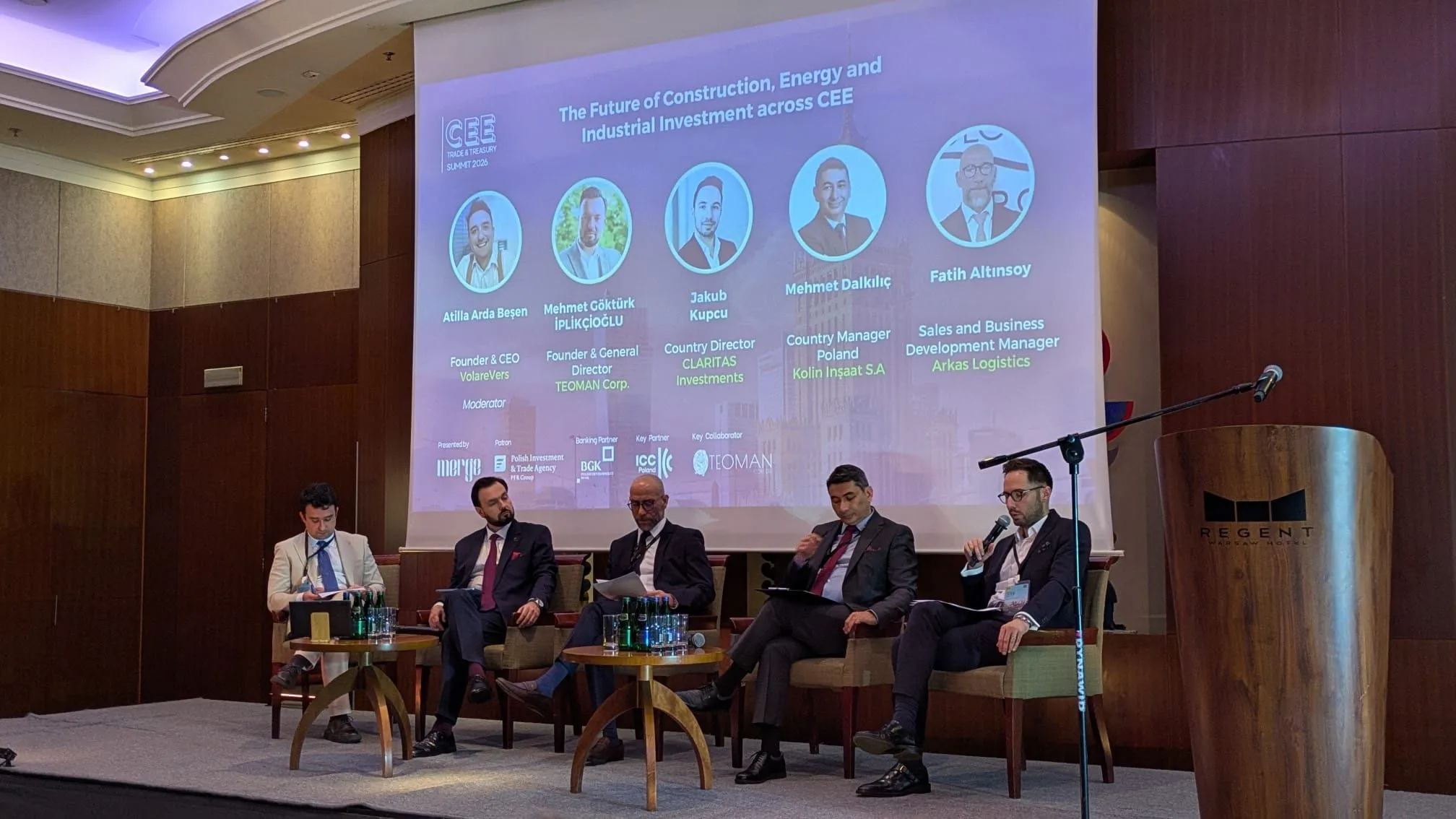
The participants represented various sectors of the economy—from construction and industrial projects to logistics and investments. This composition of the discussion reflected the interdependence of these sectors: the implementation of large-scale projects requires not only capital but also reliable suppliers, efficient transportation routes, and coordination among international partners.
Major investments in energy and industry require long-term planning and significant financial resources. Investors’ decisions are influenced by the cost of financing, the availability of materials, the stability of supply chains, and the overall economic situation.
Special attention was given to Polish-Turkish economic relations. According to data cited in the summit program, the volume of bilateral trade between Poland and Turkey in 2025 amounted to $12.5 billion. The stated goal is to increase this figure to $15 billion.
The discussion “Trade Relations Between Poland and Turkey: Strategic Importance for the Future of Europe” featured TURKPOL President Tunç Meric, Trade Counselor at the Turkish Embassy in Warsaw Can Berat Özer, Mehmet GökTürk İplikçioğlu, founder and CEO of Teoman Corp; Felix Koberski, chief trade finance expert at BGK; and Hakan Haner, a representative of EKO Konsult and ASE GROUP. Attila Arda Beşen also served as moderator.
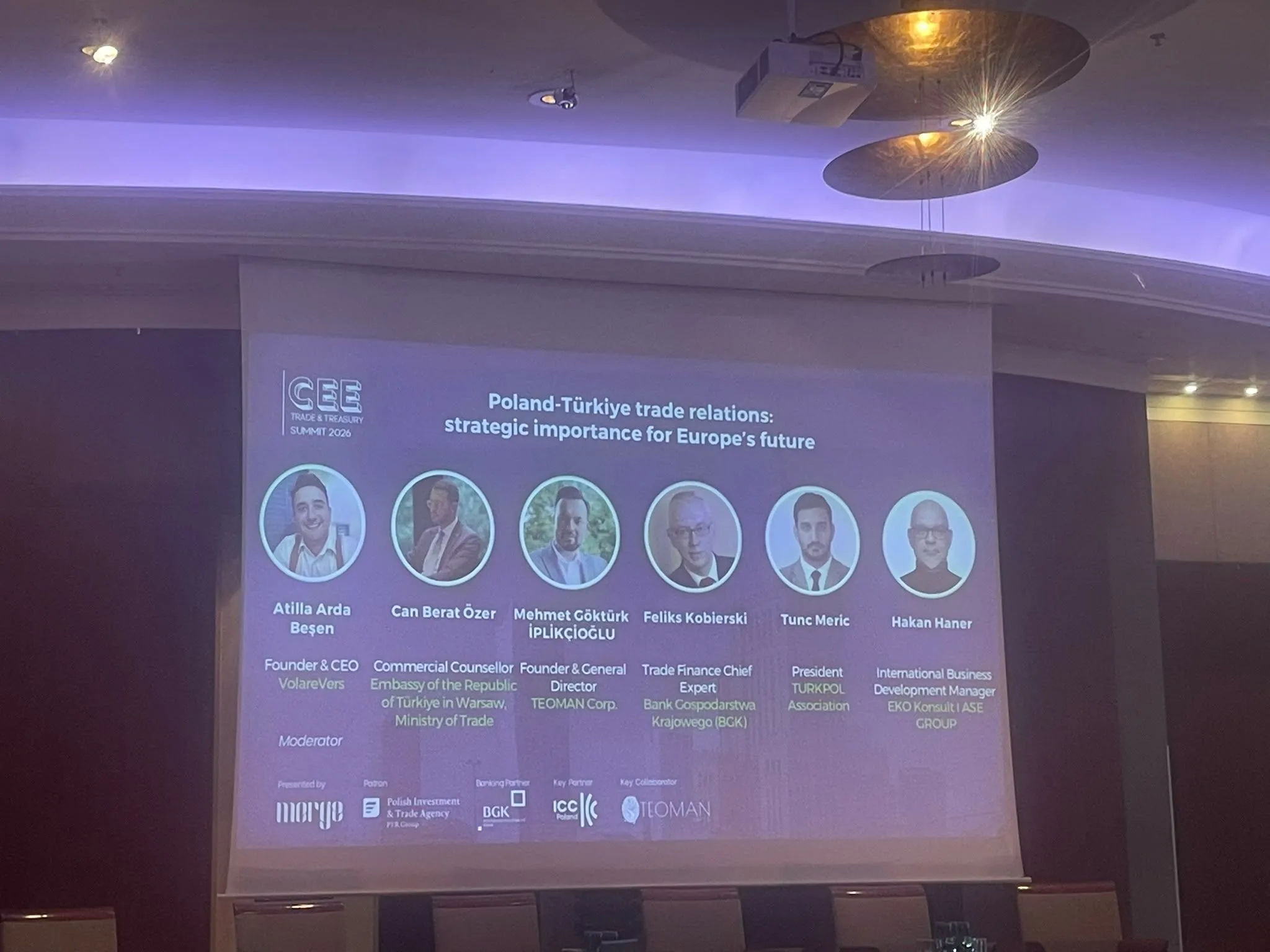
Participants discussed the importance of economic cooperation between the two countries for the European market and opportunities to deepen business ties. Poland and Turkey have the potential to expand cooperation in industry, construction, energy, and logistics. For companies, this could mean access to new suppliers, contractors, and sales markets.
At the same time, increasing trade requires not only political support but also practical financing mechanisms, predictable contract terms, and reliable logistics solutions.
How Open Banking Is Changing Business Lending
One of the practical topics of the summit was the use of open banking for making financing decisions. A presentation by Malgorzata Goren from Kontomatik, titled “The Cash Flow Advantage: Using Open Banking Data for Smarter Financial Decisions,” was dedicated to this topic.
Traditional creditworthiness assessments do not always provide a complete picture of a company’s financial condition. Difficulties can arise when evaluating young companies with a short credit history or businesses whose revenues fluctuate significantly depending on the season.
Another problem is outdated financial data. Financial statements from previous periods may not reflect the current situation, especially if a company is growing rapidly or facing sharp changes in demand. Additional risks are associated with unreliable documents and the difficulty of verifying the information provided by the borrower.
Open banking data provides a more up-to-date picture of account activity, provided the customer has given proper authorization and data protection requirements are met. Analyzing the regularity of income, expense structure, seasonal fluctuations, and payment behavior helps to better assess a company’s actual financial condition.
For small and medium-sized businesses, this can expand access to credit. If a company has a short operating history but demonstrates regular income and controlled expenses, cash flow data can supplement traditional assessment criteria.
At the same time, technology does not eliminate all credit risks. Financial institutions must consider the completeness of the data, changes in the company’s operations, its obligations, and the overall market situation. Open banking is an additional analytical tool, not an automatic guarantee of obtaining financing.
Working Capital and Payment Management

The summit also addressed accounts receivable, working capital management, and financing for international operations. These issues are particularly important for companies that operate on credit terms or rely on regular payments from major customers.
A company may have a significant volume of orders and yet lack the funds to cover current expenses. This is caused by the time lag between paying for materials, production, or delivery and actually receiving payment from the buyer. If payment delays coincide with the need to finance new orders, the strain on liquidity increases.
In international trade, the situation is complicated by longer delivery times, currency fluctuations, and differences in payment terms. Therefore, companies need to forecast cash inflows and outflows, monitor accounts receivable, and determine in advance their need for additional financing.
Possible tools include credit lines, factoring, and other forms of working capital financing. The choice depends on the business structure, customer payment discipline, the cost of raising funds, and the length of the operating cycle.
Effective liquidity management enables companies not only to cover current expenses but also to take advantage of new business opportunities without placing an excessive financial burden on the company.
Sanctions and Geopolitical Risks in International Trade
A separate discussion was devoted to sanctions, export controls, and the execution of international trade transactions in the context of geopolitical fragmentation. The panel included Tomasz Wlostowski, Robert Soban, Michał Tomaszewski, and Robert Soha. The moderator was Wojciech Panek.
International companies are forced to operate in an environment where trade restrictions and political decisions can directly impact supply chains, payments, and the selection of counterparties. Vetting partners is no longer limited to assessing their solvency or business reputation.
Companies must take into account the sanctions status of their counterparties, the origin of goods, the final recipients of products, and possible restrictions on specific transactions. Inadequate due diligence can lead to payment delays, delivery problems, or legal consequences. At the same time, additional control procedures increase business costs and prolong the preparation of international agreements.
Participants discussed these challenges in the context of interactions between companies, banks, and other financial intermediaries. It is important for businesses to have clear procedures for vetting partners, to properly document transactions, and to respond promptly to changes in regulatory requirements.
Under these conditions, risk management becomes part of everyday business planning. It affects not only a company’s legal security but also its ability to maintain stable supplies, fulfill contracts, and retain the trust of international partners.
What Role Does AI Play in Finance?
Digitalization and the use of AI have become key components of discussions about the future of financial processes. Companies are seeking ways to process information faster, forecast cash flows more accurately, and identify risks before they impact business operations.
Automated tools can help analyze payment transactions, detect unusual transactions, assess revenue and expense trends, and prepare forecasts for working capital needs. Combined with open banking data, this creates additional opportunities for financial planning.
At the same time, implementing such solutions requires high-quality data, adequate information security, and integration with existing systems. Automated analysis does not always take into account all the circumstances of a specific transaction, so finance teams must verify the results and retain control over critical decisions.
For businesses, the value of AI lies not only in reducing the time spent on routine tasks. These technologies can help identify changes in the financial situation more quickly, plan payments, and evaluate potential scenarios. However, the effectiveness depends on how well a company has organized its data and workflows.




