
Astronomers discover the lightest pair of neutron stars — Live Science
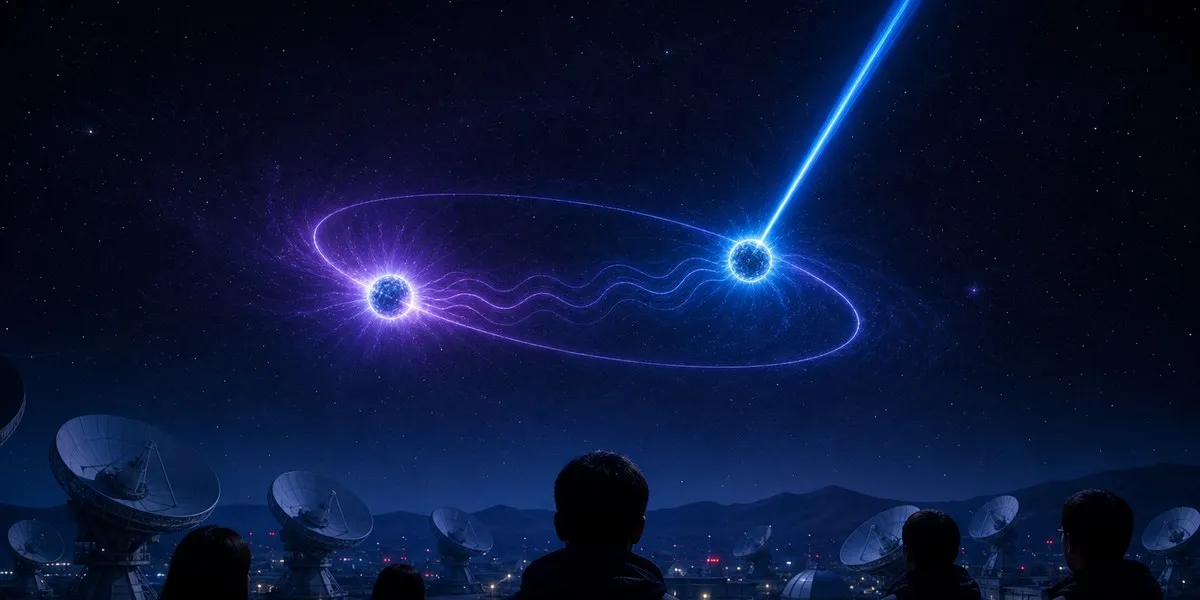
Astronomers using China’s FAST radio telescope have discovered the lightest known binary neutron star system — PSR J1856-0039, Live Science reports. The two ultra-dense stellar remnants orbit each other in about 2.36 hours and, according to researchers’ calculations, will merge in approximately 82 million years.
One of the system’s objects is a pulsar that rotates about 43 times per second. Its regular radio pulses made it possible to precisely track the pair’s motion. The system was discovered in 2020 during a survey of the Milky Way’s disk using China’s FAST radio telescope.
Three relativistic effects
The team observed the system 17 times between 2020 and 2025, measuring the arrival times of the pulsar’s radio pulses. Scientists recorded three effects predicted by general relativity: the gradual shrinking of the orbit due to gravitational-wave emission, the rotation of the elliptical orbit, and a change in the rate of the pulsar’s “clock” depending on its position in the orbit.
More current news is available on the UA.News Telegram channel Telegram.
The distance between the stars decreases by about 2.7 meters each year. The system’s orbit rotates by 17.6 degrees per year, while the shift in pulse arrival times can reach about half a millisecond. All three measurements produced consistent estimates of the objects’ masses; according to the researchers, the results agree with general relativity’s description of the system’s motion to a level of about 1%.
Star masses and the future merger
The pulsar’s mass is about 1.3 solar masses, while that of its companion is approximately 1.19 solar masses. The total mass of this pair is the lowest among known binary neutron star systems. After the future merger, a neutron star with a mass of about 2.26 solar masses may form, although the researchers also allow for the remnant to collapse into a black hole.
Scientists plan to observe the pulsar for decades to detect the frame-dragging effect. The rotation of the neutron star is expected to twist spacetime around it and cause oscillations in the neighboring orbit. Such measurements may provide new data on the distribution of mass inside neutron stars.




