
Atomic steps guided quantum vortices in a superconductor — ScienceDaily
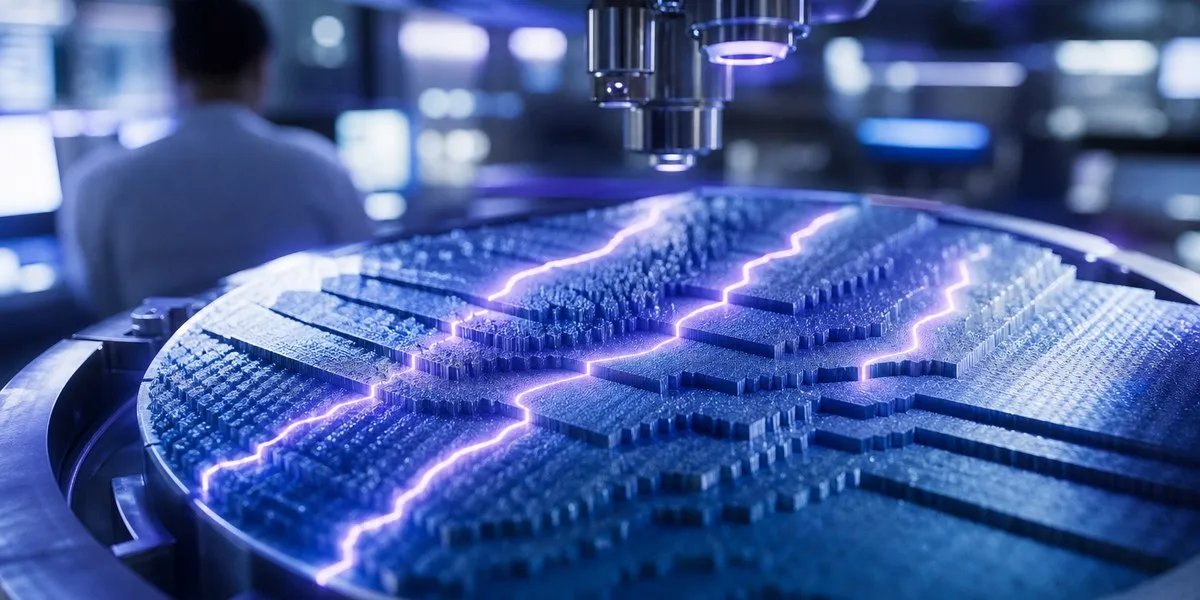
Researchers in Japan at the MANA Center for Materials Nanoarchitectonics, part of Japan’s National Institute for Materials Science (NIMS), found that steps one atom high can guide the motion of quantum vortices in an ultrathin superconductor. Under certain conditions, vortices moved along such steps more than 1,000 times more easily than across them, ScienceDaily reports.
Atomic steps as guides
Superconductors can conduct electric current without resistance at temperatures below the critical temperature. At the same time, quantum vortices arise in them — areas where a magnetic field penetrates the material and around which electric currents circulate. The movement of vortices can create electrical resistance and affect the operation of a superconductor.
The team led by Takashi Uchihashi studied an ultrathin superconductor with parallel, regularly arranged atomic steps on its surface. Using scanning tunneling microscopy, the scientists confirmed the surface structure and directly observed vortices positioned along these steps.
More current news is available on the UA.News Telegram channel Telegram.
Effects of temperature and magnetic field
Four-probe resistance measurements showed a significant difference in vortex motion depending on direction. At intermediate magnetic field values, the steps acted as guides, creating preferred paths of motion for the vortices.
At magnetic fields of approximately 0.10 to 0.20 tesla, vortices could move freely along the steps without being trapped by material defects. The researchers called this one-dimensional vortex motion without pinning. At the lowest temperatures, vortex motion was governed by quantum tunneling — a phenomenon in which quantum objects pass through energy barriers.
The authors of the study note that temperature and magnetic field can be used to tune this effect. The findings were published in the journal Physical Review B; practical application of the approach will require further development.




