
Two possible surviving planetesimals found near a white dwarf — Space.com
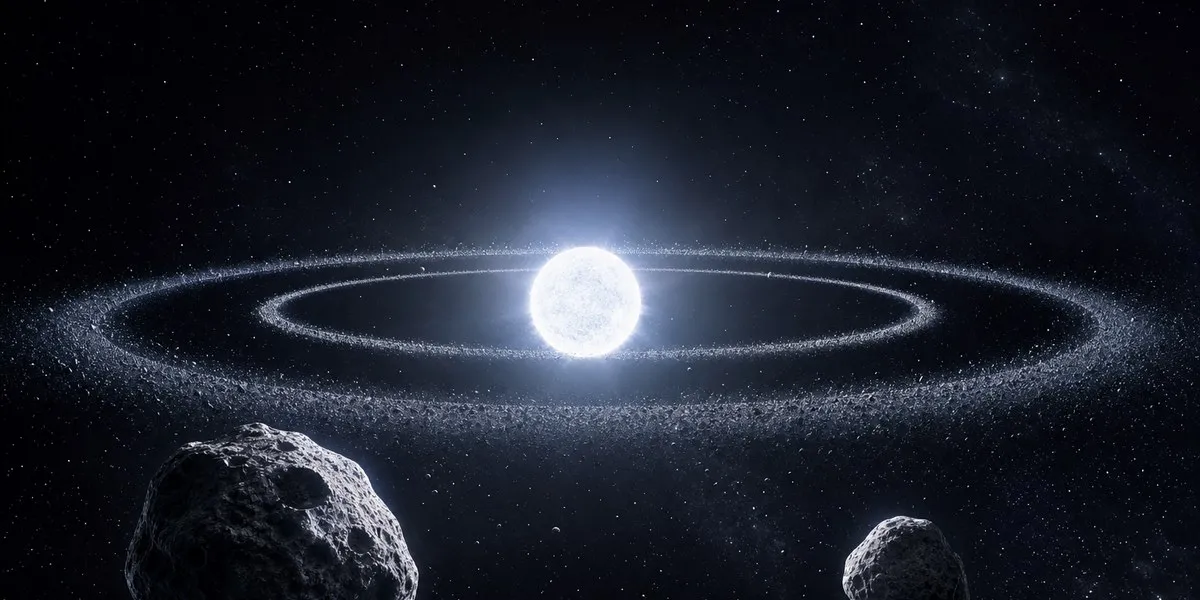
Astronomers have discovered two possible planetesimals near the white dwarf J1328−1450, located about 1,600 light-years from Earth — bodies that likely survived the transformation of their star. One of them may be no larger than an ordinary asteroid in the Solar System, while the other, according to researchers’ estimates, may be larger than the Moon but smaller than the dwarf planet Pluto, Space.com reports.
Double debris disk
A distinct gap in the material surrounding the white dwarf pointed to the possible surviving bodies. Observations showed the presence of inner and outer rings of debris separated by a substantial void. The researchers noted that previously known debris disks around white dwarfs appeared as a single flat rotating disk rather than a double structure.
The study’s lead author, University of Trieste astronomer Nicola Gentile Fusillo, called the system the first example of a complex system with a double debris disk and potentially two surviving planetesimals. The team suggests that this structure is a sign that these bodies were not completely vaporized during their star’s red giant phase.
More current news is available on the UA.News Telegram channel Telegram.
Composition of destroyed bodies
Using the Very Large Telescope (VLT), astronomers detected calcium, oxygen, magnesium, and iron in the disk. Scientists believe this indicates that the destroyed bodies had a composition similar to that of the rocky planets in the inner Solar System.
The chemical composition of the outer and inner parts of the system differed. According to the team’s estimate, this means that at least two of the engulfed planets had very different compositions. The study may also show what a planetary system like the Solar System could become in the future.
White dwarfs form when stars of approximately solar mass exhaust the hydrogen in their cores and can no longer sustain the thermonuclear fusion of hydrogen into helium. In about 5 billion years, the Sun is expected to enter its red giant phase and expand, engulfing the inner planets, including Earth. The study’s results were published in the journal Nature Astronomy.




