
Coral near Costa Rica found to be so unique it was given a new family — ScienceDaily
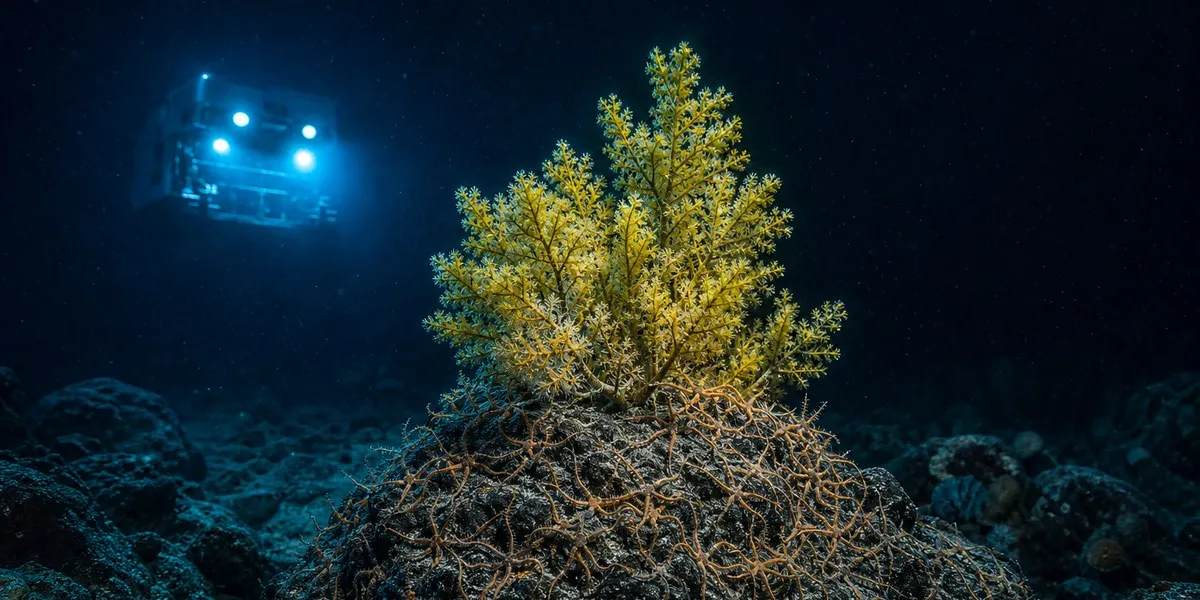
Scientists have discovered a new species of bright yellow octocoral, Laurinque elenya, on seamounts near Costa Rica. Its genetic and anatomical features proved so unusual that researchers created not only a new genus, Laurinque, but also a separate family, Laurinqueidae, ScienceDaily reports.
Discovery at depths of up to 529 meters
The coral was found in the Pacific Ocean at depths between 360 and 529 meters. Its branching, tree-like colonies can grow to more than a meter in height. Samples were collected by the remotely operated vehicle SuBastian during the 2019 and 2023 expeditions aboard the research vessels Falkor and Falkor (too), operated by the Schmidt Ocean Institute.
The expeditions explored seamounts near Cocos Island and along Costa Rica’s Pacific margin. The new coral was often found on rocky outcrops almost entirely covered with brittle stars.
More current news is available on the UA.News Telegram channel Telegram.
A name inspired by Tolkien’s languages
The genus Laurinque was named after the word Laurinquë, meaning “golden tree” in Quenya, one of the Elvish languages created by John Ronald Reuel Tolkien. The species name elenya means “starry” or “belonging to the stars” and refers to the dense clusters of brittle stars around the coral colonies.
Initially, scientists sequenced three genes commonly used to identify and classify corals. However, each of them pointed to a different family unrelated to the others. The team then used phylogenomic analysis, which compares hundreds of genes simultaneously. It showed that Laurinque elenya is a distinct evolutionary lineage, closest to the family Eunicellidae but sufficiently different to warrant the creation of a new family.
The findings of the international group of scientists led by Odalisca Breedy of the University of Costa Rica were published in the open-access journal ZooKeys. Coral gardens of this type are considered vulnerable marine ecosystems: their three-dimensional structure provides habitat for various deep-sea organisms.




