
Star found stripping matter from a brown dwarf — ScienceDaily
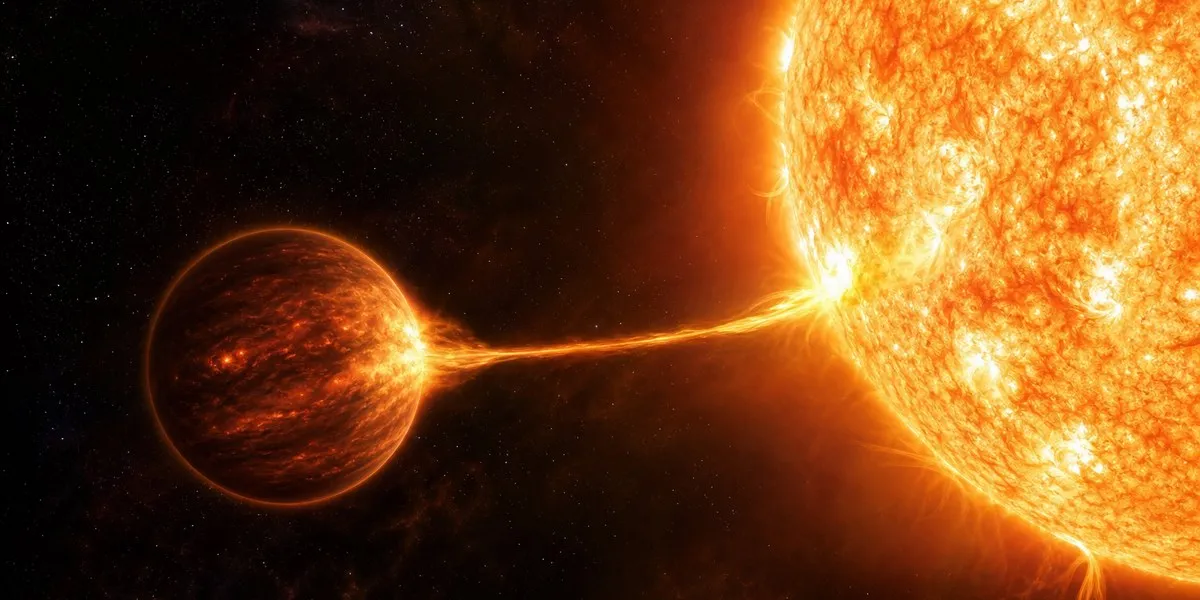
An international group of astronomers has discovered the ZTF J0440+2325 system in the Milky Way, in which a low-mass star is gradually stripping matter from a nearby brown dwarf. The system is located about 300 light-years from Earth. As ScienceDaily reports, this is the first recorded case in which a low-mass star is actively accreting material from another low-mass object.
An 87-minute orbit
The study, published on October 5 in Nature Astronomy, was led by researchers at the Massachusetts Institute of Technology. The central star has a mass approximately 85 times that of Jupiter, while its companion has a mass of about 25 Jupiter masses. A brown dwarf is an object more massive than an ordinary planet but not massive enough to sustain the hydrogen fusion characteristic of stars.
The brown dwarf completes one orbit around the star every 87 minutes, and its entire orbit would fit within the Sun’s diameter. Astronomers first noticed the unusual triangular shape of the system’s light curve in data from the Zwicky Transient Facility survey. Further observations showed that the motion of the objects in the system does not match the scenario of a so-called “black widow” binary system with a neutron star.
More current news is available on the UA.News Telegram channel Telegram.
Matter falls directly onto the star
Computer modeling showed that matter leaving the brown dwarf moves along trajectories leading directly to the star’s surface. Unlike black holes or neutron stars, a low-mass star has a much larger surface, so, according to the researchers’ calculations, the stream of matter strikes it directly and creates a hot, bright region.
This very region, whose visibility to an observer changes during the brown dwarf’s 87-minute orbital motion, explains the periodic brightness variations and the triangular signal. The team estimated the brown dwarf’s rate of mass loss at about one hundred-thousandth of Earth’s mass per year. Nevertheless, due to the companion’s substantial mass, the process may continue for hundreds of thousands of years or potentially billions of years.




