
UCL researchers link crocodile relatives’ survival to warm regions — ScienceDaily
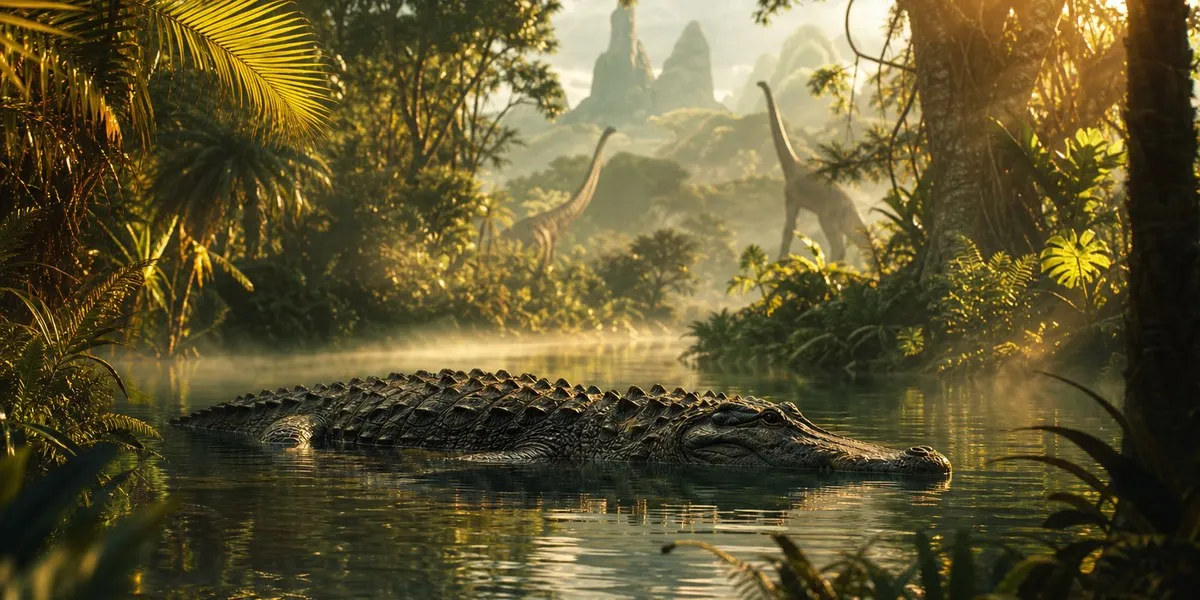
Scientists at University College London (UCL) in the United Kingdom have suggested that relatives of modern crocodiles may have survived the asteroid impact 66 million years ago thanks to warm tropical and subtropical regions near the equator. According to modelling results, these areas retained suitable conditions, while the habitats of many non-avian dinosaurs shrank sharply, ScienceDaily reports.
Climate refugia after the asteroid impact
The study, published in the journal Science Advances, covered more than 7,000 fossil remains and records of over 400 modern and extinct species of crocodiles and their relatives. The authors combined these data with computer models of Earth’s ancient climate and geography over 245 million years.
Models of the effects of the Chicxulub asteroid impact showed that with a 5% or 10% reduction in sunlight, areas near the equator remained warm enough for crocodile relatives. Under a scenario involving a 15% reduction in sunlight, such areas also became unsuitable, but the researchers consider this option unlikely. An increase in atmospheric carbon dioxide concentrations in the simulations did not change the availability of suitable climate zones.
More current news is available on the UA.News Telegram channel Telegram.
Following warm climates
According to the scientists’ conclusions, representatives of this evolutionary lineage for most of their 250-million-year history mainly moved in pursuit of warm climates rather than adapting to substantially different temperatures. During warming periods, their range expanded, while during global cooling it contracted to the tropics.
About 50 million years ago, in the early Eocene, global temperatures were approximately 10°C higher than today, and there was no permanent ice at the poles. At that time, crocodile relatives lived at high latitudes in North America, Europe and even Antarctica. The researchers also identified exceptions: about 94 million years ago, one branch evolved to withstand higher temperatures, while around 34 million years ago an extinct group in Australia adapted to arid conditions.
The authors stress that favourable temperatures were probably not the only reason for survival. Small body size, a semi-aquatic lifestyle, a flexible diet and low energy requirements may also have increased the chances. The scientists note that modern crocodiles may find it more difficult to move to suitable climates because of cities, roads and agricultural land.




