
Study links shearwaters’ jet lag to course deviations — Ars Technica
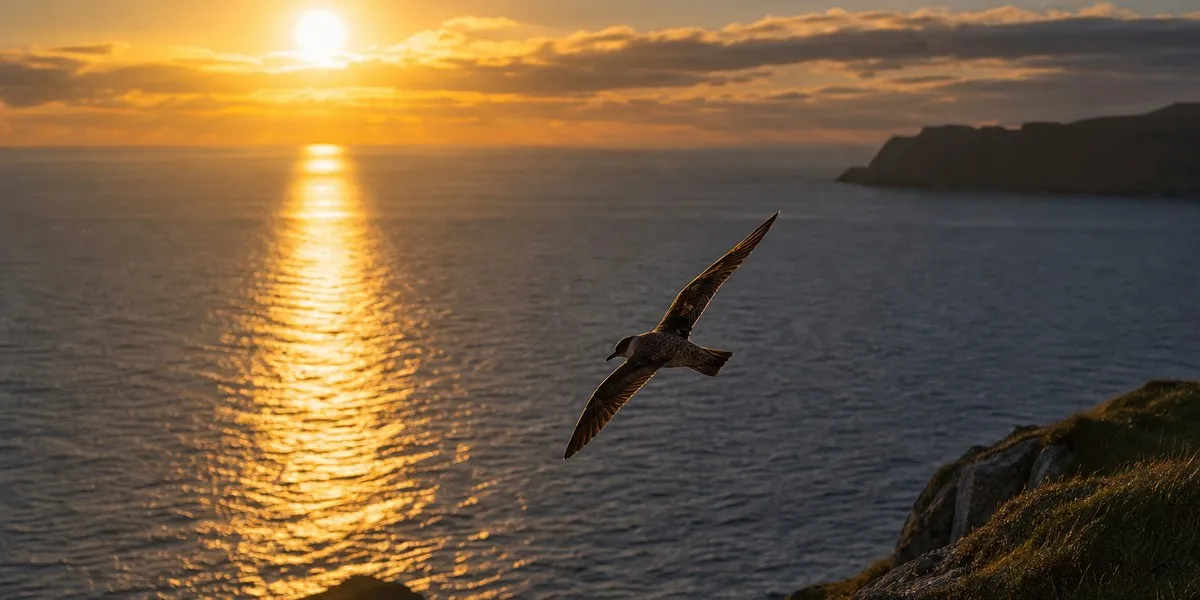
Researchers have found that small shearwaters from colonies on the western coasts of the United Kingdom may experience a kind of jet lag while returning from feeding grounds. A shift in the birds’ internal clocks is linked to slight deviations in orientation by the Sun, Ars Technica reports.
Solar compass and internal clock
Small shearwaters can travel hundreds of kilometers a day over the North Atlantic. They fly from nesting sites to feed at distances ranging from several dozen to more than a thousand kilometers. To return, the birds likely determine their position using a kind of “map” that may be linked to smells, while choosing their direction by the Sun.
This method of navigation requires an accurate sense of time, as the Sun’s position in the sky changes during the day. According to the researchers, shearwaters adjust their internal clocks at dawn and dusk. If a bird shifts by one degree of longitude between sunrise and sunset, its clock differs from local time by about four minutes. When moving eastward, birds should deviate clockwise, and when moving westward, counterclockwise.
More current news is available on the UA.News Telegram channel Telegram.
Two decades of GPS observations
A team from the University of Oxford analyzed 3,688 foraging trips made by 1,045 birds. GPS trackers began to be fitted to shearwaters in 2004, when the devices became small enough for birds of this size. These journeys lasted from one day to two weeks.
The scientists separately examined 335 returns to colonies that took place out of sight of land. The deviations matched predictions for a solar compass with a shifted internal time. At the same time, study author Patrick Levin cautioned that the work was not a controlled experiment, so the causal relationship should be interpreted carefully. The researchers also assessed the possible effects of crosswinds, the Coriolis force and a magnetic compass, but these factors explained the data less well.
Orientation errors reached about 15 degrees. According to the team’s calculations, during a 1,000-kilometer flight eastward, the average deviation would be about seven degrees, while regularly refining their position would add only about five kilometers to the route.




