
Researchers find how trees straighten trunks with tension wood — ScienceDaily
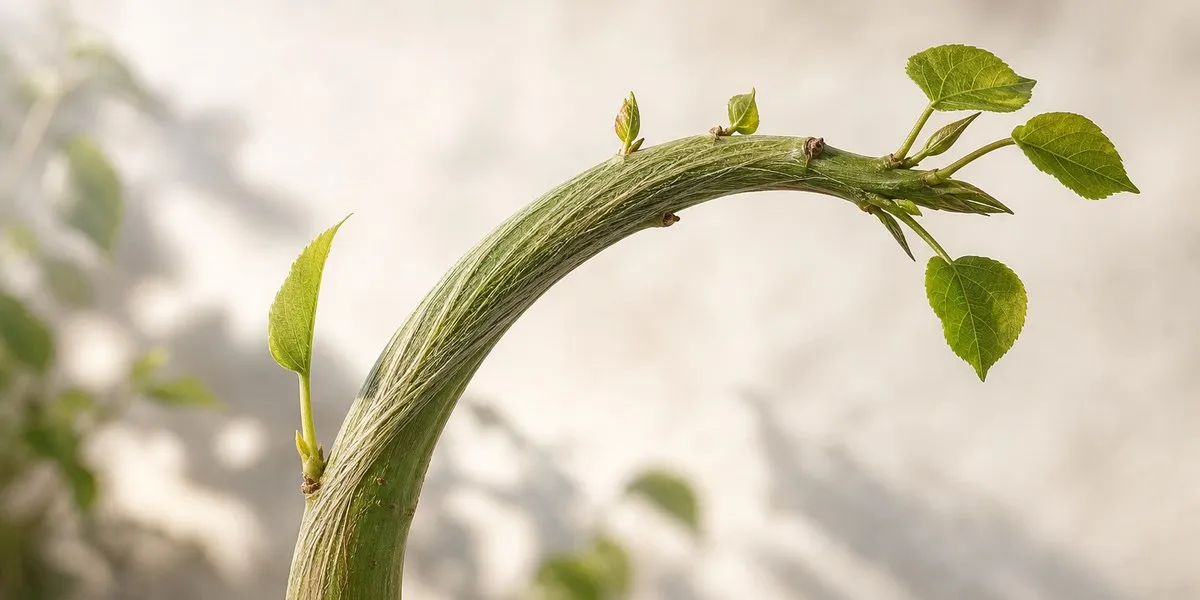
Researchers have found that trees can straighten curved stems by changing the location where special tension wood forms. In the experiment, it began forming on the opposite side of the stem and acted like an antagonistic muscle, ScienceDaily reports.
An experiment without light and gravity signals
Plants respond to gravity, the direction of light and the position of their own stem. To separately study plants' ability to sense their own shape, young trees were placed on a horizontal platform rotating inside a sphere with uniform lighting.
The platform's rotation prevented the trees from receiving a stable signal about the direction of gravity, while lighting from all sides removed the reference point of a light source. This allowed researchers to observe the trees' response to the shape of their own stems without the usual external signals.
Initially, young poplars were positioned horizontally. As they grew, their stems bent upward, bringing their tops closer to a vertical position. About ten days later, when the bend became noticeable, the trees were transferred to the experimental setup. Over the following weeks, the stems gradually became almost straight.
More current news is available on the UA.News Telegram channel Telegram.
Tension wood changes the side where it forms
The bending is linked to tension wood, a special type of wood that creates a pulling force as it forms. When it develops on the upper side of a stem, it pulls the stem upward and causes it to bend.
The analysis showed that after the experimental system was launched, tension wood on the upper side of the stems stopped developing. At the same time, the same wood began to form on the opposite side. According to the researchers, it created a pulling force in another direction, allowing the curved stems to gradually straighten.
Previously, tension wood was believed to form only on the upper side of stems, helping trees maintain a vertical position, including on slopes. The new results indicate that it can form on opposite sides of a stem, and that trees combine environmental signals with an internal sense of their own shape.
The researchers note that understanding this mechanism could be useful for forestry and agriculture. It could potentially help select plants that grow straighter and retain their shape better, as well as study cereal crop lodging and internal stresses that may affect wood quality.




