
47 buildings in Singapore adopt alternatives to air conditioning — Asharq Al-Awsat
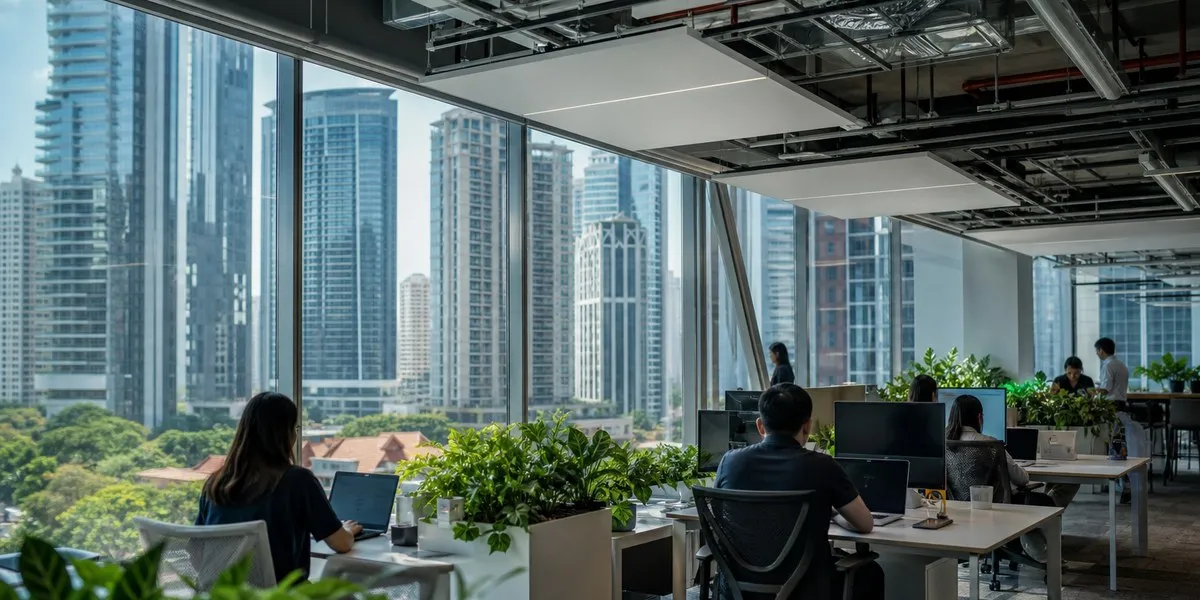
In Singapore, at least 33 public and 14 private buildings had introduced alternative cooling technologies by mid-2026, aimed at reducing dependence on traditional air conditioners. This was reported by Asharq Al-Awsat, citing the city-state’s building authorities.
Singapore has Southeast Asia’s highest rate of air-conditioner ownership per capita: cooling units are installed in about 99% of private homes. The country’s building sector accounts for one-fifth of emissions, while cooling represents between 40% and 60% of an individual building’s energy consumption.
Cooling with ceilings and water
One option has been active chilled beams — perforated ceiling panels with cooling coils. At the eight-storey Paya Lebar Green office building in eastern Singapore, water is cooled to 9°C and supplied to such panels. Air currents inside the structure draw warm air from the room, which passes through the system, cools down and returns to the office.
According to designers at DP Architects, this solution reduced energy consumption by more than 30% compared with conventional air conditioning. The offices are kept at a temperature of about 24°C, and the system itself operates more quietly than traditional air conditioners.
More current news is available on the UA.News Telegram channel Telegram.
Passive displacement cooling is used in the port authority’s maintenance building at Tuas harbour. Air cooled by ceiling coils descends, and after warming up, naturally rises back to the ceiling. This reduces the need for mechanical fans and lowers noise levels.
Energy efficiency and a habit of cold
Another solution is radiant cooling: water at temperatures between 14°C and 18°C circulates through pipes or panels and absorbs heat from people and objects in the room. A 2024 government study identified such technologies as one of the key areas: according to its estimate, they could provide the city with energy savings of up to 48%.
The most widespread alternative approach so far remains hybrid cooling — setting air conditioning to 25.5–27°C in combination with fans. DP Architects director Chua Tze Jun noted that people accustomed to air-conditioned offices still find it difficult to accept temperatures of around 26°C.
Singapore aims to achieve net-zero emissions by 2050. At the same time, Nanyang Technological University cooling technology specialist Wang Man Pun noted that alternative methods have not yet surpassed vapour-compression systems in efficiency.




