
Physicist models internal time in a system of 24,000 atoms — ScienceDaily
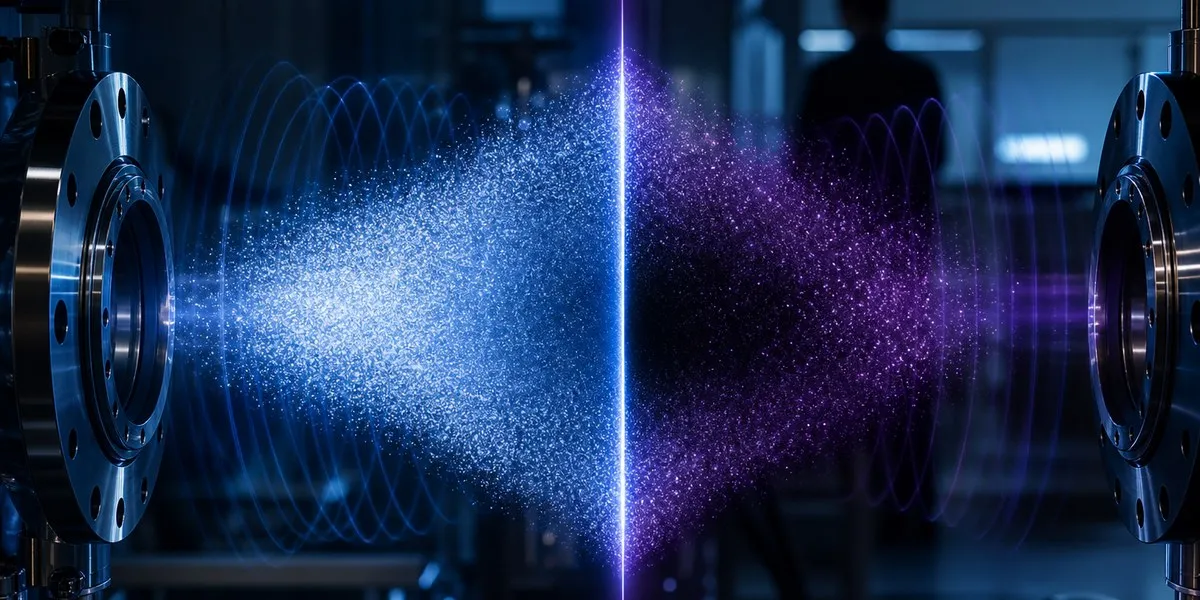
Giovanni Barontini, a physicist at the University of Birmingham, created an isolated quantum system from approximately 24,000 ultracold atoms in which the passage of time could be determined without an external clock. The study, published in Physical Review Research, showed that such internal timekeeping can arise from changes in particle distribution, ScienceDaily reports.
Quantum model with two regions
The atoms were cooled to a temperature only a few billionths of a degree above absolute zero, at which quantum effects become especially noticeable. Two laser beams of different frequencies formed a thin barrier that divided the system into an observable “bright” region and an unobservable “dark” region.
Despite the system’s isolation from the external environment, atoms could move between these two parts. The “bright” region cyclically expanded and contracted. These processes were a simplified analogy of the Big Bang and the Big Crunch, rather than a reproduction of real cosmological events.
More current news is available on the UA.News Telegram channel Telegram.
Entropy as an internal measure
To measure the course of the process, Barontini used changes in entropy associated with changes in the distribution of particles in the system. When the distribution of atoms in the “bright” region changed, this made it possible to order events without referring to a clock outside the experiment.
The scientist called this approach entropic time. According to the experiment’s results, such time has a direction, meaning it creates a distinction between the past and the future, and makes it possible to establish a sequence of events even during the system’s expansion and contraction. At the same time, its pace can accelerate or slow down depending on changes in entropy.
The researcher also showed that one form of the Schrödinger equation can be written in terms of entropic time. This means that the internal measure is suitable not only for ordering events but also for predicting the evolution of a quantum system. The experiment does not prove that time in the Universe is an illusion, but it demonstrates the possibility of meaningful internal measurement of time in an isolated quantum system.




